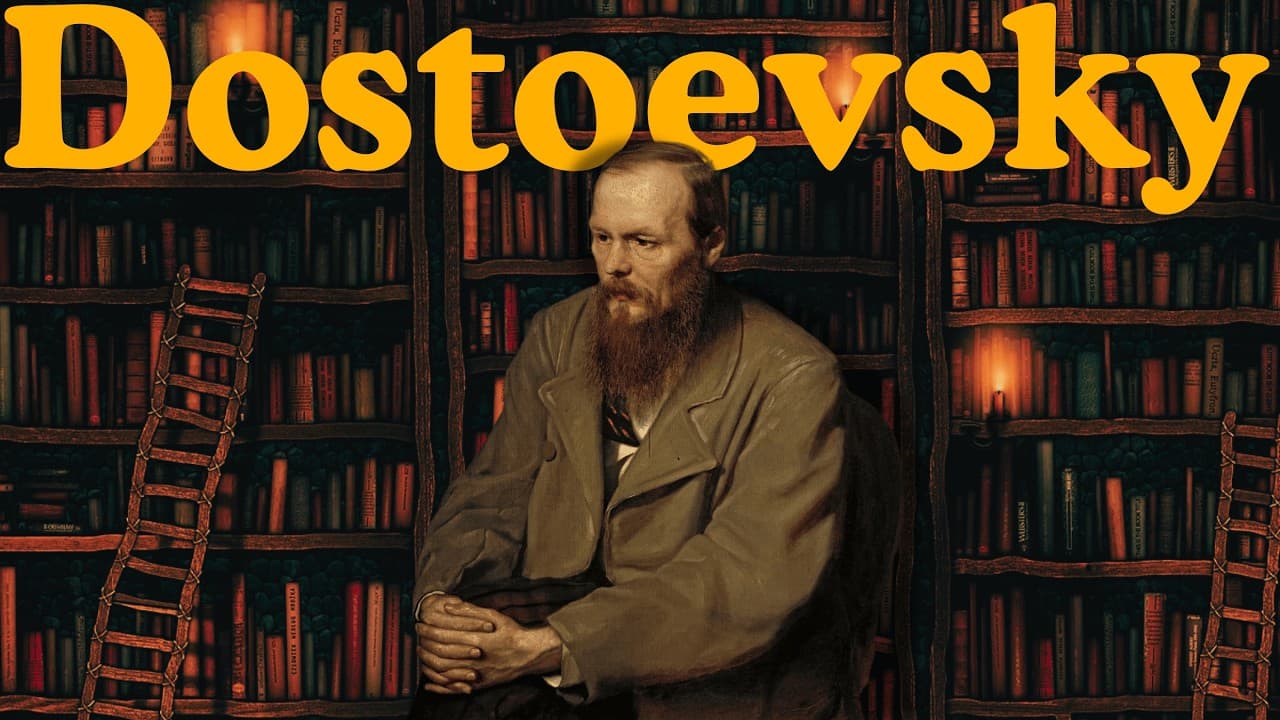
What Did Dostoevsky Actually Believe About God?
Orthodox Theology, the Church Fathers & the Novels
Enjoying the episode?
Occasional letters on philosophy, reading, and the examined life. No spam, ever.
Chapters
- 0:00:00Chapter 1: Hell Is the Inability to Love
- 0:32:39Chapter 2: Kenosis and the Vulnerability of God
- 1:04:13Chapter 3: Theosis, Prelest, and the Two Paths of Becoming
- 1:36:08Chapter 4: Sobornost, the Gaze of the Other, and Communal Salvation
- 2:09:03Chapter 5: Apophatic Theology, Holy Mystery, and the Faith That Does Not Know
Full Transcript
Chapter 01: Hell Is the Inability to Love
In the seventh century, a monk living in solitude on the edge of the Arabian desert wrote a sentence that would quietly reshape Christian theology for over a thousand years. Isaac of Nineveh, known to the Orthodox world as Isaac the Syrian, declared that those who are tormented in Gehenna are scourged by the scourge of love. Hell, Isaac taught, is not a courtroom. It is not a prison built by an angry judge. It is the experience of being loved by a God whose love you can no longer receive. The fire is real, but it burns from within. It is the agony of a soul that has made itself incapable of the one thing for which it was created.
This single idea, radical in its simplicity, stands behind nearly everything Fyodor Dostoevsky ever wrote. It is the hidden architecture of his novels, the theological grammar that structures his understanding of sin, suffering, freedom, and redemption. Without it, his characters become case studies in psychology or illustrations of philosophical problems. With it, they become something far more unsettling: icons of a spiritual condition that the Orthodox Christian tradition has been diagnosing and treating for nearly two millennia.
The tradition in question is patristic theology, the body of thought produced by the Church Fathers, those theologians, monks, and bishops of the first through eighth centuries whose writings became the intellectual foundation of Eastern Orthodox Christianity. These are not figures most Western readers encounter in their education. Isaac the Syrian, Maximus the Confessor, Gregory of Nyssa, John Climacus, Pseudo-Dionysius the Areopagite: their names are unfamiliar, their works largely untranslated into accessible English editions until the twentieth century. Yet their ideas saturate Dostoevsky's fiction in ways that secular scholarship has only recently begun to recognize.
To read Dostoevsky through the patristic lens is not to impose an alien framework on his novels. It is to recover the framework he himself inhabited. Dostoevsky was not a theologian in any systematic sense. He did not write treatises or produce doctrinal arguments. But he was an Orthodox Christian who read the Fathers, who visited monasteries, who corresponded with monks, and who structured the deepest moral questions of his fiction around categories that come directly from the Eastern Christian tradition. Understanding those categories does not close down interpretation. It opens up dimensions of the novels that are simply invisible without it.
The most consequential of these categories is the Orthodox understanding of sin. In the Western Christian tradition, shaped decisively by Augustine of Hippo and later by Anselm of Canterbury and the Protestant Reformers, sin is understood primarily as a legal problem. Human beings have transgressed God's law. They owe a debt they cannot pay. Justice demands punishment, and salvation comes through a transaction: Christ pays the debt on humanity's behalf, satisfying the demands of divine justice. This is sometimes called the juridical or forensic model of salvation. It treats sin as a crime, God as a judge, and the cross as a legal settlement.
It is important to note that this characterization is a simplification. There are juridical elements in the Eastern tradition and therapeutic elements in the West. The distinction is one of emphasis, not absolute division. But the emphasis matters enormously, and it shaped the theological imagination of Russian Christianity in ways that are directly relevant to Dostoevsky.
The Eastern Orthodox tradition developed a fundamentally different understanding. Drawing on the Greek-speaking Fathers rather than the Latin tradition of Augustine, Orthodox theology understands sin not as a crime but as a sickness. The human soul was created for communion with God. When that communion is broken, the soul does not become guilty in a primarily legal sense. It becomes ill. It loses its capacity for love, for genuine freedom, for the perception of reality as it truly is. Sin is a disease of the will, an infection of the heart, a gradual closing of the self against the source of its own life. And salvation, correspondingly, is not acquittal but healing. Christ came not as a judge issuing pardons but as a physician offering a cure.
This distinction, which may sound abstract in summary, transforms the reading of every character Dostoevsky ever created. Consider Raskolnikov. In the legal model, his crime is murder, his punishment is Siberia, and his redemption is a kind of moral acquittal earned through suffering and repentance. This reading is coherent, but it flattens the novel into a morality tale: crime followed by punishment followed by forgiveness. The therapeutic model sees something entirely different. Raskolnikov is not primarily a criminal. He is a man whose soul has become sick. His theory of the extraordinary man, his conviction that certain individuals stand above conventional morality, is not merely an intellectual error. It is a symptom. It reveals a will that has turned inward, that has lost its capacity to perceive other human beings as real. The murder itself is not the origin of his sickness but its most visible manifestation. He was already ill before he picked up the axe. The fever that strikes him afterward, the paranoia, the inability to connect with anyone around him: these are not just psychological consequences of guilt. They are the spiritual sickness becoming visible in his body.
The therapeutic model also reframes what happens in the Siberian epilogue. In a juridical reading, Raskolnikov's time in the penal colony is his punishment, the price extracted by justice for his crime. But in the therapeutic reading, Siberia is the hospital. The hard labor, the isolation, the stripping away of his intellectual pretensions: these are not penalties. They are the conditions under which healing becomes possible. When Raskolnikov finally weeps at Sonya's feet by the riverbank, he is not paying a debt. He is a man whose fever has finally broken, who is feeling for the first time the warmth of a love he had been too sick to receive. The patristic tradition would call this the beginning of metanoia, a word usually translated as repentance but whose Greek root means a fundamental change of mind, a turning of the whole person toward a new orientation.
And Sonya's role changes too. She is not merely the virtuous woman who inspires repentance through her goodness. She is the healer. She sees Raskolnikov's condition for what it is, not a legal problem requiring confession to the authorities, though she does urge him to confess, but a spiritual illness requiring the restoration of his capacity to love. When she reads the story of Lazarus aloud to him, the patristic tradition would recognize this as precisely the right medicine: the word of God spoken into the ear of a soul that has begun to die. Lazarus was not punished for being dead. He was called back to life. This is what Sonya offers Raskolnikov: not judgment but resurrection.
Now consider Stavrogin, the hollow center of Demons. If Raskolnikov's sickness is a fever, Stavrogin's is something more terminal. He is a man who has lost the ability to feel anything at all. He commits acts of extraordinary depravity, not out of passion or conviction, but out of a terrible indifference. He cannot love. He cannot hate with any genuine force. He cannot believe or disbelieve. He exists in a kind of spiritual death that the patristic tradition would recognize as the final stage of the disease. Isaac the Syrian wrote about precisely this condition: the soul that has so thoroughly closed itself against God and against other persons that even divine love, which never ceases, becomes a torment to it. Stavrogin's suicide at the end of the novel is not an act of despair in the ordinary sense. It is the logical conclusion of a soul that has made itself incapable of receiving the love that sustains all existence. He is, in Isaac's precise theological sense, already in hell. Isaac wrote that the sorrow which takes hold of the heart on account of the sins of one's weakness is incomparably greater than any other sorrow. But Stavrogin is past even this sorrow. He has reached the point where the soul can no longer grieve for itself, and that, in the patristic understanding, is the true catastrophe: not suffering but the inability to suffer, the anesthesia of a heart that has deadened itself against all feeling, including the feeling of its own ruin.
This way of reading Dostoevsky's characters through the therapeutic model reveals a pattern that runs across his entire body of work. The pattern is not crime and punishment, though one of his novels bears that title. It is sickness and healing, or more precisely, sickness and the refusal or acceptance of healing. Every major character in Dostoevsky inhabits some point on this spectrum. At one end stand figures like Alyosha and Zosima, who have accepted the medicine of humility and love, who have learned to keep their souls open to the divine life that sustains them. At the other end stand figures like Stavrogin and Svidrigailov, whose spiritual illness has progressed to the point where they can no longer even recognize themselves as sick. In between stand the great struggling figures: Raskolnikov, Dmitri Karamazov, even the ridiculous man of Dostoevsky's short story, who is shown the possibility of love and must choose whether to receive it.
The Fathers understood that this spectrum was not merely individual. Sin, in the therapeutic model, is never purely private. A sick soul radiates its illness outward, infecting those around it. This is why Dostoevsky's novels are so densely social, so crowded with characters whose fates are entangled. Raskolnikov's sickness does not stay contained within his garret room. It poisons his relationships with his mother, his sister, his friend Razumikhin. Stavrogin's spiritual death leaves a trail of destroyed lives behind him: Shatov, Kirillov, Liza, Marya Lebyadkina. The illness is contagious. And the healing, when it comes, is equally communal. Raskolnikov cannot heal himself alone. He needs Sonya. Dmitri cannot transform himself through sheer will. He needs the encounter with Alyosha, with Grushenka, with the suffering that breaks open his closed heart.
Isaac the Syrian understood this communal dimension of spiritual life with particular clarity. In his Ascetical Homilies, Isaac writes that the person who has found their own sins to be hateful has found peace. He does not mean this as an exercise in guilt or self-flagellation. He means that genuine self-knowledge, the honest recognition of one's own spiritual sickness, is the precondition for healing and for genuine compassion toward others. The person who knows their own capacity for evil cannot stand in judgment over anyone else. They can only stand alongside them, as fellow patients in the hospital of the world. This is the posture Zosima embodies in The Brothers Karamazov: not the moral superiority of a saint looking down on sinners, but the radical humility of a healer who knows that he too carries the disease.
The phrase that gives this chapter its title comes from a passage in The Brothers Karamazov that scholars have traced directly to Isaac the Syrian's influence. Father Zosima, the elder at the monastery where Alyosha serves as a novice, teaches that hell is the suffering of being unable to love. Fathers and teachers, Zosima says, what is hell? I maintain that it is the suffering of being unable to love. Once in the infinite existence, immeasurable in time and space, a spiritual creature was given on his coming to earth the power of saying, I am and I love. Once, only once, there was given him a moment of active living love, and for that was earthly life given him, and with it times and seasons. And that happy creature rejected the priceless gift, prized it and loved it not, scorned it and remained callous.
This passage is not simply Dostoevsky's personal philosophy expressed through a fictional character. It is a nearly direct paraphrase of Isaac the Syrian's theology, mediated through the living monastic tradition that Dostoevsky encountered at the Optina Pustyn monastery. And this brings us to one of the most important biographical connections in Dostoevsky's life: his relationship with the Russian monastic tradition and specifically with the institution of the elder.
In June of 1878, Dostoevsky's three-year-old son Alexei, whom the family called Alyosha, died of an epileptic seizure. The death devastated Dostoevsky and his wife Anna. Within weeks, Dostoevsky traveled to the Optina Pustyn monastery in the Kaluga region, accompanied by the young philosopher Vladimir Solovyov. This was not Dostoevsky's first encounter with Russian monasticism, but it was the most consequential. At Optina, he met Elder Ambrose, the most renowned spiritual director in Russia.
The institution of the elder, or starets in Russian, was central to the Orthodox monastic tradition. An elder was not an administrator or an official. He was a monk who had achieved, through decades of prayer and ascetic practice, a particular gift of spiritual discernment. The Russian term for this gift, prozorlivost, implies something close to clairvoyance: the ability to perceive the true spiritual condition of another person, to see past their self-presentations and rationalizations to the actual state of their soul. Pilgrims traveled to Optina from across Russia to seek the elder's counsel. They would confess not just their sins but their confusions, their sorrows, their spiritual ailments. And the elder would respond not with generic moral instruction but with a word addressed specifically to that person's condition.
This is the model for Father Zosima in The Brothers Karamazov. When Zosima bows before Dmitri early in the novel, he does so because he perceives, through spiritual discernment, the suffering that lies ahead for Dmitri. This is not fortune-telling. It is the therapeutic gaze of the elder tradition. Zosima sees Dmitri's spiritual condition, the violent passions, the genuine but disordered love, the capacity for both destruction and transformation, and he responds with a gesture of profound compassion. The bow acknowledges Dmitri's coming suffering as something sacred, something through which healing might come.
Elder Ambrose himself was known for precisely this kind of discernment. Visitors described his ability to address their unspoken concerns, to identify the spiritual root of problems they had presented only in terms of their practical symptoms. Dostoevsky spent two days at Optina and had three private conversations with Ambrose. We do not have a detailed record of what was said, but the timing is significant. Dostoevsky was grieving his son. He was also beginning to plan The Brothers Karamazov, the novel that would become his greatest exploration of faith, doubt, and the possibility of love in a world of suffering. The encounter with Ambrose gave him not just a character model for Zosima but a living demonstration of the patristic tradition in action: the elder as physician of souls, diagnosing and treating spiritual illness through a combination of prayer, discernment, and compassionate attention.
The connection between Optina Pustyn and the broader patristic tradition deserves attention, because it illuminates how Dostoevsky encountered the Church Fathers not as dead texts but as a living practice. Optina was not merely a place of prayer. It was the center of a revival of patristic learning in nineteenth-century Russia. The monastery's publishing house produced Russian translations of patristic texts that had previously been available only in Greek or Church Slavonic. The monks at Optina read Isaac the Syrian, John Climacus, Maximus the Confessor, and the other Fathers not as historical documents but as practical guides for the spiritual life. When Elder Ambrose counseled a visitor, he was drawing on centuries of accumulated spiritual wisdom, applying the insights of the desert monks to the conditions of nineteenth-century Russian life. The Optina tradition was a living link between the ancient Fathers and the modern world, and Dostoevsky recognized it as such.
This is why the monastery scenes in The Brothers Karamazov feel so different from the rest of the novel. They are not merely a change of setting. They represent a different order of reality, a space where the patristic understanding of the human person as a being in need of healing is not just a theory but a daily practice. Zosima's cell is a clinic. His conversations with visitors are diagnostic sessions. His teachings are prescriptions. And when Alyosha leaves the monastery to enter the world, he carries this therapeutic vision with him, encountering each person he meets not as a problem to be solved but as a soul in some stage of sickness or health.
The difference between the elder's authority and the Grand Inquisitor's authority is worth noting here, because it is a theological difference with enormous consequences for Dostoevsky's fiction. The Grand Inquisitor rules through system: miracle, mystery, and authority deployed as instruments of control. His knowledge of human nature is statistical and general. He knows what humanity needs in the aggregate. He has no interest in the individual soul. The elder, by contrast, exercises no institutional authority at all. He holds no office. He issues no decrees. His authority comes entirely from his capacity to see, to perceive the unique spiritual condition of the person standing before him and to offer a word that addresses that specific condition. The Inquisitor manages populations. The elder heals persons. The Inquisitor's gaze reduces human beings to a mass, a problem to be managed through the distribution of bread and the imposition of order. The elder's gaze individuates, perceiving each soul in its unique condition, its particular struggle, its specific need. One might say that the Inquisitor sees humanity while the elder sees human beings, and this distinction makes all the difference. It runs through all of Dostoevsky's work, and it is rooted directly in the patristic understanding of spiritual authority as therapeutic rather than juridical.
Before moving forward, it will be useful to introduce several theological concepts that the Orthodox tradition draws from the Church Fathers and that will recur throughout this exploration. Each of these terms names a specific dimension of the Christian life as the Fathers understood it, and each illuminates a different aspect of Dostoevsky's fiction.
Kenosis refers to the self-emptying of God in the incarnation. The word comes from the Greek verb kenoein, to empty, and it describes the mystery at the heart of Christian theology: that God chose to enter the world not in power and glory but in weakness, poverty, and vulnerability. The eternal God took on human flesh, submitted to hunger and fatigue, wept, suffered, and died. Kenosis is not simply something that happened once in history. It reveals the very nature of divine love: a love that gives itself away completely, that descends to the lowest place, that conquers not by force but by radical self-surrender.
Theosis, sometimes translated as divinization or deification, is the Orthodox teaching that human beings are created to participate in the divine nature. The fourth-century Father Athanasius of Alexandria put it most memorably: God became human that humans might become God. This does not mean that human beings are absorbed into the divine essence or lose their individuality. It means that the purpose of human existence is transformation, a growing participation in God's own life and love, a gradual healing of the sickness that separates creatures from their creator. Theosis is the destination toward which the therapeutic model of salvation aims.
Apophatic theology, also called the via negativa or negative theology, is the tradition rooted in the writings of Pseudo-Dionysius the Areopagite and Gregory of Nyssa that holds that God ultimately transcends all human concepts and categories. We can say what God is not. We cannot adequately say what God is. Every affirmation about God, no matter how true, must be balanced by the acknowledgment that God exceeds it. The highest knowledge of God is a kind of unknowing, a recognition that the divine mystery is inexhaustible and that any system claiming to capture it completely has already distorted it.
Prelest is a term from the ascetic tradition, used extensively by John Climacus in The Ladder of Divine Ascent, that refers to spiritual delusion or self-deception. It describes the condition of a person who mistakes their own spiritual experience for genuine encounter with God, who confuses intellectual certainty with faith, or who cultivates spiritual pride while believing themselves to be humble. Prelest is particularly dangerous because it operates through a counterfeit of genuine spiritual life. The person suffering from it often appears, both to themselves and to others, to be deeply spiritual, when in fact they have simply found a sophisticated way to inflate their own ego.
Sobornost is a concept drawn from the Slavophile theologian Alexei Khomyakov but rooted in patristic trinitarian theology. It refers to the free unity of persons in love, a communion that preserves the full integrity and freedom of each member while binding them together in a shared spiritual life. Sobornost is neither collectivism, which dissolves the individual into the mass, nor individualism, which isolates persons from one another. It is the kind of unity that the Orthodox tradition sees reflected in the Holy Trinity itself: three persons, fully distinct, fully united, their unity constituted not by compulsion or absorption but by love.
These five concepts, kenosis, theosis, apophatic theology, prelest, and sobornost, are not random selections from an encyclopedia of Orthodox theology. They form an integrated vision of the human condition. Kenosis describes how God reaches toward us. Theosis describes what we are meant to become. Apophatic theology describes the limits of what we can know about the God who calls us. Prelest describes the ways we deceive ourselves on the journey. And sobornost describes the communal context in which all of this unfolds. Together, they form the theological vocabulary that the patristic tradition brings to Dostoevsky's fiction. They are not decorative additions to a psychological or philosophical reading. They are the categories through which the deepest structures of his novels become visible. A reading that lacks them is not wrong, but it is incomplete. It is like listening to a symphony with an entire register of instruments muted. The melody is recognizable, but the full harmonic depth remains unheard.
The patristic tradition was not, for Dostoevsky, an academic subject. It was a living inheritance, transmitted through the monastic tradition, through the liturgical life of the Orthodox Church, and through the spiritual reading that formed part of every devout Russian household in the nineteenth century. Dostoevsky's own library included the Philokalia, the great anthology of patristic writings on prayer and the spiritual life that had been translated into Russian by Paisius Velichkovsky and his disciples in the late eighteenth century. He read and annotated the works of Tikhon of Zadonsk, the eighteenth-century Russian bishop whose synthesis of patristic theology and pastoral care became a model for the character of the elder Tikhon in Demons. He corresponded with monks. He attended services. He took communion.
The figure of Tikhon of Zadonsk deserves particular mention. This eighteenth-century bishop, sometimes called the Russian Chrysostom, was one of Dostoevsky's most important spiritual models. Tikhon had retired from his bishopric to live in a monastery, where he devoted himself to prayer, pastoral care, and writing. His works combined the theological depth of the Greek Fathers with a tender sensitivity to the struggles of ordinary believers. Dostoevsky read Tikhon extensively and created a character bearing his name in Demons: the retired bishop to whom Stavrogin attempts to confess. The confession scene, which Dostoevsky's publisher initially refused to print, is one of the most theologically charged moments in all his fiction. Stavrogin confesses not out of repentance but out of a perverse desire to be witnessed in his depravity. And Tikhon, the elder figure, perceives this immediately. He sees that Stavrogin's confession is itself a symptom of his sickness, not a step toward healing but another form of spiritual exhibitionism. The scene dramatizes a core insight of the patristic tradition: that the outward form of a spiritual act, even the act of confession, can be corrupted when the inner disposition is wrong.
None of this made Dostoevsky a saint or a model of piety. His gambling addiction, his explosive temper, his complicated personal life: all of these were well known to his contemporaries and to himself. But the patristic tradition, precisely because it understands sin as sickness rather than as moral failure in a legalistic sense, does not require its adherents to be healthy before they can apprehend the truth. A sick person may understand the nature of health better than someone who has never been ill. Dostoevsky's own struggles, his own capacity for cruelty and self-deception, gave him an intimate knowledge of the spiritual conditions the Fathers described. He wrote about the inability to love not as an outsider diagnosing a theoretical problem but as a man who had felt the scourge of that inability in his own heart.
The Russian religious thinkers who came after Dostoevsky recognized the patristic depth of his work almost immediately. Vladimir Solovyov, the philosopher who had accompanied Dostoevsky to Optina Pustyn, saw in the novels a literary expression of the Orthodox vision of divine humanity. Nikolai Berdyaev, writing in the early twentieth century, argued that Dostoevsky could not be understood apart from the spiritual tradition of Eastern Christianity. Sergei Bulgakov, the theologian and former Marxist who became an Orthodox priest, wrote that Dostoevsky's novels contained a theology of the human person more profound than any found in systematic treatises. These thinkers were not projecting their own interests onto Dostoevsky. They were recognizing something that was there from the beginning, embedded in the very structure of the fiction, waiting for readers with the theological vocabulary to name it.
This is what makes the patristic reading of Dostoevsky so powerful and so unsettling. It does not domesticate the novels or reduce them to religious instruction. It reveals them as works of spiritual diagnosis, maps of the soul's sickness and its possible healing, drawn by a man who knew the terrain from the inside. Isaac the Syrian's vision of hell as the inability to love is not a comforting doctrine. It is a terrifying one. It means that hell is not something imposed from outside by a punishing God. It is something we build for ourselves, brick by brick, every time we choose isolation over communion, control over vulnerability, the closed fist over the open hand. And it means that the way out is not through satisfying a legal requirement but through the slow, painful, uncertain process of learning to love again, a process that Dostoevsky's characters enact in all its difficulty, and that the Fathers mapped with the precision of physicians who had spent their lives studying the diseases of the human heart.
Chapter 02: Kenosis and the Vulnerability of God
There is a hymn embedded in Paul's letter to the Philippians that has shaped Orthodox theology more profoundly than almost any other passage of scripture. Though he was in the form of God, Paul writes of Christ, he did not regard equality with God as something to be exploited, but emptied himself, taking the form of a servant, being born in human likeness. And being found in human form, he humbled himself and became obedient to the point of death, even death on a cross. The Greek word for this self-emptying is kenosis, and it names not merely something Christ did at one moment in history but a revelation of who God eternally is. The God of Orthodox Christianity does not rule from a distance. He descends. He enters the lowest place. He takes on the condition of those he loves. And he does this not out of obligation or as a concession to weakness, but because self-giving love is the very nature of divine existence.
This idea, developed with extraordinary philosophical rigor by Maximus the Confessor in the seventh century, transforms the meaning of power, authority, and victory in ways that Dostoevsky understood more deeply than perhaps any other modern writer. Maximus argued that Christ possessed two complete and distinct wills, one divine and one human. At the Council of Constantinople in 681, the Church affirmed this teaching against those who held that Christ had only one will. The theological stakes were immense. If Christ had only a divine will, then his human suffering and obedience were merely theatrical. He would have been God pretending to be human. But if Christ had a genuine human will, then his obedience, his suffering, his submission to death were real acts of human freedom. Christ did not bypass the human condition. He entered it fully, with all its vulnerability and limitation, and from within that condition he freely chose to align his human will with the divine will. Not through compulsion. Not through the suppression of his humanity. But through love.
The Philippians hymn occupies a different place in Orthodox theology than it does in Western Protestantism. In the West, particularly in the nineteenth-century German kenotic school associated with Gottfried Thomasius, kenosis was debated primarily as a Christological problem: to what extent did God divest himself of divine attributes in becoming human? Did he give up omniscience? Omnipotence? The Orthodox tradition has generally avoided this kind of speculative subtraction. For the Eastern Fathers, kenosis is not about God losing attributes. It is about God adding the fullness of human experience to the fullness of divine life. The incarnation is not a diminishment of God but an extension of God's presence into the deepest places of creaturely existence. God does not become less. The world becomes more, because God is now present within it in a way he was not before.
This subtle but crucial distinction shapes how kenosis functions as a literary and moral idea in Dostoevsky's fiction. His kenotic characters do not become less than human when they empty themselves. They become more fully human, more fully alive, more fully present to the reality around them. Their vulnerability is not weakness in the ordinary sense. It is the strength that comes from refusing to armor oneself against the world. And it is precisely this refusal of armor, this willingness to be pierced by the suffering and beauty of others, that gives them their extraordinary capacity to heal and to illuminate.
This is the theological architecture behind Dostoevsky's most luminous and most tragic characters. They are not simply good people placed in a cruel world. They are kenotic figures, persons who embody in their own lives the pattern of divine self-emptying, and who discover that the world responds to kenotic love with incomprehension, exploitation, or violence.
Prince Myshkin in The Idiot is the most obvious example. He has often been described as a Christlike figure, and Dostoevsky himself called the novel an attempt to portray a positively beautiful human being. But the theological tradition Dostoevsky drew upon specifies what kind of Christ Myshkin embodies. He is not the Christ of triumphal entry and cosmic judgment. He is the kenotic Christ, the Christ who empties himself of everything the world recognizes as strength: status, strategic intelligence, self-protective instinct, the will to dominate. Myshkin enters the social world of Petersburg aristocracy with an almost shocking absence of defense. He speaks the truth when silence would serve him better. He sees the pain in others and responds to it with an openness that leaves him completely exposed. He refuses to calculate, to maneuver, to protect his own interests.
The standard reading of The Idiot treats Myshkin's destruction as evidence that genuine goodness cannot survive in a fallen world. This is true, but it does not go deep enough. The kenotic reading reveals that Myshkin's vulnerability is not a defect in his goodness. It is the very form goodness takes when it enters the world in the manner of Christ. Kenosis means that love does not protect itself. It gives itself away. And the world, because it operates by a different logic, the logic of acquisition, competition, and self-preservation, cannot understand this gift. It can only consume it. Nastasya Filippovna is drawn to Myshkin precisely because he sees her as a person rather than a commodity, but she cannot believe in the reality of what he offers. Rogozhin is fascinated and maddened by Myshkin's refusal to compete. The entire social world around Myshkin responds to his kenotic presence by trying to absorb it into their own categories: he must be a fool, a schemer, a saint to be exploited, a curiosity to be examined. They cannot receive him on his own terms because they have no category for self-emptying love.
Maximus the Confessor's theology clarifies what is happening here. Maximus taught that genuine love is never possessive. It does not seek to control its object or to extract a return. It gives freely, and it leaves the other free to receive or refuse the gift. This is the nature of divine love as revealed in the incarnation: God does not force himself upon creation. He offers himself, and creation is free to accept or reject the offering. Myshkin embodies this pattern with devastating literalness. He offers himself to everyone he encounters, and he does not withdraw the offer when it is misunderstood or abused. The result, in the world of the novel, is catastrophe. Nastasya Filippovna is murdered. Myshkin collapses into a state resembling his earlier illness. The beautiful human being is destroyed.
There is a scene late in The Idiot where Myshkin and Rogozhin sit together in the darkness beside the body of Nastasya Filippovna. Everything has ended in catastrophe. The beautiful woman is dead. The man who loved her with possessive fury has killed her. And Myshkin, the man who loved her with kenotic openness, sits beside the murderer in the dark, their knees touching, and comforts him. This scene, which is among the most harrowing in all of literature, becomes almost unbearably profound when read through the kenotic lens. Myshkin does not recoil from Rogozhin. He does not condemn him. He descends into the darkness with him. He enters the lowest place, the place of murder and madness, and he does not withdraw. This is kenosis in its most radical form: the willingness to be present to the worst that human beings can do, without fleeing, without judging, without ceasing to love.
Maximus the Confessor wrote in his Four Hundred Chapters on Love that the one who truly loves God loves every person equally. He does not love the virtuous more and the sinner less. This is not sentimental tolerance. It is the logical consequence of seeing every person as an icon of the divine image, regardless of how deeply that image has been distorted by sin. Myshkin, in that dark room, loves Rogozhin as fully as he loved Nastasya Filippovna. He does not choose between them. He does not rank them. He simply loves, and the love costs him everything.
But the kenotic tradition insists that destruction is not the same as defeat. Christ was crucified, and from within that apparent defeat came the resurrection. Myshkin's collapse does not mean that kenotic love was wrong to enter the world in the way it did. It means that the world is sicker than it knows, that it cannot yet receive the medicine it needs. The failure is not in the love. It is in the recipients. And this distinction, which a purely secular reading cannot make, is the theological heart of The Idiot. The cross was not evidence that God had failed. It was evidence that the world had not yet learned to receive the gift being offered. Orthodox theology speaks of the crucifixion and the resurrection as a single event, not two separate acts. The emptying and the filling are simultaneous. The descent into death is already the beginning of life. This paradox illuminates why Dostoevsky structured The Idiot as a tragedy that is somehow also a revelation. Myshkin's destruction reveals what the world is. But the fact that he entered it at all, that kenotic love chose to be present even at the cost of its own annihilation, reveals what God is. Both revelations are necessary. Together they compose the complete kenotic statement.
Sonya Marmeladova in Crime and Punishment enacts a different form of kenosis, but the pattern is the same. She has emptied herself completely for the sake of her family. Her descent into prostitution is not simply a moral tragedy. Read through the patristic lens, it is a form of kenotic self-sacrifice, a willingness to take on degradation and shame for the sake of those she loves. The Orthodox tradition of holy foolishness, the yurodivy, illuminates Sonya's role. Holy fools were figures in Russian spiritual history who deliberately took on the appearance of madness, disgrace, or social contempt in order to serve God outside the structures of conventional respectability. They lived among the outcasts. They absorbed the world's contempt. They emptied themselves of social dignity precisely so that they could be present to those whom respectable society had abandoned.
The tradition of holy foolishness runs deep in Russian Christian culture. Figures like Basil the Blessed, for whom the cathedral on Red Square is named, or Xenia of Petersburg, who wandered the streets in her dead husband's military uniform, represent a form of radical kenotic witness that fascinated Dostoevsky. The holy fool renounces not only material comfort but also the comfort of being understood and respected. They take on the contempt of the world as Christ took on the cross: freely, for the sake of love, and with a hidden joy that the world's contempt cannot touch. This tradition is distinctly Eastern. While the West produced its own tradition of radical poverty in figures like Francis of Assisi, the specific form of the yurodivy, the one who appears mad in order to tell the truth, is a uniquely Orthodox phenomenon. It reflects the kenotic conviction that divine wisdom looks like foolishness to the world, and that the world's wisdom often masks a deeper madness.
Sonya is not literally a holy fool, and Dostoevsky does not romanticize her prostitution. Her suffering is real, not theatrical. But the kenotic pattern is unmistakable. She has descended to the lowest social position. She has given up her reputation, her body, her future. And from that position of total emptiness, she becomes the vessel through which healing reaches Raskolnikov. She does not heal him through argument or moral exhortation. She heals him through presence, through the sheer fact of being there, alongside him, in his degradation, without judgment and without withdrawal. This is what kenotic love looks like in practice: not a grand gesture from above but a quiet descent to where the sick person lies.
The patristic tradition draws a crucial distinction between authentic kenosis and its counterfeits. Genuine self-emptying is free, conscious, and directed toward the good of the other. It is not self-destruction, not masochism, not the erasure of the self. Christ did not cease to be God when he took on human form. He added humanity to his divinity without losing either. Sonya does not cease to be a person of profound moral sensitivity and spiritual depth when she takes on the degradation of prostitution. She retains her inner life, her prayer, her capacity for love. The emptying is of status, of comfort, of self-protection. Not of selfhood. This distinction matters because Dostoevsky was acutely aware of the ways self-sacrifice can become pathological. Several of his characters sacrifice themselves not out of love but out of pride, not to serve the other but to satisfy a need for moral superiority. The Fathers would call this a corruption of kenosis, a counterfeit that mimics the outward form while serving the ego rather than the beloved.
Alyosha Karamazov represents the most mature form of kenosis in Dostoevsky's fiction. Unlike Myshkin, who seems to arrive in the world already emptied, almost prelapsarian in his innocence, Alyosha undergoes a kenotic education. His time with Zosima is a training in self-emptying, a gradual stripping away of spiritual expectations and spiritual pride. The crucial test comes when Zosima's body decays. In Orthodox tradition, the incorruptibility of a saint's body was seen as a sign of holiness. Alyosha had expected this sign. He had invested his faith in it. When the body begins to smell, Alyosha experiences a crisis that is, at its deepest level, a kenotic moment. He must let go of his image of how holiness should look. He must empty himself of the need for miraculous confirmation. He must accept that God does not come to us in the forms we expect or demand.
This is precisely what Maximus the Confessor meant when he taught that the human will must freely align itself with God's will, not by suppressing its own desires but by allowing those desires to be transformed. Alyosha's desire for a miracle was not wrong. It was simply not yet mature. The decay of Zosima's body forces Alyosha through a kind of spiritual death, the death of his expectations, so that a deeper and more resilient faith can be born. When he has the vision at the wedding feast of Cana, he is not receiving the miracle he originally wanted. He is receiving something far better: an encounter with the living God that does not depend on external signs but on the inner transformation of his own heart.
The difference between Myshkin and Alyosha is, in kenotic terms, the difference between innocence and maturity. Myshkin empties himself because he seems never to have been full of the things the world values. His kenosis is almost involuntary, a function of his nature rather than a freely chosen orientation. This is why he cannot sustain it. He collapses not because the world overwhelms his goodness but because his goodness has no root in the kind of hard-won self-knowledge that genuine spiritual freedom requires. Alyosha, by contrast, has been formed by Zosima's teaching and by the experience of loss and doubt. He has desired miracles and seen them withheld. He has revered a holy man and watched his body decay. He has passed through the fire of disillusionment and emerged not cynical but deepened. His kenosis is not the innocence of one who has never been tested. It is the freedom of one who has been tested and has chosen, from within the testing, to remain open.
Maximus the Confessor's understanding of the will illuminates this distinction. Maximus distinguished between the natural will, which desires the good simply because it is good, and the gnomic will, which deliberates, wavers, and sometimes chooses wrongly. Christ, Maximus taught, had a natural human will but not a gnomic will, because his human nature was perfectly aligned with the divine. Human beings, by contrast, must work through the gnomic will, must deliberate and struggle and sometimes fail, before their wills can be purified and aligned. Myshkin seems to operate almost without a gnomic will, which makes him luminous but also strangely fragile. Alyosha has a gnomic will. He deliberates. He doubts. He struggles. And through that struggle, his will is gradually aligned with the kenotic pattern, not by compulsion but by the slow work of love and suffering upon his freedom.
This is why Dostoevsky planned but never completed a sequel to The Brothers Karamazov in which Alyosha would have gone further into the world, engaging with its darkness and complexity not as a naive innocent but as a kenotically formed person. The unwritten sequel haunts the novel like a promise. It suggests that kenotic love, properly matured through the discipline of spiritual formation, need not end in Myshkin's collapse. It can enter the world and survive, though survival will look nothing like what the world calls victory.
Markel, Zosima's brother whose early death is narrated in the elder's reminiscences, provides another illuminating example of kenotic awakening. As a young man dying of consumption, Markel undergoes a sudden and inexplicable transformation. He begins to speak of the beauty of the world with an intensity that frightens his family. He asks the birds outside his window to forgive him. He tells his mother that each of us is responsible for all, and that if people only knew it, paradise would come at once. This is not the speech of a philosopher working out an ethical theory. It is the speech of a person who has been emptied by approaching death and who, in that emptiness, has suddenly been filled with an overwhelming awareness of the goodness and interconnectedness of all things. Markel's kenosis is involuntary in one sense: he did not choose to be dying. But his response to it is free. He could have raged against his fate, as Ivan will rage against the suffering of children. Instead, he opens himself to a joy that the patristic tradition would recognize as a foretaste of theosis, the participation of the human person in the divine life.
Zosima carries his brother's teaching with him into his own monastic life, and it shapes his understanding of kenosis as not merely a sacrifice to be endured but a joy to be entered. This is a point that secular readings of Dostoevsky frequently miss. Kenosis in the patristic tradition is not grim. It is not the clenched-teeth endurance of suffering for its own sake. It is the discovery that when the self is emptied of its compulsive need for security, recognition, and control, what rushes in to fill the emptiness is not despair but love. The Fathers compared it to removing an obstruction from a spring: the water was always there, pressing to flow, but the blockage of self-will prevented it from reaching the surface. Kenosis removes the blockage. And what flows out is the life of God, which was always already present but which the ego's defenses kept hidden.
The Grand Inquisitor scene in The Brothers Karamazov presents the explicit negation of kenosis, and understanding it in these terms reveals theological depths that a purely political or philosophical reading cannot reach. The Inquisitor's entire argument rests on the premise that Christ was wrong to come in weakness. Humanity needs bread, not freedom. It needs miracle, mystery, and authority, not the terrifying openness of kenotic love. The Inquisitor has corrected Christ's error by building a system that gives people what they actually want: security, certainty, the comfort of submission. He has replaced the self-emptying God with a self-filling institution.
What makes the Inquisitor's vision so seductive is that it imitates compassion. He claims to love humanity. He claims to have taken on the burden of their freedom out of pity for their weakness. But Maximus the Confessor's theology reveals the deception. Genuine love, Maximus taught, does not appropriate the freedom of the other. It does not substitute its own will for the will of the beloved. The Inquisitor's compassion is a counterfeit because it denies the fundamental dignity of the persons it claims to serve. He treats human beings as patients who are too sick to choose their own treatment, and so he prescribes for them without their consent. But in the therapeutic tradition of the Fathers, the patient's freedom is never overridden. The elder offers counsel but never compulsion. Zosima advises. He does not command. He trusts the freedom of the person standing before him, even when that person might use their freedom to choose destruction. This is not naivete. It is the deep theological conviction that freedom is constitutive of personhood, and that any attempt to heal a person by removing their freedom is not healing at all but a new form of the disease.
Maximus wrote in the Ambigua that the person who loves God cannot help loving every human being as himself. The Inquisitor's error is precisely that he does not love human beings as himself. He loves an idea of humanity, a statistical aggregate, a problem to be solved. He has never sat with a single suffering person the way Zosima sits with his visitors, attending to the particular contours of their particular pain. He has replaced the personal encounter with a system, and in doing so he has enacted the very opposite of kenosis. Where kenosis descends into the particular, the Inquisitor ascends into the universal. Where kenosis enters the mess and complexity of individual human lives, the Inquisitor smooths that complexity into a manageable formula. Where kenosis gives away power, the Inquisitor accumulates it.
The Inquisitor represents a temptation that Dostoevsky felt keenly in his own life. There are moments in his letters and notebooks where he expresses frustration with the disorder and irrationality of human freedom, where he seems to wish for a simpler, more orderly world. The Inquisitor's argument is attractive precisely because it addresses a real problem. Freedom is terrifying. Most people do prefer security to the radical openness that kenotic love demands. The power of the Grand Inquisitor scene comes from the fact that Dostoevsky does not dismiss this reality. He lets the Inquisitor's case stand with its full weight. And then he sets against it not a counter-argument but a gesture, the gesture of kenotic love, which does not argue because it cannot be reduced to argument.
Christ's response to the Inquisitor is the supreme kenotic gesture in all of Dostoevsky's work. He does not argue. He does not defend himself. He does not summon angels or perform miracles. He kisses the old man on his lips. This kiss is not a rhetorical device. It is kenosis made visible. Christ empties himself of every form of power, every mode of persuasion, every strategy of self-justification, and offers only the one thing that kenotic love can offer: itself. The kiss does not refute the Inquisitor's arguments. It transcends them. It operates on a different plane entirely, the plane of self-giving love, which no argument can contain or negate.
The Inquisitor is shaken but not converted. He opens the door and tells Christ to go. This response is itself theologically significant. The Inquisitor has received the kiss of kenotic love and cannot quite absorb what it means. Something has burned in his heart, to use Isaac the Syrian's language, the scourge of a love he has organized his entire life to avoid. Whether that burning will eventually lead to his transformation or whether he will bury it beneath another layer of institutional certainty, Dostoevsky does not say. The novel leaves the question open, as kenotic love itself leaves the response open. Love offers. It does not compel. And the freedom to refuse is inseparable from the freedom to receive.
There is yet another dimension to the kenotic reading that deserves attention: the relationship between kenosis and beauty. Dostoevsky famously wrote that beauty will save the world, a phrase placed in Myshkin's mouth and often quoted without its context. In the kenotic framework, beauty is not ornamental. It is not the pleasant surface of things. It is the radiance of being that shines through when self-protective barriers are removed. A kenotic person is beautiful in this theological sense because they are transparent, because the divine image shines through them without obstruction. Myshkin's beauty, which the other characters recognize and are drawn to even as they cannot understand it, is kenotic beauty: the beauty of a life emptied of pretension, calculation, and self-interest. It is the beauty that the patristic tradition associates with the transfigured Christ on Mount Tabor, where the disciples saw, for a moment, the uncreated light shining through the veil of human flesh.
Dostoevsky understood, with a clarity born of his own spiritual struggles, that kenosis is the most dangerous form of love. It leaves the lover completely exposed. It guarantees nothing. It offers no protection against the possibility of rejection, misunderstanding, or violence. Myshkin is destroyed. Sonya is degraded. Alyosha is bereaved and shaken. Christ is crucified. The pattern is consistent: kenotic love enters the world and the world does not know what to do with it. But the patristic tradition insists that this vulnerability is not a flaw to be corrected. It is the revelation of what God is, and therefore of what human beings, made in God's image, are called to become. To receive this revelation is to begin the long journey toward a love that does not protect itself, a love that Isaac the Syrian would say is the only thing distinguishing heaven from hell. The French philosopher Simone Weil, writing in the twentieth century from a perspective deeply sympathetic to Orthodox thought, expressed this same insight when she wrote that the beauty of the world is Christ's tender smile for us coming through matter. Weil understood, as Dostoevsky did, that kenotic love does not remain safely in the realm of theology. It enters the world through flesh and matter, through specific persons in specific places, and it bears the marks of that entry: the wounds, the exhaustion, the grief. But it also bears the beauty, the strange and terrible beauty of a love that holds nothing back, that pours itself out completely, and that in doing so reveals the face of God in the most unexpected places, in a prostitute's compassion, in an epileptic prince's embrace of a murderer, in a young monk's tears over a decaying body, in a silent kiss offered to the architect of a perfect tyranny.
Chapter 03: Theosis, Prelest, and the Two Paths of Becoming
Gregory of Nyssa, the fourth-century Cappadocian Father, proposed an idea so radical that even many Christians have never fully absorbed it. He taught that the human soul's journey toward God has no end. Perfection, for Gregory, is not a destination. It is an eternal motion. The soul that draws near to God does not arrive and rest. It discovers that God is infinite, and that the closer one comes to the infinite, the more there is still to discover. Gregory called this epektasis, a term drawn from Paul's letter to the Philippians: straining forward toward what lies ahead. The soul grows endlessly into God, always satisfied and always hungry, always arriving and always departing. There is no static perfection because the object of the soul's desire is inexhaustible.
This vision of human becoming stands at the center of the Orthodox understanding of theosis, the teaching that human beings are called not merely to obey God or to receive God's favor but to participate in the divine nature itself. The destination of the human person is nothing less than union with God, a union that does not abolish the person's distinct existence but fulfills it beyond anything earthly categories can describe. Theosis is not reserved for monks or mystics. It is the purpose of every human life. The Fathers understood it as the healing of the sickness described in the previous chapter carried to its completion: the soul not merely cured of its disease but brought to the fullness of the health for which it was created, a health that is nothing less than the life of God lived in and through a human person.
Dostoevsky's novels are populated by characters who are, in one way or another, reaching for this transformation. Some reach in the right direction, through humility, love, and self-emptying. Others reach in the wrong direction, through will, transgression, and self-assertion. The patristic tradition has precise language for both movements. The first is theosis. The second is its dark mirror, a distortion the Fathers called prelest.
Consider the theory of the extraordinary man that Raskolnikov develops before his crime. Human beings, he argues, fall into two categories: ordinary people, who exist only to reproduce the species, and extraordinary people, who have the right to step over conventional morality in the service of a higher purpose. Napoleon stepped over. Newton could have stepped over. Raskolnikov believes himself to belong to this second category. His crime is, in his own mind, a test of this belief: if he can kill and not be destroyed by guilt, he will have proved himself extraordinary.
The patristic tradition would recognize this immediately as a distortion of theosis. Raskolnikov has grasped something real: human beings are not meant to remain in their present condition. There is a call to transcendence built into the structure of human existence. But he has catastrophically misidentified the nature of that transcendence. He seeks to rise above ordinary humanity through an act of will, through the assertion of his own power over the life and death of another person. This is the precise opposite of the self-emptying through which genuine theosis occurs. He is trying to become God-like by seizing divinity, by claiming for himself the power over life and death that belongs to God alone. The result is not transcendence but deeper sickness. His crime does not elevate him. It isolates him more completely than ever from the communion with others that genuine transformation requires.
The patristic framework reveals something about Raskolnikov's theory that a purely philosophical reading tends to overlook. In Western ethical philosophy, Raskolnikov's error is usually diagnosed as a category mistake: he has confused moral law with conventional law, or he has adopted an illegitimate Napoleonic ethics of exception. These diagnoses are accurate as far as they go, but they miss the specifically spiritual dimension of his error. Raskolnikov is not merely reasoning badly. He is reaching for something real, a transcendence that the human heart genuinely desires, and he is reaching in exactly the wrong direction. The Fathers would say he is moving not toward God but toward a counterfeit of God, an idol constructed from his own intellect and projected onto the world as a theory of human nature. The idol demands sacrifice, and Raskolnikov provides it: the life of the old pawnbroker. But the sacrifice does not bring the transcendence he seeks. It brings only deeper isolation, because the idol is empty. It has no life to give back.
The distinction between the Eastern and Western Christian understandings of the fall illuminates this further. In the Augustinian tradition that shaped Western Christianity, the fall of Adam and Eve introduced original sin, a hereditary guilt that is transmitted to every human being through the act of generation. In the Eastern tradition, the Fathers spoke not of original sin in this juridical sense but of ancestral sin, a condition of mortality, vulnerability, and disordered desire that we inherit not as guilt but as a spiritual illness. We are born into a world already damaged. We inherit the weakness, the confusion, the tendency toward self-will that characterize fallen humanity. But we do not inherit the legal guilt of Adam's specific act. This distinction matters for Dostoevsky because it means that his characters' struggles are not primarily about satisfying a legal debt but about overcoming a condition of spiritual weakness. Raskolnikov is not being punished for Adam's sin. He is suffering from a disease that has been passed down through generations of human fallenness, a disease that distorts the will and makes genuine transcendence seem achievable through violence rather than through love.
Kirillov in Demons enacts an even more explicit inversion of theosis. His philosophical project is to prove, through his own suicide, that human beings can overcome the fear of death and thereby become God. If I kill myself, Kirillov reasons, I will have demonstrated that death has no power over me. And if death has no power, then I am God. This is theosis turned inside out: instead of receiving divinity as a gift through communion with the living God, Kirillov attempts to manufacture divinity through an act of radical self-assertion. The Fathers would see in Kirillov's reasoning a perfect specimen of the human will attempting to achieve by force what can only be received through grace. His suicide is not a triumph of the human spirit. It is the terminal expression of a soul that has mistaken self-destruction for self-transcendence. The Fathers taught that death entered the world as a consequence of humanity's turning away from God, the source of life. To overcome death genuinely, one must turn back toward the source, must reconnect with the life that sustains all existence. Kirillov attempts the opposite: he tries to overcome death by embracing it on his own terms, by making it an act of will rather than a submission. But will detached from love and from communion with the living God produces not transcendence but annihilation. Kirillov's final moments, described by Dostoevsky with terrifying precision, reveal not the serenity of a man who has conquered death but the frenzy of a man who has realized, too late, that his theory has led him to the edge of an abyss that contains nothing at all.
The concept of epektasis reveals what is missing from both Raskolnikov's and Kirillov's projects. Gregory of Nyssa's vision of theosis is fundamentally open-ended. The soul that participates in God's life does not arrive at a fixed point of achievement. It enters an infinite journey. This means that theosis can never be the kind of thing one proves or demonstrates through a single decisive act. It is not a trophy won but a journey entered. It is a process, a continuous movement of growth and transformation that unfolds across an entire lifetime and, in the Orthodox understanding, beyond. Even death does not end the journey. The soul continues its movement toward the infinite God, and the saints who have gone before are understood to be still growing, still deepening, still entering more fully into the inexhaustible mystery of divine life. Raskolnikov's attempt to prove his extraordinary status through a single crime, and Kirillov's attempt to prove his divinity through a single suicide, both misunderstand the nature of spiritual transformation. They seek a definitive moment of transcendence where the patristic tradition describes an endless journey.
The epilogue of Crime and Punishment hints at this open-ended vision. When Raskolnikov finally experiences a genuine change of heart by the Siberian riverbank, the narrator describes it not as an arrival but as a beginning. A new story was beginning, the narrator writes, the story of the gradual renewal of a man, the story of his gradual regeneration, of his passing from one world into another, of his initiation into a new, unknown life. This is epektasis in narrative form. The real transformation lies ahead, infinitely ahead, always beginning and never complete. Dostoevsky does not show us the transformed Raskolnikov because transformation is not a state to be displayed. It is a movement to be entered.
Gregory of Nyssa used the image of Moses ascending Mount Sinai to describe this dynamic. Moses climbs higher and higher, but the summit recedes before him. The mountain is infinite. The darkness that Moses enters at the top is not the darkness of ignorance but the darkness of a reality so rich and so inexhaustible that human sight cannot contain it. Gregory saw in this image the fundamental structure of the soul's journey toward God: an ascent that never ends, a darkness that is brighter than any light the world can offer, a fulfillment that is always also a deeper hunger. Dostoevsky's open-ended characters, those who are genuinely moving toward transformation, embody this Gregorian dynamic. They do not arrive. They are always on the way.
Shatov in Demons provides an intermediate case that deserves examination. Unlike Kirillov, Shatov has turned away from revolutionary nihilism and toward a passionate Slavophile nationalism that identifies Russian destiny with the Orthodox faith. He declares that the Russian people is the God-bearing people, that Russia's mission is to bring Christ to the world. On the surface, Shatov seems to be moving toward theosis, toward a genuine embrace of the divine. But Stavrogin, in one of the novel's most piercing exchanges, asks Shatov whether he actually believes in God. And Shatov, despite all his fervent declarations about Russian Christianity, cannot answer. He believes in Russia. He believes in the idea of God. But he does not yet believe in God himself. The Fathers would see in Shatov a soul on the threshold, reaching toward theosis but still trapped in an intellectual construction that substitutes national identity for genuine encounter with the divine. Shatov has replaced the universal God of the Fathers with a national God, and while this may be a step away from nihilism, it is not yet theosis. His murder by the revolutionary cell before he can resolve this tension is one of the novel's great tragedies, a soul cut off at the very moment it might have broken through.
But the patristic tradition also mapped, with extraordinary precision, the ways this journey can go wrong. And here we encounter the concept of prelest, one of the most psychologically acute ideas in the entire history of Christian thought.
John Climacus, the seventh-century monk whose Ladder of Divine Ascent became one of the most influential texts in Eastern Christian monasticism, devoted extensive attention to the mechanisms of spiritual self-deception. He observed that the spiritual life contains a peculiar danger: the more seriously a person pursues holiness, the more opportunities there are for pride to disguise itself as virtue. The monk who fasts rigorously may begin to take pride in his fasting. The one who prays with great fervor may begin to believe that his fervor is evidence of special favor from God. The theologian who articulates subtle truths about the divine may begin to confuse his articulation with the reality it describes. In each case, the ego has found a way to co-opt the spiritual practice, to use the pursuit of God as a platform for self-aggrandizement. This is prelest: the state of being spiritually deluded while believing oneself to be spiritually advanced.
Climacus understood that prelest is not a simple error that can be corrected by pointing it out. It is a structural feature of the fallen human will, which has an almost infinite capacity to deceive itself. The person in prelest genuinely believes they are pursuing God when they are actually pursuing a glorified image of themselves. They cannot see their own deception because the deception operates at the level of their perception itself. It is as if their spiritual eyes have developed a cataract that distorts everything they see while remaining invisible to the eyes themselves. Only an external perspective, the perspective of a spiritual father or elder who can see what the person cannot see in themselves, can diagnose the condition.
Ivan Karamazov is Dostoevsky's most sophisticated portrait of prelest. Ivan's rebellion against God's world is driven by genuine moral passion. He cannot accept a universe in which innocent children suffer. He collects stories of cruelty toward children with an almost obsessive thoroughness, and he presents them to Alyosha as evidence that the world God created is morally unacceptable. His compassion is real. His outrage is real. But the patristic tradition would ask: what does Ivan do with his compassion? He does not go out and serve the suffering children. He does not descend into the places where children are hurt and offer himself as their protector or their healer. Instead, he constructs an intellectual position. He builds an argument. He returns the ticket, as he puts it, rejecting the entire scheme of creation because it includes the suffering of innocents.
The Fathers would recognize this move. Ivan has taken a genuine spiritual impulse, compassion for the suffering, and elevated it into a principle of judgment that places him above God. He has decided that his moral understanding is superior to whatever purpose the creator may have for his creation. This is the structure of prelest: a genuine spiritual capacity, in this case compassion, hijacked by the ego and transformed into a tool of self-elevation. Ivan does not feel compassion as a call to action, to love, to self-emptying service. He feels it as a credential, a mark of his moral superiority, a justification for his refusal to submit to any authority, including the authority of the God who made him.
The consequences are devastating. Ivan's intellectual rebellion leads directly to the murder of his father. Not because Ivan wills the murder, but because his philosophy, filtered through Smerdyakov's literalism, provides the rationale for it. If there is no God, everything is permitted, Smerdyakov reasons, taking Ivan's position to its logical conclusion. Ivan is horrified by this outcome, but the Fathers would say that horror is itself evidence of the gap between what Ivan professes and what his heart knows to be true. He has built an elaborate intellectual structure to justify his rejection of God's world, but his heart has not been convinced. The result is a catastrophic division within himself, a civil war between his intellect and his conscience that ends in his breakdown and hallucination of the devil.
It is worth dwelling on the specific mechanism of Ivan's prelest, because Dostoevsky renders it with surgical precision. Ivan does not simply reject God. He rejects God's world while maintaining the moral standards that only make sense within a theistic framework. He demands justice for the suffering children, but justice is a category that presupposes a moral order, and a moral order presupposes a ground of value that Ivan's rejection of God has removed. He is sawing off the branch he is sitting on, using God's own moral categories to condemn God's creation. The Fathers would recognize this as the quintessential move of the proud intellect: it borrows from the very tradition it rejects, using gifts received from God as weapons against God. Ivan's compassion is real, but it has been severed from its source and repurposed as an instrument of rebellion. This severing is the essence of prelest: not the absence of spiritual gifts but their redirection toward the glorification of the self.
The devil who visits Ivan is one of Dostoevsky's most theologically precise creations. He is not the terrifying figure of Western demonology. He is a shabby, slightly pathetic gentleman who makes small talk and tells embarrassing anecdotes. This is exactly how the patristic tradition described demonic deception: not as dramatic external assault but as a subtle internal voice that sounds reasonable, even friendly, while leading the soul further from truth. Climacus warned that the devil's most effective strategy is not temptation to obvious sin but the corruption of genuine spiritual impulses. Ivan's devil does not tempt him to commit evil. He tempts him to despair of good, to treat his own moral sensitivity as evidence that goodness is impossible rather than as a call to participate in its creation.
The Underground Man from Notes from Underground represents an earlier and even more elemental form of prelest. He is a man consumed by self-consciousness, trapped in an endless loop of self-analysis that he mistakes for authentic self-knowledge. He believes he sees himself more clearly than anyone else. He believes his refusal to be comforted or categorized is a form of freedom. But the Fathers would recognize his condition immediately: he is caught in a hall of mirrors, endlessly reflecting his own ego back to itself, mistaking the intensity of his self-regard for the depth of his self-understanding. His freedom is not freedom at all. It is the compulsive circling of a mind that has lost the ability to see beyond itself.
Climacus organized his Ladder of Divine Ascent as a sequence of thirty steps, each corresponding to a virtue to be acquired or a vice to be overcome. The order matters. The early steps deal with renunciation of worldly attachments. The middle steps address the passions: anger, lust, avarice, despondency. The later steps ascend toward love, stillness, and prayer. At every level, Climacus warns of the danger of prelest. The monk who has overcome lust may fall into pride about his chastity. The one who has achieved inner stillness may begin to believe that his stillness is his own achievement rather than a gift of grace. The higher one climbs, the more subtle the temptations become. This ascending structure of deception illuminates why Dostoevsky's intellectually sophisticated characters are often the most spiritually endangered. Ivan is more spiritually at risk than Dmitri precisely because his intelligence gives prelest more material to work with. Dmitri's sins are blunt: lust, violence, disorder. They are obvious to him and to everyone around him. Ivan's sin is subtle: the elevation of his own moral judgment to the position of ultimate arbiter, disguised as compassion for the suffering. It is harder to see because it looks like virtue.
What distinguishes prelest from mere error is its self-reinforcing character. The Underground Man's self-consciousness feeds on itself. The more he analyzes his motives, the more material he generates for further analysis. Every attempt to break free of the cycle becomes new evidence of the cycle's power. He cannot find his way out because the instrument he uses to search, his hyperactive intellect, is itself the prison. Every insight he achieves about his condition becomes another bar in the cage. Every act of self-criticism becomes another turn of the spiral. This is prelest in its purest form: the spiritual faculty itself has been captured and turned against its proper function. Climacus described this dynamic with clinical precision: the person in prelest takes the symptoms of the disease as signs of health. The Underground Man's relentless self-examination feels to him like honesty. But genuine honesty, the Fathers would insist, requires the ability to see oneself from the outside, from the perspective of the other, from the perspective of God. This is exactly what the Underground Man cannot do. He is sealed within himself, incapable of the ecstasy, the standing-outside-oneself, that genuine self-knowledge requires.
Dmitri Karamazov offers the counter-image, the movement toward genuine theosis. Dmitri is not a spiritual man in any conventional sense. He is passionate, violent, excessive, driven by desires he cannot control. But unlike Ivan and the Underground Man, Dmitri does not mistake his condition for something it is not. He knows he is in the grip of forces larger than his will. He knows he is capable of both the loftiest beauty and the most degraded sensuality. And this honest awareness of his own division, this refusal to pretend that he has resolved contradictions he has not, is, paradoxically, the beginning of genuine spiritual progress.
Gregory of Nyssa taught that the first step toward God is the recognition that one is distant from God. The soul that knows its own poverty is already moving in the right direction, because it has stopped pretending to be rich. Dmitri's anguished confession to Alyosha about the conflict between the ideal of the Madonna and the ideal of Sodom is not, in the patristic reading, evidence of his spiritual failure. It is evidence of his spiritual honesty. He sees both poles of his nature with terrible clarity. He does not rationalize the sensual as the spiritual, as the person in prelest would. He does not construct an intellectual justification for his excesses, as Ivan does. He simply confesses. He lays his divided heart open before his brother and before God, and in that act of openness, the Fathers would recognize the beginning of metanoia: not yet transformation, but the clearing of the ground on which transformation can occur.
The Fathers used the phrase penthos, compunction or godly sorrow, to describe the emotional quality of this clearing. Penthos is not guilt in the legal sense. It is not the anxiety of a debtor who fears punishment. It is the grief of a soul that has seen, even for a moment, the beauty it was made for and the distance it has traveled from that beauty. Dmitri's tears are penthos. His anguished awareness of the conflict between the Madonna and Sodom is penthos. His dream of the crying babe, which pierces him to the core with a grief that is also somehow the beginning of joy, is penthos at its purest. Climacus wrote that penthos is the door to the spiritual life, the crack through which light enters a darkened room. Dmitri is cracked open. And through that crack, the light has begun to enter.
Dmitri's dream of the crying babe, which comes to him during his imprisonment, is the moment when theosis begins to take hold. He dreams of a burned village, of starving peasant women holding a crying infant, and he is overwhelmed by a question: why are they so poor? Why is that babe crying? Why is the steppe so bare? He awakens with tears on his face and a new resolution: he will go to Siberia, he will suffer, he will sing a hymn to God from underground. This is not resignation. It is the first movement of a soul that has been broken open by compassion, the authentic compassion that Ivan's intellect could only simulate. Dmitri's compassion leads not to a philosophical position but to a willingness to suffer, to enter into the suffering of the world, to accept his own undeserved punishment as a participation in the suffering that is everywhere and that calls out for love rather than explanation.
The two paths, theosis and prelest, are not fixed and permanent. This is a crucial point in the patristic understanding of the human person. No soul is beyond redemption. No soul is guaranteed salvation. The journey is always ongoing, always capable of reversal or acceleration. Ivan may yet find his way through breakdown to genuine repentance. Dmitri may yet fall back into his old patterns of violence and excess. The openness of the outcome is not a flaw in Dostoevsky's art. It is a reflection of the Fathers' teaching that freedom is the permanent condition of the human person, that the soul is always choosing, always in motion, always capable of turning toward or away from the light. Gregory of Nyssa's infinite mountain has no summit from which one cannot fall, and no depth from which one cannot begin to climb. The direction matters more than the position. A soul moving upward from the very bottom is closer to God, in the patristic sense, than a soul at a great height that has begun to turn away.
This dynamic explains one of the most distinctive features of Dostoevsky's moral universe: his consistent sympathy for sinners who know they are sinning over moralists who believe they are righteous. Grushenka, the supposedly fallen woman of The Brothers Karamazov, shows more genuine spiritual vitality than many of the respectable characters who look down on her, because she has no illusions about her own condition. She knows what she is. She does not pretend to be holy. And this honest self-assessment, this freedom from prelest, makes her available for the kind of encounter with grace that transforms. When she shares an onion with Alyosha, when she shows him simple human kindness at the moment of his deepest crisis, she is acting from a place of spiritual poverty that is, in Gregory of Nyssa's terms, already the beginning of the ascent. She is not climbing toward God by proving her worthiness. She is simply standing where she is, with empty hands, and discovering that God has come to meet her there.
The theosis-prelest framework thus provides what secular readings of Dostoevsky cannot: a precise diagnostic language for distinguishing authentic spiritual transformation from its sophisticated counterfeits. When Dostoevsky's characters move toward genuine change, they move through humility, honesty about their own condition, and openness to the other. When they move toward destruction, they move through intellectual pride, the construction of systems that place their own judgment above the mystery of existence, and the closure of the self against any truth that threatens the ego's dominion. The patristic tradition mapped these two movements with the care of physicians who knew that the difference between medicine and poison is often a matter of direction rather than substance. The same passion that leads Dmitri toward theosis could, if turned inward, become the narcissistic self-regard of the Underground Man. The same intellectual brilliance that traps Ivan in prelest could, if turned toward the mystery of God, become the profound theological insight of a Gregory or a Maximus. The substance is the same. The orientation makes all the difference.
Chapter 04: Sobornost, the Gaze of the Other, and Communal Salvation
Maximus the Confessor, in one of his most far-reaching theological insights, argued that the human person is not a self-contained substance but a being whose very existence is constituted through relation. A human being, for Maximus, is not first an individual who then chooses to enter into relationships. Relationship is constitutive. Before any act of will or choice, the person already exists in relation to God, to the created world, and to other persons. Strip away all these relations, and you do not find a pure, isolated self underneath. You find nothing. Personhood is relational all the way down.
This understanding, which Maximus developed through his reading of the Cappadocian Fathers and their theology of the Trinity, has consequences that reach far beyond abstract metaphysics. It means that isolation is not merely unpleasant. It is ontologically destructive. A person cut off from all relation is not simply lonely. They are ceasing to be a person. They are losing the very ground of their existence. And communion, the free and loving encounter between persons, is not merely desirable. It is the condition under which persons become what they are meant to be.
The Orthodox theological tradition gave this vision of communal personhood a name: sobornost. The word comes from the Russian sobor, which means both a cathedral and an assembly or council. It suggests a gathering in which individual voices contribute to a larger whole without being silenced or absorbed. The nineteenth-century Slavophile theologian Alexei Khomyakov brought the term to prominence, but the reality it names is rooted in the deepest structures of patristic thought. The Fathers understood the Church not as an institution but as a living communion of persons, united not by external authority or doctrinal conformity but by the indwelling of the Holy Spirit. This communion is modeled on the Trinity itself: three persons, fully distinct, sharing one divine life, their unity constituted entirely by love. Sobornost is the Trinitarian pattern extended to the human community: a unity in which diversity is not merely tolerated but essential, in which each person's unique voice and unique perspective are necessary for the fullness of the whole.
This theology of relational personhood differs significantly from the Western philosophical tradition that has dominated modern thought. In the West, from Descartes through Kant to the liberal political tradition, the individual is typically understood as a self-contained rational agent who enters into relationships by choice. First there is the individual, with their inherent rights and rational autonomy. Then there are the relationships, which the individual freely constructs. The Eastern patristic tradition inverts this order. First there is relation. First there is the communion of persons, modeled on the Trinity. The individual emerges from communion, is sustained by communion, and finds their fullest expression in communion. The Western question, "How do autonomous individuals form a community?" is replaced by the Eastern question, "How does a person become fully themselves within the community that constitutes them?"
This reversal has profound implications for how we read Dostoevsky. His characters are not self-contained individuals who happen to interact. They are persons whose very existence depends on the quality of their relationships. When those relationships are broken, when communion is refused or destroyed, the person does not simply become lonely. They begin to disintegrate. Raskolnikov's isolation after the murder is not just psychological distress. It is ontological fragmentation. His personhood is coming apart because the relations that constitute it have been severed. Stavrogin's emptiness is not just moral nihilism. It is the void that remains when every relation of love and trust has been extinguished. The patristic tradition explains why Dostoevsky's isolated characters do not merely suffer. They decompose.
Dostoevsky never used the word sobornost in his novels. But the reality it names is present on nearly every page. His fiction is structured around the encounter between persons, the moment when one soul opens to another and something transformative occurs. These encounters are not merely plot devices or psychological events. Read through the patristic lens, they are sacramental: they are the points at which the Trinitarian pattern of persons-in-relation becomes visible in human life.
Consider the scene in which Zosima bows before Dmitri at the beginning of The Brothers Karamazov. The family has gathered in Zosima's cell for what is supposed to be a mediation of their disputes, but the meeting devolves into farce and recrimination. Fyodor Pavlovich raves. Ivan retreats into cold silence. Dmitri arrives late, already agitated. And in the midst of this chaos, Zosima rises, walks to Dmitri, and bows to the ground before him. The gesture shocks everyone. No one understands it. Even Dmitri does not understand it until much later, when the suffering Zosima foresaw has come upon him.
In the patristic reading, this bow is not merely an act of compassion or prophetic foresight. It is an enactment of sobornost. It is the Trinitarian pattern made visible in a human gesture.
There is another dimension to this scene that the patristic framework illuminates. Zosima's bow is also an act of seeing. The Fathers wrote extensively about spiritual sight, the capacity to perceive the divine image in another person, to see through the masks of social convention and self-presentation to the reality beneath. This capacity is not natural in the ordinary sense. It is a gift of grace, cultivated through the discipline of prayer and the purification of the heart. The pure in heart shall see God, Christ taught, and the Fathers understood this not as a promise about the afterlife but as a description of what happens when the heart is cleansed of its distortions: it begins to see what was always there, the presence of God in every person, the divine image shining through even the most degraded exterior.
This theology of seeing transforms the meaning of Dostoevsky's most powerful scenes of human encounter. When Myshkin first meets Nastasya Filippovna and looks at her portrait, his response is not aesthetic appreciation or romantic attraction. He sees her suffering. He perceives the person beneath the beautiful surface, the person who has been used and damaged and who has learned to use her beauty as a weapon because she has forgotten that she is anything more than an object. Myshkin's gaze restores her personhood, if only for a moment. He sees the divine image in her, and for an instant she sees it too, reflected back in his eyes. The patristic tradition would call this a moment of recognition: two persons perceiving each other in truth, in the light of the divine image they both bear. Such moments are rare in life and rare in literature. But they are the moments around which Dostoevsky's novels turn, the moments where the patristic vision of persons-in-communion becomes briefly, blazingly actual.
Zosima perceives Dmitri not as a problem to be solved or a sinner to be judged but as a person standing before God, bearing a suffering that connects him to all other suffering persons. The bow acknowledges this connection. It says: your suffering is not yours alone. It belongs to the whole body of humanity. And I, as a member of that body, share in it. This is what "everyone is responsible for all" means at its deepest level. It is not a moral exhortation to do better. It is an ontological claim about the nature of personhood. We are already connected. The only question is whether we will acknowledge the connection or deny it.
The Hesychast prayer tradition provides the practical framework through which this theology of communion was enacted in the monastic life that shaped Dostoevsky's imagination. Hesychasm, from the Greek hesychia meaning stillness or quiet, is the tradition of contemplative prayer that developed in the Eastern Church from the fourth century onward and reached its theological culmination in the fourteenth-century writings of Gregory Palamas. The central practice of hesychasm is the Jesus Prayer: Lord Jesus Christ, Son of God, have mercy on me, a sinner. This prayer is repeated continuously, with attention and intention, until it becomes, as the tradition describes, a prayer of the heart, a prayer that continues even when the mind is occupied with other things, a prayer that descends from the head into the chest and synchronizes with the beating of the heart.
The Philokalia, the anthology of patristic writings on the spiritual life that was central to the Hesychast revival, was compiled in the eighteenth century by Nikodemos of the Holy Mountain and Makarios of Corinth. Its Russian translation by Paisius Velichkovsky became a foundational text of Russian Orthodox spirituality. Dostoevsky knew the Philokalia. The monks of Optina Pustyn lived by its teachings. Zosima's spiritual formation and his capacity for discernment are rooted in the Hesychast tradition of inner prayer and attention.
What may seem paradoxical is that this tradition of inner stillness, of withdrawal into the heart, is actually the foundation of genuine communion with others. The Hesychast does not retreat from the world in order to escape it. The Hesychast retreats in order to cultivate the quality of attention that makes genuine encounter possible. Without inner stillness, the person who goes out to meet others brings only their own noise, their own projections, their own agendas. They see the other not as the other truly is but as their own desires and fears have constructed them. The Hesychast tradition teaches that only a quiet heart can truly perceive another person. Only a mind that has been stilled of its compulsive self-chatter can hear what the other is actually saying. This is why Zosima can see Dmitri's heart when no one else can. His years of prayer have cultivated in him a capacity for attention that cuts through the surface presentations of the ego and perceives the person beneath.
Alyosha's departure from the monastery, which Zosima commands, is a Hesychast act carried into the world. Zosima does not send Alyosha away because the monastery has failed him. He sends him away because the monastery has succeeded. The inner stillness, the capacity for attention, the quality of loving perception that Alyosha has cultivated through monastic prayer: these are not meant to remain cloistered. They are meant to be practiced in the streets, in the homes, in the messy and chaotic encounters of ordinary human life. Alyosha's presence in the world is the Hesychast tradition made flesh, the contemplative life translated into active love.
This translation is not easy or smooth. Alyosha struggles. He is bewildered by the world's complexity. He does not always know what to say or do. But he carries with him the capacity that the Hesychast tradition was designed to cultivate: the ability to be present to another person without agenda, without judgment, without the need to fix or solve or convert. When he sits with Grushenka, he does not try to reform her. When he speaks with Ivan, he does not try to argue him out of his rebellion. When he encounters the schoolboys after Ilyusha's death, he does not deliver a theological lecture. He simply stands among them, fully present, fully attentive, and something happens. Something communicates. The barriers between persons become, for a moment, transparent.
This transparency is what the patristic tradition calls communion. It is worth pausing to consider how different this is from the Western contemplative tradition's emphasis on individual mystical experience. In the Western tradition shaped by figures like John of the Cross and Teresa of Avila, the contemplative life is often described in terms of the individual soul's ascent toward union with God. The soul withdraws from the world, passes through stages of purgation and illumination, and arrives at a mystical union that is fundamentally private. The Hesychast tradition shares some of these features, but its orientation is different. The goal of inner stillness is not private union with God but the capacity for genuine communion with all of creation. The Hesychast returns to the world not with a private mystical experience to treasure but with opened eyes, with a heart capable of perceiving the divine image in every person encountered. The movement is centrifugal: from stillness outward into encounter. Alyosha embodies this centrifugal movement. His monastic formation does not separate him from the world. It equips him to enter the world more fully, more attentively, more lovingly.
This transparency stands in radical contrast to the anti-communal visions that Dostoevsky's novels also explore. Shigalyov's system in Demons represents the political destruction of sobornost. Starting from unlimited freedom, Shigalyov declares, I arrive at unlimited despotism. His system divides humanity into a small governing elite and a vast herd of identical, interchangeable laborers. Individuality is eliminated. Personal freedom is abolished. The mass is managed for its own good by those who know better. This is collectivism in its purest form: the dissolution of persons into functions, the replacement of free communion with enforced uniformity.
The Grand Inquisitor's vision represents the religious destruction of sobornost. His Church provides bread, miracle, and authority in exchange for freedom and individuality. The Inquisitor claims to love the people he controls, but his love is directed at a statistical abstraction, not at real persons. He does not know them. He does not see them. He manages them. Real persons, with their unpredictable desires, their irrational choices, their stubborn insistence on being themselves, are precisely what the Inquisitor's system cannot tolerate. Sobornost requires that each person be fully themselves, fully free, fully present. The Inquisitor's system requires that they be interchangeable, manageable, predictable.
Pyotr Verkhovensky in Demons provides yet another variant of anti-sobornost: the revolutionary cell as a parody of communion. Pyotr binds his followers together not through love but through complicity in crime. He understands, with a manipulator's instinct, that shared guilt creates a bond. When the cell murders Shatov, every member becomes bound to every other through their participation in the act. This is a demonic mirror of the communion the Fathers described. Where sobornost unites persons through shared love and shared responsibility freely accepted, Pyotr's cell unites them through shared guilt and shared fear. The structure is the same. The content is inverted. And the result, instead of the flourishing of persons that genuine communion produces, is the destruction of persons. Every member of the cell is diminished, compromised, trapped. They have entered into a communion that devours rather than nourishes.
Dostoevsky understood that both the political and religious destructions of sobornost share a common root: the refusal to accept the risk that genuine communion involves. Sobornost means standing before another person without armor, without control, without guarantees. It means allowing the other to be genuinely other, to say things you did not expect, to make choices you would not have made. It means accepting that the communion of persons is always fragile, always threatened, always in need of renewal through acts of love and attention. This is terrifying. The Inquisitor and Shigalyov both seek to eliminate this terror by eliminating the conditions that produce it. But in doing so, they eliminate personhood itself. The safety they offer is the safety of the grave. The controlled society of the Grand Inquisitor and the leveled society of Shigalyov are both cemeteries of the spirit, places where persons have been replaced by functions and where the unpredictable, dangerous, infinitely valuable reality of the free human person has been safely buried.
Dostoevsky saw in nineteenth-century Russia the beginning of the forces that would, in the twentieth century, attempt to realize these anti-sobornost visions on a massive scale. His prophetic insight was not primarily political. It was theological. He understood that the destruction of genuine communion between persons, whether through revolutionary collectivism or through bureaucratic management, is not merely a social problem. It is a spiritual catastrophe. It is the systematic uprooting of the conditions under which theosis can occur, the replacement of the living encounter between person and person with the dead mechanism of system and function.
The scene at Ilyusha's stone, which closes The Brothers Karamazov, is Dostoevsky's most sustained image of sobornost in action. Alyosha stands with the schoolboys at the funeral of their friend. He does not deliver a systematic theology of communion. He speaks simply, from the heart, about the importance of remembering Ilyusha, about the power of a good memory, about the way a single act of kindness can sustain a person through years of darkness. And the boys respond. They respond not because they have been convinced by an argument but because they have been gathered into a communion, a free assembly of persons united by love and grief and hope. This is sobornost: not a program, not a system, not an institution, but a moment of genuine human meeting in which persons recognize one another as persons and are transformed by the recognition.
Maximus the Confessor wrote that the mystery of the incarnation contains in itself the meaning of all symbols and enigmas of scripture and the hidden meaning of the whole of creation. This is a staggering claim, and it is directly relevant to Dostoevsky's vision of sobornost. If the incarnation is God entering into communion with creation, taking on human nature so that human nature can participate in divine life, then every genuine act of human communion is an echo of that primal event. Every time one person truly sees another, truly listens, truly opens themselves to the presence of the other, the incarnation is being continued. The Eucharistic theology of the Orthodox Church makes this explicit: in the liturgy, the community gathers to share the body and blood of Christ, and in that sharing they become what they receive, a living communion of persons united in the divine life. Dostoevsky does not describe the liturgy in his novels, but his communion scenes carry the same sacramental weight. When persons meet authentically in his fiction, something holy is happening. The sacramental dimension is not a metaphor. It is the theological claim that every genuine encounter between persons participates in the same reality that the Eucharist makes explicit: the communion of created beings in the life of the God who made them.
Gregory Palamas, the fourteenth-century theologian who gave Hesychasm its definitive theological articulation, made a crucial distinction between God's essence, which is forever beyond human knowledge, and God's energies, which are the ways God makes himself present and knowable in creation. The uncreated light that the Hesychasts perceived in prayer was, Palamas taught, not a created phenomenon or a psychological projection but the actual energy of God, God's own presence reaching into the world and illuminating those who have prepared themselves to receive it. This distinction between essence and energies is unique to Orthodox theology and carries significant implications for the understanding of sobornost. If God is present in the world through his energies, then the communion of persons is not merely a human achievement. It is a participation in divine activity. When two persons truly meet, God's energy is at work in the meeting. The communion is not just between the two persons. It is a three-way communion: person, person, and the God whose energies make genuine encounter possible.
The theological concept that binds all of this together is what Maximus called the cosmic liturgy: the idea that the entire created order is oriented toward communion with God and with itself. Creation is not a machine. It is a living body, and every creature within it is a member of that body, connected to every other member by invisible bonds of relation and mutual dependence. Human beings, as the bridge between the material and spiritual worlds, have a unique role in this cosmic liturgy. They are called to gather all of creation into conscious communion with God, to be the priests of the natural world, offering up the beauty and suffering of creation as a gift to its creator.
Dostoevsky's scenes of communion between persons take place within this larger cosmic frame, even when the characters themselves are unaware of it. When Alyosha falls to the earth after his vision and weeps, kissing the ground, he is enacting the cosmic liturgy. He is the human being offering creation back to God, receiving the beauty of the earth as a gift and returning it with tears of gratitude. When Dmitri dreams of the crying babe and awakens with a new orientation toward the suffering of the world, he is being drawn into the cosmic liturgy, into the web of relation and responsibility that connects every creature to every other. Even the Underground Man, trapped in his isolation, testifies to the reality of sobornost by negative example: his suffering is precisely the suffering of a person who has severed himself from the communion for which he was made. His isolation is not freedom. It is the absence of the very thing that makes freedom meaningful. Maximus taught that the mode of being that separates one from the whole is the root of evil. The Underground Man has separated himself from the whole, and the result is not the autonomous selfhood he craves but a spiral of self-referential misery that confirms, by its very intensity, the truth of what it denies: that persons cannot flourish in isolation, that the self sealed within itself is a self in the process of destruction.
The sobornost framework also illuminates the relationship between Dostoevsky's fictional communities and the actual monastic communities that inspired them. The elders of Optina Pustyn did not live in isolation. They lived in a skete, a small community attached to the larger monastery, where the rhythm of shared prayer, shared meals, and shared silence created the conditions for deep interpersonal communion. The Russian monastic tradition, following the Desert Fathers, understood that solitude and community are not opposites but complementary disciplines. The monk retreats into solitude to quiet the noise of self-will. Then the monk returns to community to practice the love that solitude has made possible. This rhythm of retreat and return, of stillness and encounter, is the living pulse of sobornost, and it is the rhythm that Dostoevsky builds into the structure of The Brothers Karamazov: Alyosha moves between the monastery and the town, between the elder's cell and the family's chaos, between contemplation and action, and each movement enriches the other.
The Hesychast tradition teaches that the person who has achieved inner stillness perceives the world differently. Colors become more vivid. Sounds become more distinct. The beauty of the natural world, which the busy mind overlooks, reveals itself with startling clarity. This heightened perception is not a mystical extra. It is the natural state of a soul that has been freed from the constant noise of self-concern. Dostoevsky's most luminous passages, the descriptions of the Russian landscape, the sudden moments of beauty that break through the grim texture of his narratives, carry this Hesychast quality. They are the world perceived by a heart that has been quieted enough to see.
The distinction between sobornost and its counterfeits matters immensely for understanding the political dimension of Dostoevsky's thought. He was suspicious of socialism, but not because he opposed the idea of human solidarity. He opposed socialism because he saw it as a counterfeit of sobornost, an attempt to achieve through external organization what can only grow from the inner transformation of persons. You cannot legislate communion. You cannot enforce love. You can create institutions that provide the external conditions for human flourishing, but the actual communion of persons, the free meeting of souls that transforms both parties, cannot be manufactured by any system. It can only be cultivated, slowly and patiently, through the kind of inner work that the Hesychast tradition describes and through the concrete acts of love and attention that Zosima teaches.
This is not a reactionary position, though it has sometimes been read that way. It is a theological claim about the order of transformation. The Fathers consistently taught that the renewal of society begins with the renewal of the person. Not because individual change is sufficient by itself, but because genuine social transformation requires persons capable of genuine communion, and such persons can only be formed through the long discipline of prayer, self-knowledge, and kenotic love. Alyosha at Ilyusha's stone is not solving a political problem. He is forming a community, and the formation happens not through ideology or organization but through the simple, radical act of being fully present to each person in the circle and inviting them to be fully present to one another.
The sobornost reading also illuminates one of the most distinctive and puzzling features of Dostoevsky's narrative art: the confession scene. His novels are full of moments where one character pours out their heart to another, often at great length, often with startling intimacy, often to a person they barely know. Raskolnikov confesses to Sonya. Ivan tells Alyosha about his rebellion and the Grand Inquisitor. Dmitri confesses his inner torment to Alyosha. Stavrogin attempts to confess to Tikhon. These scenes are not merely psychological. They are liturgical. In the Orthodox sacrament of confession, a person stands before the icon of Christ, in the presence of a priest who serves as witness, and speaks the truth about their condition. The priest does not judge. He witnesses. He receives. And in the act of speaking the truth before another person, something changes in the speaker. The truth, which had been locked inside, poisoning the soul from within, is brought into the open where it can be seen, acknowledged, and potentially healed.
Dostoevsky's confession scenes follow this sacramental pattern. The one who confesses is not seeking information or advice. They are seeking a witness, a person who will receive their truth without flinching, without judgment, without turning away. When Raskolnikov confesses to Sonya, her response is not moral evaluation. It is presence. She suffers with him. She enters into his condition. And this shared suffering, this communion in truth, is what begins the healing. The patristic tradition would recognize this as the sacramental core of Dostoevsky's art: the meeting of persons in truth, in the presence of a love that holds them both.
Nikolai Berdyaev, the Russian religious philosopher who wrote extensively about Dostoevsky, argued that Dostoevsky's genius lay precisely in his understanding that the human person is revealed only in communion with other persons. A person alone is an abstraction. It is only in the encounter with the other, in the moment of genuine meeting, that personhood becomes actual. Berdyaev traced this insight directly to the patristic tradition and to the theology of the Trinity. If God is a communion of persons, and if human beings are made in God's image, then personhood is inherently communal. The isolated individual is not the fundamental unit of reality. The communion of persons is. And Dostoevsky's novels, with their dense webs of relationship, their elaborate networks of confession and encounter, their refusal to let any character exist in isolation, are literary enactments of this theological truth.
Chapter 05: Apophatic Theology, Holy Mystery, and the Faith That Does Not Know
In the sixth century, a mysterious writer known only as Pseudo-Dionysius the Areopagite produced a short treatise called The Mystical Theology that would shape the course of Christian thought for over a millennium. The treatise begins with a prayer to the Trinity that asks to be led to the darkness beyond light, to the summit beyond all summits, where the pure, absolute, and unchangeable mysteries of theology are revealed in the darkness of silence. From this extraordinary opening prayer, dense with paradox and longing, unfolds one of the most radical ideas in the history of Western thought: that the highest and most intimate knowledge of God is not knowledge at all but a kind of unknowing, a luminous darkness that is brighter than any light the human mind can generate.
Pseudo-Dionysius developed what came to be called apophatic theology, the via negativa, the way of negation. God, Dionysius argued, transcends every concept, every category, every name that human language can assign. God is not good in the way we understand goodness. God is not being in the way we understand being. God is not even "God" in the way we understand the word. Every affirmation about the divine, no matter how carefully formulated, must be immediately qualified by the acknowledgment that God exceeds it. We can say what God is not with greater confidence and precision than we can say what God is. And the highest form of theological discourse is not speech but silence, not affirmation but the recognition that every affirmation has fallen short.
Gregory of Nyssa, writing two centuries before Dionysius, had already articulated a version of this insight through his reading of the book of Exodus. When Moses ascends Mount Sinai to meet God, he first encounters God in the burning bush, which is light. Then God appears in the cloud that leads Israel through the desert, which is semi-obscure. Finally, on the summit of Sinai, Moses enters the thick darkness where God is. Gregory interpreted this progression not as a descent into ignorance but as an ascent into a deeper mode of knowing. The light of the burning bush is the beginner's knowledge of God: clear, vivid, accessible. The cloud is the intermediate stage, where simple certainties begin to dissolve. The darkness on the summit is the most intimate knowledge of God, achieved not through concepts but through the surrender of concepts, not through sight but through the willingness to see by not seeing.
This tradition stands behind one of the most debated and least understood moments in all of Dostoevsky's fiction: Christ's silence in the Grand Inquisitor scene. The Inquisitor speaks for pages. He delivers a systematic, coherent, devastating argument against Christ's decision to come to humanity in freedom rather than in power. He has reasons. He has evidence. He has a theory of human nature and a program for human management. Christ says nothing.
The standard readings of this silence treat it as a literary device. Christ is silent because silence is more powerful than argument, or because his answer is embodied in his person rather than his words, or because Dostoevsky wanted to show that faith cannot be reduced to propositions. These readings are not wrong, but they do not go deep enough. The apophatic tradition reveals what is theologically at stake in the silence. Christ does not answer the Inquisitor because God cannot be contained in an answer. The Inquisitor has a system. Christ exceeds all systems. The Inquisitor has arguments. Christ transcends all arguments. The Inquisitor speaks from within the categories of human reason: power, control, necessity, happiness. Christ exists beyond those categories, in the darkness that Dionysius described, where all concepts fail and only presence remains.
The kiss that Christ offers is the apophatic gesture par excellence. In a scene dominated by language, by the Inquisitor's torrent of words, the kiss is the moment where language stops and something else begins. It communicates nothing propositional. It conveys no argument, no information, no doctrine. It is pure presence, pure self-giving, pure relation. It operates on a plane that the Inquisitor's categories cannot reach. And this is precisely why it is devastating. The Inquisitor can defend himself against arguments. He has answers for every objection. But he cannot defend himself against a kiss, because a kiss does not inhabit the space of argument. It inhabits the space of mystery, the space where the apophatic God dwells beyond all human systems of thought.
The apophatic dimension of the Grand Inquisitor scene becomes even more striking when compared with other literary treatments of similar themes. In Milton's Paradise Lost, God speaks at length, defending his governance of creation in explicit theological arguments. In Goethe's Faust, God speaks in the Prologue in Heaven, setting the terms of the wager with Mephistopheles. These are kataphatic treatments: God makes positive statements about himself and his purposes. Dostoevsky chose the opposite path. His Christ is apophatic. He communicates through silence and through touch, through the withdrawal of propositional content and the offering of personal presence. This is not a literary failure or an evasion. It is the most precise theological statement Dostoevsky could make: that the God of Orthodox Christianity is not the kind of being who can be captured in a monologue, no matter how eloquent. He is the kind of being who can only be encountered in the darkness beyond speech.
Dostoevsky's famous letter to Natalya Fonvizina, written in 1854 after his release from the Siberian prison camp, contains a sentence that has puzzled commentators ever since. If someone proved to me that Christ is outside the truth, and that in reality the truth were outside of Christ, then I should prefer to remain with Christ rather than with the truth. Read without the apophatic tradition, this sentence seems to endorse irrationalism: Dostoevsky is choosing blind faith over evidence, loyalty over logic. But the apophatic tradition makes the sentence not only coherent but profound. Dostoevsky is saying that Christ is not reducible to any propositional truth, not even the highest and most certain truth that human reason can construct. Christ is a person, not a proposition. He is an inexhaustible mystery, not a solved equation. He is, in the language of the Fathers, a mystery in the original sense of the word: not a puzzle to be cracked but a reality to be entered and inhabited. To choose Christ over "the truth" is not to choose irrationality over reason. It is to choose a person over a system, a living mystery over a dead certainty. It is the apophatic recognition that the God revealed in Christ always exceeds what can be said about him, and that loyalty to a person is a fundamentally different kind of commitment than assent to a doctrine.
This letter illuminates a feature of Dostoevsky's fiction that has often been noted but rarely explained satisfactorily: his refusal to resolve his novels into clear, unambiguous messages. He gives Ivan Karamazov the most powerful arguments in the novel and never refutes them logically. He creates characters who embody diametrically opposed worldviews and refuses to declare a winner. He structures his narratives so that every affirmation is shadowed by a doubt, every moment of grace is preceded by a moment of darkness, and the reader is left not with certainty but with a deepened capacity for wonder.
Literary critics have explained this feature through Bakhtin's concept of polyphony: multiple voices, each with its own authority, none subordinated to a single authorial perspective. This is an accurate literary description. But the patristic tradition offers a theological explanation that goes deeper. Dostoevsky's novels are apophatic art. They approach the deepest truths not through direct statement but through the accumulation of perspectives, contradictions, and irresolutions that gesture toward a reality beyond any single perspective's grasp. Just as the apophatic theologian approaches God through negation, stripping away every concept that falls short, Dostoevsky approaches the mystery of the human person through the negation of every reductive explanation. His characters cannot be captured by psychology. They cannot be captured by philosophy. They cannot be captured by ideology. Each attempt to reduce them to a single meaning is undermined by something in the text that exceeds the reduction. They are, in the apophatic sense, inexhaustible. This is why Dostoevsky's novels continue to generate new readings, new interpretations, new scholarly arguments after more than a century. They have not been used up because they cannot be used up. Like the God of apophatic theology, they always have more to reveal, and every new reading discovers something that previous readings missed. The novels grow richer with each encounter, not because the reader is projecting new meanings onto them, but because the reality they contain is genuinely inexhaustible, genuinely exceeding every attempt at comprehensive interpretation.
This connection between apophatic theology and literary form is not coincidental. The Fathers understood that language about God must be used differently from language about created things. When we speak of a table, our words can adequately contain the reality. When we speak of God, our words gesture toward a reality they can never contain. Dostoevsky applied the same logic to his characters. When we speak of ordinary fictional characters, our interpretive categories can adequately contain them. Raskolnikov, as the tortured intellectual who commits murder and is redeemed through love, is an adequate summary of many novels. But Raskolnikov as Dostoevsky writes him exceeds every summary. He is more than his crime, more than his theory, more than his redemption. He is a person, and persons, like God, exceed every attempt to capture them in a formula.
The epilogue of Crime and Punishment enacts the apophatic principle with particular clarity. After nearly five hundred pages of psychological and moral analysis, after tracing every twist and turn of Raskolnikov's inner torment, the novel arrives at the moment of genuine transformation, the moment when Raskolnikov's heart opens to Sonya and to life. And at precisely this moment, the narrative pulls back. It does not describe the transformation. It does not explain what happens in Raskolnikov's soul. It simply tells us that a new life was beginning, and that the story of that new life would be a different story. The most important event in the novel occurs in silence, offstage, beyond the reach of the narrative voice. This is apophatic art at its purest: the recognition that the deepest reality cannot be spoken, that the most important truth must be gestured toward rather than stated, that the silence at the center of the narrative is not a failure of description but an act of reverence before a mystery that exceeds description.
Alyosha's vision at the wedding feast of Cana enacts a different kind of apophatic experience. In this passage, Alyosha is listening to the Gospel reading over Zosima's coffin and falls into a dream-like state. He sees the wedding at Cana, and Zosima is there, joyful, calling him to join the celebration. The passage is suffused with a quality that Orthodox theology calls the uncreated light: a brightness that is not physical illumination but the radiance of God's presence. Alyosha does not receive propositional knowledge from this experience. He does not learn a doctrine or arrive at an argument. He is simply overwhelmed by a presence so real and so full that his heart overflows. When he goes outside and falls to the earth, kissing the ground and weeping, he has not been intellectually convinced of anything. He has been encountered by the apophatic God, the God who comes not in argument but in presence, not in proof but in love.
The tension between the kataphatic and the apophatic runs through all of Dostoevsky's work and gives it its characteristic quality of affirmation shadowed by doubt. Kataphatic theology is the tradition of positive statement about God: God is good, God is love, God is truth. These statements are true and necessary. The Fathers never abandoned kataphatic theology. But they insisted that every kataphatic statement must be held in tension with its apophatic complement: God is good, but not in any way we can fully understand. God is love, but not in any way we can fully comprehend. The moment we believe we have grasped God's goodness or God's love completely, we have actually grasped an idol, a reduced image of the divine that satisfies the intellect but falls infinitely short of the reality.
Dostoevsky's novels maintain this tension with extraordinary consistency. He affirms that love is real, that redemption is possible, that persons are sacred. These are kataphatic claims, and he means them. But he always surrounds them with the apophatic shadow: Ivan's arguments are never logically refuted. Stavrogin's despair is never explained away. The suffering of children is never given a satisfying theodicy. Myshkin's goodness does not save him from destruction. The apophatic dimension ensures that Dostoevsky's faith is never neat, never comfortable, never a system that resolves all contradictions. It is faith in the face of mystery, affirmation in the presence of the unknowable.
This is the faith of the Fathers. Gregory of Nyssa's Moses does not find certainty on the summit of Sinai. He finds darkness, and in the darkness he finds God. But the finding is not a possession. It is an encounter that deepens the mystery rather than resolving it. The closer Moses comes to God, the less he can say about God. The more intimate his knowledge, the more he recognizes how much exceeds his knowledge. This is not skepticism. It is not the modern doubt that questions whether truth exists. It is the patristic recognition that truth is so vast, so deep, so inexhaustible that every human articulation of it is both true and inadequate.
Pseudo-Dionysius wrote that we celebrate the cause of all things precisely because it is not any of the things it causes. This is not a lament. It is a recognition that reality is richer than any mind can contain, that there is always more, that the darkness beyond light is not emptiness but superabundance. Dostoevsky's faith partakes of this recognition. His refusal to resolve his novels into neat conclusions is not the despair of one who has found no answers. It is the reverence of one who has found that the questions themselves are inexhaustibly rich, that the mystery of the human person is as deep as the mystery of God, and that both mysteries deserve to be honored with the kind of attention that refuses to simplify.
Dostoevsky lived in this space. His faith was real, fierce, and costly. But it was never the faith of certainty. It was the faith of one who had entered the dark cloud and found there something he could not name, could not capture, could not systematize, but could not deny.
Alyosha's faith after Zosima's body decays is this kind of faith. Before the decay, Alyosha had a faith structured by expectations: the holy elder's body would remain incorrupt, God would provide visible signs, holiness would be publicly vindicated. When these expectations are destroyed, Alyosha does not lose faith. He loses the scaffolding that had supported a faith not yet mature enough to stand on its own. What remains, after the scaffolding falls, is something stronger: a faith that does not need miracles because it rests on something deeper than evidence. It rests on the apophatic encounter with a God who cannot be proved, cannot be displayed, cannot be demonstrated, but who is present in the darkness as surely as in the light.
Hans Urs von Balthasar, the Catholic theologian who wrote extensively about Dostoevsky, recognized this apophatic quality in Dostoevsky's art and compared it to the iconographic tradition of Eastern Christianity. An icon is not a picture of God. It is a window through which the divine presence shines. The icon painter does not represent God. He creates the conditions under which God can be encountered. Dostoevsky's novels function in a similar way. They do not represent the truth about God or the human person. They create the conditions under which that truth can be encountered by the reader. The novel becomes a kind of verbal icon, a window opened not by gold leaf and pigment but by language, character, and narrative. And like the icon, the novel works not through the information it contains but through the presence it mediates.
The novels themselves function as apophatic disciplines for the reader. To read Dostoevsky seriously is to be stripped of intellectual certainties. One enters the novel with clear moral categories and finds them disrupted. One enters with a theory of human nature and finds it inadequate to the complexity of the characters. One enters with confident judgments about good and evil and finds that the boundaries are porous, that the saint contains the sinner and the sinner contains the saint, that no person can be finally reduced to a verdict. This stripping away is not nihilism. It is the apophatic discipline applied to the human person. Just as the theologian strips away inadequate concepts of God to approach the reality behind them, the novel strips away inadequate concepts of the character to approach the living person behind them. The reader who emerges from a Dostoevsky novel with fewer certainties but deeper perceptions has undergone something analogous to what the contemplative undergoes in prayer: a purification of vision, a dismantling of false constructions, a clearing of the space in which genuine encounter can occur.
This is not moral relativism. Dostoevsky has clear convictions about love, freedom, and the sacred worth of persons. But he presents those convictions in a way that resists the closure of systematic thought. He invites the reader into a space of not-knowing that is also a space of deeper knowing, a space where the certainties of the intellect give way to the humility of the heart.
Sergei Bulgakov, who moved from Marxism through idealism to Orthodox priesthood, wrote that Dostoevsky's art achieves what systematic theology cannot: it makes the mystery of the human person present rather than merely describing it. A theological treatise can explain theosis. A novel can enact it. A theological treatise can define apophatic theology. A novel can practice it. Dostoevsky's fiction does not explain the mystery of the person. It places the reader in the presence of persons who are irreducibly mysterious, whose depths cannot be sounded, whose fates cannot be predicted, whose significance cannot be exhausted. This is the apophatic principle brought to life in literary form.
The closing pages of The Brothers Karamazov carry this apophatic quality. The novel does not end with a resolution. It ends with a scene of memory and promise at a child's grave, with Alyosha telling the boys to remember this moment, to hold onto it when darkness comes, to trust that a single good memory may be enough to save a person from destruction. This is not a triumphant conclusion. It is a seed planted in uncertain soil. It affirms love but does not guarantee its victory. It affirms hope but does not dispel doubt. It sends the reader forward into the unwritten sequel, into the future that Dostoevsky did not live to narrate, carrying only the fragile, tenacious, apophatic faith that love is stronger than death, that persons matter more than systems, and that the mystery at the heart of existence is not a problem to be solved but a presence to be encountered.
The patristic tradition, from Isaac the Syrian through Gregory of Nyssa through Maximus the Confessor through Pseudo-Dionysius through John Climacus, forms a continuous lineage of thought about the human person, the nature of God, and the relation between them. It is a tradition that takes evil seriously without being crushed by it, that affirms the goodness of creation without ignoring its brokenness, that insists on the reality of transformation without pretending that transformation is easy. Dostoevsky drew from this tradition not a set of doctrines to illustrate but a way of seeing the world, a theological grammar that shaped the very structure of his art.
To read his novels through this grammar is to discover dimensions that secular readings cannot access. The therapeutic model of sin reveals why his characters' struggles are not primarily moral but ontological, why their suffering is not punishment but diagnosis, why their healing comes not through willpower but through love received. Kenosis reveals why his most luminous characters are also his most vulnerable, why the world breaks them even as they illuminate it, why their apparent failure is actually the most radical form of victory. Theosis and prelest reveal the two paths that every human being faces, the path of genuine transformation through humility and grace and the path of spiritual delusion through pride and self-assertion. Sobornost reveals why his novels are so densely social, why isolation is the greatest of all catastrophes, why communion is the only context in which persons become fully real. And apophatic theology reveals why his art resists closure, why his most profound moments occur in silence, why his faith is always faith at the edge of the abyss rather than faith in the comfort of certainty.
These are not external labels applied to Dostoevsky's work by pious readers looking for religious content. They are the internal categories of the tradition in which Dostoevsky lived, prayed, struggled, and created. They do not replace the philosophical and psychological readings that have enriched our understanding of his novels. They deepen those readings by revealing the theological ground on which they stand. Freedom, which secular readers rightly identify as Dostoevsky's central theme, takes on new meaning when understood as the freedom of a person created for theosis, a freedom oriented not toward arbitrary choice but toward the fullness of participation in the divine life. Suffering, which secular readers rightly identify as the great problem of Dostoevsky's fiction, takes on new meaning when understood through the therapeutic model, as the painful process of a soul being healed of the sickness that separates it from its own deepest truth. Love, which secular readers rightly identify as Dostoevsky's answer to nihilism, takes on new meaning when understood as kenotic self-emptying, a love that does not merely feel warmly toward others but pours itself out completely, without reserve and without guarantee of return.
The Church Fathers did not write novels. But they mapped the territory that Dostoevsky's novels explore. They charted the sickness and the healing, the deceptions and the awakenings, the isolations and the communions that constitute the spiritual life of the human person. Dostoevsky took their maps and transformed them into art, into characters and scenes and dialogues that bring the patristic vision to life with an immediacy and power that no theological treatise could achieve. In doing so, he did not merely illustrate the Fathers' teachings. He extended them. He showed what they look like when they are lived, struggled with, failed at, and sometimes, in moments of terrible grace, fulfilled. In this sense, Dostoevsky's novels are themselves a contribution to the patristic tradition, not a repetition of what the Fathers said but an extension of their vision into the territory of modern consciousness, where the questions they asked are, if anything, more urgent than ever.
The modern reader who encounters Dostoevsky for the first time may know nothing of Isaac the Syrian or Gregory of Nyssa or Maximus the Confessor. This does not matter. The patristic vision is woven so deeply into the fabric of the novels that it communicates itself to anyone willing to enter the fiction with an open heart. The reader who weeps for Raskolnikov has already, without knowing it, entered the therapeutic vision of sin as sickness. The reader who is moved by Myshkin's vulnerability has already, without knowing it, encountered kenotic love. The reader who senses that Ivan's rebellion is both magnificent and somehow wrong has already, without knowing it, perceived the dynamics of prelest. The reader who feels that the schoolboys gathered at Ilyusha's stone represent something sacred has already, without knowing it, experienced sobornost. And the reader who closes The Brothers Karamazov with more questions than answers, with a deepened sense of mystery rather than a satisfied sense of resolution, has already, without knowing it, been formed by the apophatic tradition. The theology does not need to be named in order to be felt. It lives in the art itself, as the uncreated light of the Hesychast tradition lives not in propositions about light but in the actual experience of seeing.
The mystery remains. It will always remain. This is what the apophatic tradition teaches, and it is what Dostoevsky's art embodies: that the deepest truths about God and about the human person are not problems to be solved but realities to be entered, not systems to be mastered but mysteries to be inhabited. The Fathers spent their lives in prayer and study, moving deeper and deeper into a darkness that was brighter than any human light. Dostoevsky spent his life in art and suffering, moving deeper and deeper into the question of what it means to be human when the human person is understood not as a biological accident or a rational agent but as a being created for communion with the infinite God. Neither the Fathers nor Dostoevsky arrived at final answers. Both arrived at something better: a way of asking the questions that honors their depth, that refuses to settle for easy solutions, and that trusts that the mystery itself, entered with honesty and love, is not a deficiency to be remedied but a fullness to be inhabited. The darkness on the mountaintop is not the absence of God. It is the overwhelming presence of a God who is more than any light can show. And the unresolved questions that Dostoevsky's novels leave with us are not the absence of meaning. They are the presence of a meaning so deep, so vast, and so alive that no single formulation can contain it, and that the only adequate response is the response of Moses on Sinai: to stand in the darkness, attentive, receptive, and open to whatever comes.