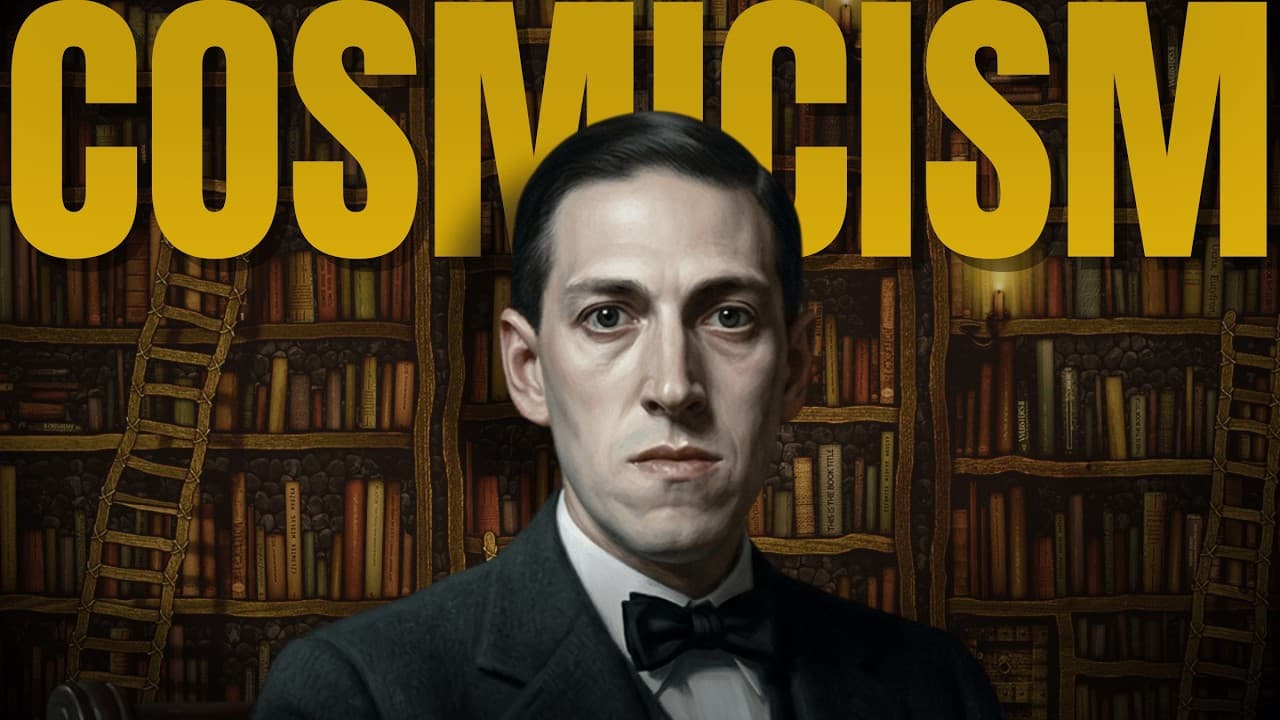
H.P. Lovecraft | The Complete Philosophy of Cosmic Horror for Sleep
HP Lovecraft's Complete Philosophy for Sleep
Enjoying the episode?
Occasional letters on philosophy, reading, and the examined life. No spam, ever.
Chapters
- 0:00:00Chapter 1: The Man from Providence
- 0:15:32Chapter 2: The Mechanistic Universe
- 0:31:52Chapter 3: Cosmic Indifference
- 0:48:12Chapter 4: The Weird Tale as Philosophy
- 1:04:14Chapter 5: The Call from the Abyss
- 1:19:51Chapter 6: Mountains, Colours, Shadows
- 1:35:41Chapter 7: The Limits of Knowledge
- 1:51:52Chapter 8: The Philosopher's Failures
- 2:08:06Chapter 9: Cosmicism Among the Philosophies
- 2:24:57Chapter 10: The Indifferent Stars
Full Transcript
Chapter 01: The Man from Providence
On a clear night in the autumn of 1903, a boy of thirteen stood on the hill behind his grandfather's house in Providence, Rhode Island, and pointed a small telescope at the sky. The boy was thin, pale, already old in a way that had nothing to do with years. His name was Howard Phillips Lovecraft. What he saw through that lens would shape everything he believed, everything he wrote, and every sleepless night he spent walking the streets of Providence for the rest of his life.
What he saw was distance. Not the comfortable distance of a landscape or a horizon, but the kind of distance that makes the mind go quiet. Saturn hung in the eyepiece, banded and ringed, impossibly far away and impossibly indifferent to the boy staring up at it from a New England hilltop. Beyond Saturn lay the fixed stars, each one a sun, most of them larger than the one that warmed his face during the day. And beyond those stars, more stars, receding into a darkness that had no end. The numbers in his astronomy books were not abstractions. They were statements about what was actually real. The light reaching his eye from certain of those points had been traveling since before human civilization existed. Some of those stars had already died, their light a message from a corpse, arriving millions of years too late to mean anything to anyone.
The boy understood this. He had been reading about astronomy since he was twelve, consuming every text he could find with the intensity of someone who has discovered the one subject that makes the world legible. Within a year he would begin writing a regular astronomy column for the Providence Tribune, and later for the Pawtuxet Valley Gleaner and the Providence Evening News, demonstrating a command of scientific concepts remarkable for his age. But there is a difference between understanding a fact and feeling it settle into your bones. That night on the hill, or one very like it, something took root in Howard Lovecraft that never left him. The universe was not built for human comfort. It was not built for anything. It simply existed, vast beyond reckoning, operating according to laws that had nothing to do with the hopes and terrors of the small creatures who had briefly appeared on the surface of one unremarkable world.
He had been born on August 20, 1890, at 194 Angell Street, in the house of his maternal grandfather, Whipple Van Buren Phillips. Providence was the only city Lovecraft ever truly loved, and in some sense it was the only place he ever fully inhabited. The house on Angell Street was large, comfortable, well-appointed, and full of books. Whipple Phillips was a prosperous businessman with wide-ranging interests, a man who read history and science, who told his grandson stories drawn from the Arabian Nights with a vividness that made the boy feel as though the walls of the parlor had dissolved and the deserts of the ancient world had come flooding in. The library became young Howard's sanctuary. He read without supervision and without plan, following his curiosity through volumes of classical literature, Roman history, chemistry, and the Gothic tales that gave him his earliest taste of the literature of the strange. By the age of six he was writing his own stories. By eight he had discovered chemistry and built a small laboratory. The life of the mind was not a retreat for him. It was the first and most real thing he knew.
His father offered a different education entirely. Winfield Scott Lovecraft was a traveling salesman for the Gorham Manufacturing Company, a silverware firm based in Providence. In April of 1893, when Howard was two years old, Winfield suffered a psychotic episode in a hotel room in Chicago. He was brought back to Providence and committed to Butler Hospital, the city's institution for the treatment of mental illness. The diagnosis was general paresis, the terminal neurological stage of syphilis. Winfield Lovecraft spent the remaining five years of his life in that hospital, his mind deteriorating in ways his young son was shielded from understanding. He died on July 19, 1898. Howard was seven.
The boy was told his father had suffered a kind of nervous paralysis brought on by overwork. Whether he accepted this story fully, or whether something in him sensed the darker truth, we cannot know for certain. What we can see is the mark it left on his imagination. His fiction, when it came, would be saturated with images of inherited corruption. Taints carried in bloodlines. Minds that crack under the pressure of knowledge they were never designed to hold. Ancestral secrets that surface without warning and destroy the person who discovers them. These are not merely literary conventions. They are the recurring anxieties of a man who grew up in the shadow of a father consumed from within by a disease that devoured reason itself.
His mother, Sarah Susan Phillips Lovecraft, filled the space that Winfield's collapse had opened, but she filled it in ways that complicated everything. She was by multiple accounts a difficult, emotionally intense woman who both adored her son and burdened him with an attention that left little room for ordinary childhood. She kept him largely isolated from other children. She is reported to have told him he was ugly, reinforcing a conviction the boy was already developing that he was fundamentally different from the people around him, that he belonged to a separate order of being. She dressed him in clothing appropriate for a much younger child well past the age when it would have drawn comment. The relationship was one of fierce, suffocating closeness, and its effects lasted decades. Sarah would eventually suffer her own breakdown and be committed to Butler Hospital, the same institution where her husband had died. She entered Butler in 1919 and died there on May 24, 1921. The symmetry is almost too precise. Both parents, lost to the same building, their minds undone in ways their son could only imagine and dread.
Between these losses, Lovecraft built the interior world that would sustain him. His education was formal only in the loosest sense. He attended Hope Street High School in Providence, but his attendance was irregular, disrupted by periods of what he described as near-complete nervous collapse. In 1908, at the age of eighteen, he suffered a breakdown severe enough to prevent him from graduating. He never received his diploma. He never attended Brown University, though he lived close enough to see its campus from his window, to hear the bells from its chapel, to watch its students walk the streets that he walked alone in the early hours of the morning. This failure haunted him for the rest of his life. It was not merely the absence of a credential. It was the confirmation of a pattern he was already beginning to recognize: that his mind and the world operated on incompatible terms, that the intensity of his inner life came at the cost of his ability to navigate the structures that ordinary people moved through without difficulty. He was a man of formidable intellectual capacity who could not manage the ordinary demands of institutional life, and the gap between what he knew himself capable of and what the world recognized him as became one of the defining tensions of his existence.
Then, in 1904, came the blow that reshaped everything. Whipple Van Buren Phillips died. The death was devastating on its own terms, the loss of the person who had been more father than grandfather, the man who had told him stories and opened the library and made the world feel large and full of wonders. But the material consequences were equally destructive. Whipple's estate was mismanaged and largely lost. The family could no longer afford the house at 454 Angell Street. Howard and his mother moved to smaller, rented quarters at 598 Angell Street. Lovecraft wrote about the loss of that house for the rest of his life, returning to it in letters decades later with a specificity of grief that suggests the wound never closed. The house was not merely a house. It was the last physical anchor to a world of security, learning, and continuity that the Phillips family had represented. Its loss confirmed what the telescope had already been teaching him. The things we value most, stability, belonging, the sense that we occupy a place in a world that makes sense, exist at the mercy of forces entirely indifferent to whether they survive.
What followed was a period of almost total withdrawal. From roughly 1908 to 1914, Lovecraft lived as a recluse, shut away in his mother's house, reading, sleeping through the days, and emerging only at night. He described himself later as a hermit, and the word is not much of an exaggeration. He wrote amateur poetry in deliberate imitation of the eighteenth-century styles he admired, modeling his diction on Dryden and Pope as though the previous hundred and fifty years of literary history had been a mistake he could correct by ignoring it. The poetry was competent and almost entirely lifeless. His voice had not yet found its subject.
But the night walks were something else. Lovecraft would leave his house after dark and walk for hours through the colonial streets of Providence's East Side. Past the old gambrel-roofed houses on Benefit Street. Past the First Baptist Church, built in 1775. Past the John Brown House, which he considered the finest example of Georgian architecture in the country. Through silent neighborhoods where the eighteenth century seemed to linger in the brickwork and the iron railings, as though time had pooled in certain corners and refused to drain away. These walks were not exercise. They were a form of habitation. Lovecraft was occupying a version of Providence that existed before industrialization and immigration had transformed the city into something he found chaotic and threatening. He was walking through the past, and in the past he found a temporary refuge from a present he could neither master nor accept.
The night was his element. He did his best thinking under a sky full of stars, the same stars that had first shown him the truth about the scale of things. There is something important in this preference. Walking at three in the morning through streets built by men dead for two centuries, beneath a cosmos that did not know or care that either he or they had ever existed, Lovecraft occupied the precise space from which his philosophy would emerge. Below him, the human effort to build something that endures. Above him, the void that renders all such efforts temporary. He did not yet have the language or the literary form to express what he felt in that space. But the feeling was already complete.
In 1914, the isolation began to crack. Lovecraft discovered amateur journalism, a sprawling network of self-published magazines whose contributors debated everything from politics to prosody and corresponded with one another in letters of sometimes extraordinary length. For a man who had spent six years in near-total seclusion, the amateur press was oxygen. It gave him readers. It gave him arguments. It gave him a reason to write prose rather than imitation Pope. He threw himself into the community with an energy that surprised everyone who knew him, writing editorials, critiques, and essays on subjects ranging from astronomy to the correct usage of English grammar. He corresponded furiously, producing letters that ran to thousands of words, letters that would eventually fill five thick volumes of selected correspondence published after his death and that constitute one of the most remarkable bodies of personal writing in American literature. In these letters, more than in any other medium, Lovecraft thought aloud. He worked out his positions on science, philosophy, art, and the nature of reality with a candor and specificity that his fiction, bound by the conventions of the weird tale, could not always accommodate.
And it was through the discipline of regular publication that he discovered the possibility of writing fiction worth reading. In 1917 he produced "Dagon," a brief, fierce story about a man who encounters evidence of a civilization older than humanity on a stretch of sea floor risen temporarily above the waves. The story was overwrought in places and derivative in others. But the central idea was already fully formed. Something existed in the universe that was older, larger, and more powerful than the human species. It did not hate us. It did not love us. It did not know we were here. And the discovery of its existence was enough to destroy a mind.
The man who wrote that story was twenty-six, financially dependent, socially marginal, and possessed of a vision of the universe that most people would find intolerable. He had arrived at this vision not through formal education or systematic philosophy but through the slow accumulation of loss, solitude, and a childhood encounter with the night sky that had never stopped reverberating. A father devoured by madness in an institution. A grandfather whose death meant the end of everything stable. A mother whose love was indistinguishable from confinement. And a telescope that had shown him, at thirteen, that the cosmos was not a home.
These were the raw materials of a philosophy that did not yet have a name. The name would come later. The ideas behind it were already in place, waiting in the dark streets of Providence for the fiction that would finally give them form.
Chapter 02: The Mechanistic Universe
Lovecraft did not arrive at his philosophy by reading philosophers. He arrived at it by reading scientists, and then thinking harder about what they had said than most of them were willing to. The distinction matters. He was not a man who sat down with Plato's dialogues and worked his way forward through the Western tradition in an orderly fashion. He was a man who picked up a book about astronomy or chemistry or evolutionary biology, absorbed its implications with ferocious literalness, and then followed those implications to places their authors had carefully avoided going.
By his own account, the process began early. The same years that saw him devouring astronomy texts and writing columns about planetary observation also saw him reading widely in the natural sciences, in ancient history, and in the popular scientific literature that was flooding the English-speaking world at the turn of the twentieth century. This was the age of confident materialism. Darwin had published "On the Origin of Species" in 1859, and by the time Lovecraft was born in 1890 the basic framework of evolutionary biology had reshaped every field it touched. The earth was old. Life was a process of blind variation and natural selection. Human beings were not the purpose of creation but one branch of an ancient and indifferent tree. These ideas were not controversial in scientific circles by 1900. They were the settled background against which everything else was being worked out.
Lovecraft absorbed this background completely and without reserve. There was no period of doubt, no dramatic crisis of faith, no anguished passage from belief to unbelief such as we find in the biographies of so many Victorian and Edwardian intellectuals. He simply read the evidence, accepted its implications, and moved on. By his own account, he had abandoned any residual belief in the supernatural by the time he was twelve. The universe was matter and force, operating according to discoverable laws, and everything else was wishful thinking. He called himself a mechanistic materialist, a phrase he used repeatedly in his letters and that describes his position with considerable precision. The universe, as he understood it, was a machine. It operated according to physical laws that admitted no exceptions, no divine interventions, no purposes beyond the interactions of matter and energy. There was no God. There was no soul. There was no cosmic plan. Consciousness itself was an accident, a byproduct of electrochemical processes in a brain that had evolved to help a particular species of primate survive on the African savanna. Every feeling of meaning, purpose, or transcendence that human beings had ever experienced was, in the strictest sense, a local phenomenon with no purchase on the larger reality.
He was not the first person to think this way. The philosophical lineage behind his position stretches back more than two thousand years, and Lovecraft knew it. He had read the ancient atomists, the Greek and Roman thinkers who first proposed that reality consists entirely of atoms moving through empty space. Democritus, who declared that nothing exists except atoms and the void. Epicurus, who built on Democritus's physics a philosophy of modest pleasure and the absence of fear, arguing that if the universe is material and the gods are indifferent, then the proper response is not despair but a calm enjoyment of the brief life we have. And Lucretius, whose poem "De Rerum Natura," On the Nature of Things, presented the Epicurean worldview with a literary power that Lovecraft genuinely admired. Lucretius wrote about the infinite universe, the mortality of the soul, and the groundlessness of religious fear with a directness that still feels modern. Lovecraft recognized in him a kindred spirit, a man who looked at the cosmos without flinching and reported what he saw.
But the ancient atomists, for all their courage, lived before the full implications of their position could be understood. They did not know about deep time. They did not know about galaxies, or the electromagnetic spectrum, or the fossil record, or the second law of thermodynamics. They proposed a universe of infinite atoms in infinite void, but they could not yet measure the actual scale of that infinity. The scientific revolution and its aftermath filled in the picture that Democritus and Lucretius had only sketched, replacing philosophical intuition with measured fact, and each new discovery made the human position smaller. What had been a daring speculation in ancient Athens became, by the early twentieth century, an established description of reality supported by converging lines of evidence from physics, chemistry, biology, and astronomy.
Lovecraft was acutely aware of this progressive diminishment, and he traced its history in his letters with a precision that reveals how carefully he had thought it through. Copernicus had removed the Earth from the center of the solar system. Galileo had shown that the heavens were not perfect and unchanging but turbulent and material. Newton had demonstrated that the same physical laws governed the motion of an apple and the orbit of a planet, collapsing the ancient distinction between the terrestrial and the celestial. Darwin had placed human beings inside nature rather than above it. And the new astronomy of the late nineteenth and early twentieth centuries, the astronomy that Lovecraft followed with passionate attention, was revealing a universe so large that the human mind could not meaningfully comprehend it. Each step in this progression had stripped away another layer of the comfortable fiction that the cosmos existed for us.
Among the modern thinkers who influenced Lovecraft most directly, and whose works he discussed in his letters with the kind of specific, engaged commentary that reveals genuine intellectual absorption rather than casual name-dropping, two deserve particular attention. The first was Ernst Haeckel, a German biologist and philosopher whose book "The Riddle of the Universe," published in 1899, attempted a grand synthesis of scientific knowledge into a unified materialist worldview. Haeckel was a monist. He believed that mind and matter were two aspects of a single substance, that there was no soul independent of the body, and that the universe could be understood entirely through the methods of natural science. His book was enormously popular, translated into dozens of languages, and widely discussed in the educated circles that Lovecraft moved through, even if those circles were, in his case, largely composed of books rather than people. Haeckel's confident declaration that science had solved, or would solve, every genuine question about reality gave Lovecraft a framework. But it was a framework he would push far beyond what Haeckel intended. Haeckel was, at bottom, an optimist. He believed that understanding the universe through science was a source of wonder and fulfillment. Lovecraft drew the opposite conclusion. Understanding the universe through science was a source of dread.
The second was Hugh Elliot, a British writer whose "Modern Science and Materialism," published in 1919, presented a rigorous case for the materialist position. Elliot argued that consciousness, free will, and the apparent purposefulness of life could all be explained as products of physical processes operating according to deterministic laws. Nothing existed outside the material world. Lovecraft read Elliot with enthusiasm and cited him in letters as a decisive influence. What he found in Elliot was not a new idea but a particularly unflinching statement of the idea he had already been developing on his own: that the universe is a mechanism, that human beings are part of that mechanism, and that the feelings of significance we attach to our existence are projections onto an indifferent reality.
Schopenhauer entered the picture from a different angle. Arthur Schopenhauer, the great German pessimist, had argued in "The World as Will and Representation" that the fundamental nature of reality is a blind, purposeless striving he called the Will. The Will drives all of nature, from the growth of plants to the ambitions of empires, but it strives toward nothing. It has no goal, no direction, no meaning. Suffering is the default condition of all conscious life because consciousness exists only to serve the Will's purposeless demands. Schopenhauer's pessimism resonated with Lovecraft's own developing sense that existence was, at bottom, a problem without a solution. But Lovecraft never fully adopted Schopenhauer's metaphysics. The Will, as Schopenhauer described it, was still a cosmic principle, something that organized reality even if it organized it cruelly. Lovecraft's cosmos had no organizing principle at all. It was not cruel. Cruelty requires intention. It was simply there, and human beings were simply irrelevant to it.
Nietzsche, whom Lovecraft also read, presented a different kind of challenge. Nietzsche had declared God dead and had attempted to build a new system of values on the ruins of the old one. The Ubermensch, the will to power, the eternal recurrence: these were Nietzsche's answers to the void left by the collapse of Christian metaphysics. Lovecraft admired Nietzsche's courage in facing the implications of a godless universe. He recognized in Nietzsche a thinker who refused to look away from uncomfortable truths, who insisted that honest confrontation with reality was preferable to comfortable illusion. But he rejected the conclusions. The idea that a human being could, through sheer force of will, create meaning in a meaningless cosmos struck Lovecraft as a kind of noble delusion. It was still anthropocentrism, still the insistence that the human perspective mattered, dressed up in more muscular clothing. Nietzsche had killed God only to put humanity on the empty throne. Lovecraft wanted to leave the throne empty. The universe does not care about your will to power. It does not know that you have a will at all.
What is striking about all of these encounters is the consistency of Lovecraft's response. Wherever he found a thinker who had glimpsed the indifference of the cosmos and then tried to rescue human significance from the wreckage, Lovecraft noted the glimpse and rejected the rescue. He was not interested in consolation. He was not looking for a philosophical system that would make materialism feel comfortable. He was looking for the truth, and the truth, as he understood it, was not comfortable. It was not supposed to be. The discomfort was the point. A philosophy that makes you feel better about your place in the universe has already failed as a description of reality, because reality does not care whether you feel better about it or not.
This is the point at which Lovecraft's position becomes genuinely distinctive. Many thinkers before him had denied God. Many had embraced materialism. Many had argued that the universe operates according to impersonal laws with no regard for human wishes. But most of them had found a way to make this vision livable. The Epicureans counseled gentle pleasure. The Stoics counseled acceptance and virtue. Nietzsche counseled self-overcoming. Even Schopenhauer offered aesthetic contemplation and ascetic renunciation as partial escapes from the Will's tyranny. Lovecraft offered nothing. Or rather, what he offered was the unflinching recognition that there is nothing to offer. The universe is a mechanism. Human beings are an accident within that mechanism. Our categories of meaning, purpose, value, and significance are local inventions that apply only to ourselves and only for as long as we happen to exist. When we are gone, which on a cosmic timescale will be very soon, the mechanism will continue without noticing our absence.
In a letter to Farnsworth Wright, the editor of Weird Tales magazine, written in July of 1927, Lovecraft stated his position with characteristic directness. All of his tales, he explained, were based on the fundamental premise that common human laws and interests and emotions have no validity or significance in the vast cosmos at large. This single sentence is as close to a philosophical manifesto as Lovecraft ever wrote. It does not say that human laws and emotions are illusions, exactly. It says something more precise and more unsettling. It says they have no validity beyond the human sphere. They are real to us. They matter to us. But the cosmos at large, the actual universe in which we exist, does not recognize them and is not governed by them.
The implications of this position are severe, and Lovecraft knew it. If human values have no cosmic validity, then no human achievement, no matter how grand, has any significance beyond the species that produced it. Civilization is not a step toward anything. It is a local phenomenon, impressive by local standards, invisible from any distance. The great works of art, science, and philosophy that human beings have produced over the past several thousand years are, from a cosmic perspective, as temporary and as meaningless as the nest-building of a particular colony of ants. This is not a comforting thought. It is not meant to be.
But Lovecraft was not paralyzed by it. He continued to read, to write, to correspond, to take his night walks through Providence, to care deeply about architecture and history and the proper use of the English language. He was a man who believed that nothing matters on a cosmic scale and who nevertheless poured thousands of hours into things that mattered to him on a human scale. There is a tension in this, a productive tension that runs through everything he wrote. The question of how to live when you believe that life is cosmically insignificant is the question that animates his fiction. He did not try to resolve it with a philosophical system. He tried to express it through stories that make the reader feel what it is like to stand at the edge of that abyss. The stories were his answer, and they were the only answer he considered honest.
Chapter 03: Cosmic Indifference
The most famous sentence Lovecraft ever wrote appears in the opening paragraph of "The Call of Cthulhu," the story that would eventually give its name to an entire mythology. The most merciful thing in the world, I think, is the inability of the human mind to correlate all its contents. We live on a placid island of ignorance in the midst of black seas of infinity, and it was not meant that we should voyage far. The sentence is so frequently quoted that it has become a kind of shorthand for Lovecraft's entire philosophy, reproduced on posters and in anthologies and in countless introductions to his work. But its familiarity can obscure what it is actually saying, which is something more precise and more disturbing than most readers pause to consider.
Notice what Lovecraft calls merciful. Not kindness. Not love. Not any positive condition of the human situation. What he calls merciful is ignorance. The inability to see clearly. The failure of the mind to connect what it knows into a coherent picture of reality. He is saying that if we could see the universe as it actually is, the experience would be intolerable. The fragmentation of our understanding, the way we compartmentalize knowledge into disciplines and specialties and isolated facts that never quite add up to a whole, is not a flaw in human cognition. It is a mercy. The alternative would be a clarity so complete that it would shatter the mind that achieved it.
This is the core of cosmicism. Not a doctrine to be believed. Not a program to be followed. Not even, in the strict sense, an argument to be evaluated. It is a recognition, a way of seeing the cosmos that, once achieved, cannot be fully undone. It is not a formal philosophical system in the way that Kant's critical philosophy or Hegel's dialectic is a system. Lovecraft never wrote a treatise. He never defined his terms with academic precision or constructed arguments in the manner of professional philosophers. What he produced instead was a vision, expressed through fiction and elaborated in thousands of pages of personal correspondence, of the human situation in a universe that is not hostile, not evil, not meaningfully engaged with humanity in any way. The universe is indifferent. It operates according to principles that have no connection to human categories of meaning, purpose, value, or moral order. The stars are not cruel. Cruelty is a human concept, requiring intention and awareness. The stars simply burn, and when they are done burning they go dark, and neither the burning nor the darkness has anything to do with the creatures who once looked up at them and imagined they were signs.
This claim, stated baldly, can sound like nihilism, and Lovecraft is often described as a nihilist. But the label is imprecise. Classical nihilism, particularly in its Nietzschean form, holds that nothing has value, that all beliefs are groundless, and that the recognition of this groundlessness creates a crisis from which new values might be forged. Lovecraft is not saying that nothing has value. He is saying something more specific and in some ways more radical. Human values are real, within the human sphere. They matter to us because we are the kind of creatures we are. Love, justice, beauty, courage: these are genuine features of human experience. They are not illusions. But they are local. They apply to human beings in the way that the social behavior of a particular species of ant applies to that species of ant. From any perspective beyond the human, they simply do not register.
The distinction is important because it changes what follows. If nothing has value, then the appropriate response might be despair, or defiance, or the creation of new values through an act of will. These are the responses that existentialism, in its various forms, has proposed. Camus said we must imagine Sisyphus happy. Sartre said we are condemned to be free. Nietzsche said we must become who we are. Each of these responses assumes that the human confrontation with meaninglessness is the central drama of existence, that the absence of cosmic meaning creates a space in which human meaning-making becomes heroic, even sacred. Lovecraft would have found all of this touching and beside the point. The human confrontation with meaninglessness is not the central drama of existence. It is not a drama at all. It is one species' private difficulty, occurring on one planet, for a cosmically negligible period of time. The universe does not watch us struggle with meaning the way a spectator watches a play. It does not watch us at all.
This is not a challenge to be overcome. It is not a condition to be transcended. It is simply the way things are, as plainly factual as the distance between stars, and the only honest thing to do is to acknowledge it without pretending otherwise. Lovecraft is not offering a response. He is offering a description. And the description, precisely because it is not framed as a problem requiring a solution, leaves the reader with nowhere to stand.
There is a loneliness in this position that is unlike any other philosophical loneliness. The existentialist is alone in a meaningless world, but the world is at least scaled to the existentialist. It is a human-sized world, a world of choices and commitments and relationships with other people who are also struggling to find or create meaning. The cosmicist is alone in a way that makes the existentialist's loneliness look like a minor domestic inconvenience. The cosmicist is alone the way a single bacterium is alone on the floor of the Pacific Ocean. The loneliness is not emotional. It is structural. It is built into the situation.
Consider what this meant concretely, not as an abstract proposition but as a lived experience for a man in Providence in the 1920s. Lovecraft was writing during a period of rapid scientific advancement. Einstein's theories of relativity had revealed that space and time were not fixed and absolute but flexible, warped by mass and energy, behaving in ways that contradicted every intuition human beings had developed over hundreds of thousands of years of evolution. Quantum mechanics was beginning to suggest that at the smallest scales, reality did not behave like anything at all, that particles could exist in multiple states simultaneously, that observation itself altered what was being observed. The new astronomy was pushing the boundaries of the known universe further and further out, past the Milky Way to other galaxies, each containing billions of stars, separated by distances that made the entire history of human civilization look like a footnote written in letters too small to read.
Lovecraft followed these developments with the attention of someone who understood their philosophical implications. In his letters from this period, he discussed relativity and the expanding universe with a facility that reveals extensive reading, even if his understanding was necessarily that of an informed layperson rather than a practitioner. He subscribed to scientific journals and read popular accounts of the new physics with the same intensity he brought to his literary interests. He was not a scientist. He had no formal training and no capacity for mathematics beyond a basic level. But he grasped, with an intuitive clarity that many professional scientists avoided, what the new picture of reality implied for the human sense of significance. The scientists themselves often drew back from the implications. They discovered that the universe was unimaginably vast and old, and then they went home to their families and lived as though this knowledge had no bearing on the question of whether human life meant anything. Lovecraft refused that compartmentalization. If the universe is what science says it is, then we are what that universe implies we are: temporary arrangements of matter, briefly aware, on a world that will one day be swallowed by its own sun. If the universe is billions of years old and billions of light-years across, and if human beings have existed for a few hundred thousand years on a single planet in one corner of one galaxy, then every claim we make about cosmic purpose or divine intention is, at best, a projection. We are not at the center of anything. We are not the point of anything. We are a local event, briefly conscious, and the universe that produced us has no more investment in our continuation than it has in the continuation of any other chemical reaction.
What makes this position genuinely unsettling, and what distinguishes it from the cheerful materialism of thinkers like Haeckel or the defiant atheism of thinkers like Nietzsche, is Lovecraft's insistence that the encounter with cosmic reality is not empowering but destructive. Other materialists had treated the recognition of humanity's smallness as a kind of liberation. If there is no God watching and judging, then we are free. If there is no cosmic purpose, then we can make our own. Lovecraft rejected this entirely. Freedom is a human concept. Making our own purpose is a human project. And the cosmos does not recognize human concepts or human projects. The experience of genuinely confronting the indifference of the universe is not liberating. It is annihilating. It does not free the mind. It breaks it.
This is the engine that drives every story he wrote. His narrators do not encounter evil. Evil would be almost reassuring, because evil implies a moral universe in which good and evil are real forces. What his narrators encounter is something worse than evil: reality without human meaning. A creature sleeping in a sunken city that is older than the human species. A color that falls from the sky and drains the life from everything it touches, not out of malice, but because that is simply what it does. A mountain range in Antarctica that contains evidence that humanity was an afterthought, a mistake, an accidental byproduct of beings whose concerns were as remote from ours as ours are from the concerns of bacteria. In each case, the horror is not that the universe is hostile. The horror is that it is going about its business, and its business has nothing to do with us.
It is worth pausing here to note what cosmicism is not, because the misreadings are common and consequential. It is not Satanism or anti-theism. Lovecraft was not rebelling against God. Rebellion requires a God to rebel against, and Lovecraft simply found the concept irrelevant. It is not nihilism in the popular sense, the sense in which people use the word to mean that nothing matters and therefore anything is permitted. Things matter to human beings. Love matters. Suffering matters. The question is whether they matter to anything beyond the beings who experience them. Lovecraft's answer was no, and he delivered that answer without either celebrating or mourning it. It is not pessimism exactly, though it shares territory with the pessimistic tradition. A pessimist says the world is bad. Lovecraft says the world is not anything, in moral terms. It is not good or bad. It is not for us or against us. It is simply not about us.
There is a passage in Lovecraft's letters, written to a correspondent in 1929, that puts the matter as clearly as anything he ever wrote. He described his fundamental conviction that the world is a meaningless assemblage of matter and force, that human experience is essentially without significance in the larger scheme, and that the most profound truths are those that reveal the utter emptiness of all human pretensions to cosmic importance. He did not write this in anguish. He wrote it in the same measured, analytical tone he used to discuss architecture or the proper pronunciation of English place-names. The indifference of the universe was not, for Lovecraft, a source of torment. It was a fact, and he recorded it with the composure of someone recording the temperature or the phase of the moon. This composure is itself part of the philosophy. If the universe is truly indifferent, then anguish about its indifference is just another human projection, another way of making the cosmos about us.
But the composure is deceptive. If cosmic indifference were merely an intellectual position, something a person could hold at arm's length and examine dispassionately, then it would be philosophy in the ordinary sense: an argument to be debated, a claim to be tested against competing claims. Lovecraft understood that it was something more than this. The full apprehension of humanity's cosmic insignificance is not an intellectual event. It is an experiential one. It does something to the person who achieves it. It rearranges the interior landscape. It makes certain comforts unavailable and certain horrors newly visible. This is why Lovecraft turned to fiction rather than to philosophical argument. An argument can be refuted. An experience cannot. And the experience Lovecraft wanted to create, the encounter with a reality that does not acknowledge your categories or respect your boundaries, required a literary form capable of producing that experience in the reader.
He found that form in the weird tale, a form he had been practicing and refining for years. Not the ghost story, which operates within a moral universe where the dead return because something is unfinished or unjust. Not the horror story in the conventional sense, which frightens by threatening the body or violating social taboos. The weird tale does something different. It presents the reader with something that should not exist, something that violates not the laws of society but the laws of the mind, the basic categories through which human beings organize their experience of reality. The weird is not frightening because it threatens us. It is frightening because it suggests that the framework within which threat and safety, meaning and meaninglessness, even existence and nonexistence are defined might itself be inadequate. This is philosophy operating at the level of the nervous system. And it is to this form, and to the philosophical work it does, that we now turn.
Chapter 04: The Weird Tale as Philosophy
In 1927, Lovecraft wrote an essay called "Supernatural Horror in Literature" that functions as both a literary history and a philosophical manifesto. The essay traces the tradition of weird fiction from the earliest Gothic novels through Poe, Machen, Dunsany, Blackwood, and James, and in doing so it reveals what Lovecraft believed fiction could accomplish that philosophy could not.
The key passage comes early. Lovecraft writes that the oldest and strongest emotion of mankind is fear, and the oldest and strongest kind of fear is fear of the unknown. This is not a casual observation. It is a philosophical claim about the relationship between human consciousness and reality. Fear of the unknown is not merely one emotion among many. It is the foundational emotion, the one that all others are built upon, because it arises from the most basic condition of human existence: the fact that we are finite creatures in an infinite universe, that our knowledge is bounded and our perception limited, and that beyond the edge of what we know lies something vast and ungovernable.
The weird tale, as Lovecraft understood it, is the literary form that engages this foundational fear most directly. It does not merely frighten. Plenty of fiction frightens. A story about a murderer hiding in a house frightens because it presents a threat to the body. A story about a ghost frightens because it suggests that the dead are not gone. These are fears that operate within the framework of ordinary experience. They are scary, but they are comprehensible. The weird tale operates at a different level. It presents something that the framework itself cannot contain. It suggests that the categories through which we organize reality, the distinction between living and dead, between material and immaterial, between possible and impossible, are not features of reality but features of the human mind, and that reality extends far beyond the reach of those categories.
This is why Lovecraft's fiction is so often described as cosmic horror rather than simply horror. The horror is not in the threat. It is in the scale. It is the recognition that the thing encountered is not merely dangerous but fundamentally alien, that it belongs to an order of reality that the human mind was not designed to process. The madness that so often afflicts Lovecraft's characters is not a literary convenience. It is a philosophical statement. It says: here is what happens when a human mind encounters something it cannot contain. The mind does not rise to the occasion. The mind breaks.
Lovecraft's essay makes clear that he saw himself as working within a long tradition, but also as pushing that tradition in a new direction. The Gothic novelists had used supernatural elements to explore social anxieties: fear of the past, fear of aristocratic power, fear of female sexuality confined within patriarchal structures. Poe had internalized the horror, making it a function of the narrator's psychology rather than an external threat. Machen and Blackwood had introduced the concept of the numinous, the sense of a reality behind ordinary appearances that is both terrifying and awesome. Lovecraft drew on all of these precedents but subordinated them to a single philosophical project: the representation of cosmic indifference as an experiential reality.
The weird tale, in Lovecraft's hands, becomes a thought experiment conducted at the level of sensation rather than argument. What would it feel like to discover that humanity is not the dominant intelligence on Earth? What would it feel like to realize that the universe contains entities so vast and so alien that our encounter with them would shatter our minds? What would it feel like to learn that everything we believe about the nature of reality, from our physics to our metaphysics, is a local approximation that breaks down the moment it encounters something outside its range? These are philosophical questions, but Lovecraft understood that they cannot be answered philosophically. They can only be experienced. And the weird tale, with its emphasis on atmosphere, on the slow accumulation of dread, on the revelation that arrives too late and cannot be undone, is the form best suited to producing that experience.
This is what separates Lovecraft from the philosophers he read and admired. Schopenhauer could argue that the world is suffering. Nietzsche could declare that God is dead. But arguments, however compelling, remain at a distance from the reader. They engage the intellect. They can be debated, qualified, held at arm's length. The weird tale engages the nervous system. It makes you feel what it would be like to stand in the space that the philosophers describe. And the feeling, once achieved, is harder to dismiss than any argument.
Chapter 05: The Call from the Abyss
"The Call of Cthulhu," written in the summer of 1926 and published in Weird Tales in February 1928, is the story that crystallizes everything Lovecraft had been working toward. It is not his best piece of prose. It is not his most atmospheric or his most technically accomplished. But it is the story in which his philosophical vision finds its fullest narrative expression, the one that transforms cosmicism from an intellectual position into a mythology.
The story is structured in three parts, each narrated at one remove from the events it describes. Francis Wayland Thurston, the narrator, is assembling the papers of his recently deceased grand-uncle, Professor George Gammell Angell of Brown University. Among those papers he finds evidence of a pattern so vast and so disturbing that he becomes convinced his uncle was murdered for knowing too much. The first section, "The Horror in Clay," concerns a young artist named Henry Anthony Wilcox, who during a period of feverish dreams sculpts a bas-relief depicting a creature of terrible aspect, a thing with a vaguely anthropoid outline but an octopus-like head and rudimentary wings. The second section, "The Tale of Inspector Legrasse," moves to the swamps of Louisiana, where a police inspector has encountered a cult worshipping an idol identical to Wilcox's sculpture. The cult's liturgy includes chanted phrases in no known language, most notably the words Ph'nglui mglw'nafh Cthulhu R'lyeh wgah'nagl fhtagn, which translate roughly as "In his house at R'lyeh, dead Cthulhu waits dreaming." The third section, "The Madness from the Sea," recounts the discovery of a sailor's journal documenting an encounter with a risen island in the South Pacific, an island of non-Euclidean geometry and alien architecture, from which Cthulhu itself briefly emerges before the island sinks again beneath the waves.
The philosophical architecture of this three-part structure deserves careful attention, because it is not merely a narrative device but a demonstration of how cosmic knowledge works. Each section moves further from the safety of civilized, rational life and closer to the reality that civilization exists to deny. Thurston begins as a scholar sitting in a library, reading his uncle's papers. He ends in a state of existential terror, having assembled a picture of reality so disturbing that he expects to be killed for possessing it. The movement of the story is not from ignorance to knowledge in the triumphant sense that Western culture usually celebrates. It is from comfortable ignorance to unbearable knowledge, and the knowledge in question is not a specific fact but a condition: the condition of knowing that human civilization is not the dominant force on this planet, that something older and more powerful exists beneath the surface of the world we have built, and that its awakening would render everything we have ever accomplished meaningless.
One of the story's most effective philosophical techniques is this layering of narration. We never encounter Cthulhu directly. We read Thurston's account of his uncle's notes about Wilcox's dreams about Cthulhu. We read Thurston's account of a police inspector's account of a cult that worships Cthulhu. We read Thurston's account of a dead sailor's testimony about seeing Cthulhu. Each layer of mediation increases the distance between the reader and the event, and yet the effect is not to diminish the event but to amplify it. The very fact that we can only approach this knowledge indirectly, through fragments and intermediaries and reconstructed accounts, mirrors the philosophical claim at the heart of the story: that the truth about reality is not something human beings can confront directly. We can only catch glimpses, assemble partial pictures, and infer the shape of something too large to see whole.
Cthulhu itself is not a monster in the conventional sense. It is a philosophical proposition given narrative form. What if there existed a being so old that human history, all of it, the rise and fall of every empire, every religion, every system of thought, was a single moment in its sleep? What if that being was not evil, not hostile, not engaged with humanity in any way, but simply present, occupying a reality so far beyond our comprehension that our encounter with it would destroy our minds not through any malicious intent but through the sheer incompatibility of its nature with our cognitive apparatus? This is what Cthulhu represents. It is the cosmos made flesh, the indifference of the universe given a shape that the human imagination can almost but not quite grasp. The horror of "The Call of Cthulhu" is not that Cthulhu might destroy civilization. It is that civilization, in the face of what Cthulhu represents, was never anything more than a fragile local arrangement maintained by the accident of our ignorance.
Nearly a decade before "The Call of Cthulhu," in 1917, Lovecraft had written the story that contains the first clear articulation of this vision. If "The Call of Cthulhu" is cosmicism at its most architecturally ambitious, "Dagon" is cosmicism stripped to its essentials: raw, compressed, almost frantic in its urgency. The narrator is a marine officer whose ship is captured by a German raider during the First World War. He escapes in a small boat and drifts for days until he finds himself stranded on a vast expanse of ocean floor that has risen above the surface, exposing a landscape of black, slimy mud that stretches to the horizon in every direction. The stench is overpowering, a reek of decaying marine life exposed for the first time in geological ages. The terrain is alien, a landscape that no human being was meant to see. As the narrator walks across this nightmare landscape, he discovers a monolith covered in carvings that depict beings of enormous size, vaguely humanoid, moving through an underwater world that predates anything in the human record.
Then the narrator sees it. A vast, Polyphemus-like shape, rising from the water beside the monolith, a living thing of enormous size and alien anatomy that belongs to the same world as the carved figures on the stone. The creature is real. The civilization that produced the monolith is real. And the narrator, alone on this risen plain of sea-mud in the middle of the Pacific, standing before evidence that everything he understood about the history of life on Earth is wrong, feels his mind begin to give way.
The encounter drives him to the edge of sanity. The story ends with him in a rented room, addicted to morphine, writing his account before the thing he has seen catches up with him. "Dagon" is crude in places, its effects sometimes more theatrical than atmospheric. But the philosophical core is already complete. The narrator has encountered evidence of a civilization that existed before humanity and that was produced by beings who dwarf us in every sense. His response is not heroism or even comprehension. It is collapse. The knowledge is too large for the container of a human mind.
Between "Dagon" and "The Call of Cthulhu," Lovecraft wrote a story that operates in an entirely different register but arrives at a closely related philosophical conclusion. "The Music of Erich Zann," written in 1921, is one of his most restrained and effective works. The narrator, a university student, rents a cheap room in a building on a street called the Rue d'Auseil, a street that he can never afterward find on any map. Above him lives an old German man named Erich Zann, a mute who plays the viol in a local theater orchestra. At night, after the performances, Zann returns to his room and plays music of extraordinary strangeness and intensity, music unlike anything the narrator has heard before.
The narrator, drawn by the strangeness and intensity of the music, befriends Zann and eventually learns, or rather intuits, the truth. Zann's room has a high window that opens onto something. Not a street. Not a courtyard. Something else, something that the narrator glimpses only once, in a moment of terrifying revelation. Zann plays his wild, unearthly music not for pleasure or art but as a defense, a barrier, a wall of sound erected nightly against whatever exists on the other side of that window. When the barrier fails, when the wind tears the music from Zann's hands and the window bursts open, what the narrator sees through the opening is not a cityscape but a void, a blackness full of movement and sound and the suggestion of immensities beyond calculation.
This story is among the most philosophically suggestive things Lovecraft ever wrote, and it is worth dwelling on what it means. Zann is an artist. But his art is not expression. It is not the outpouring of an inner life into form. It is protection. It is a barrier. He plays to keep something out, and what he is keeping out is the cosmos itself, the reality that presses against the thin membrane of human experience. We might read this as Lovecraft's most intimate reflection on what art, including his own art, is actually doing. Every story, every painting, every piece of music is, in some sense, a wall built against the void. It shapes experience into patterns that the mind can hold. It creates the illusion of order, meaning, narrative coherence. And it works, most of the time. But the void does not go away because we have built walls against it. It waits. The music is beautiful and desperate in equal measure. It is the sound of a human being using the only tool available to him to hold back a truth that would destroy him if it got through. And it does get through. The window opens. The void enters. Zann dies. The narrator flees. The street disappears from every map, as though reality itself has sealed over the wound.
What these three stories share, beneath their considerable differences in structure and tone, is a single philosophical argument expressed in three variations. Human beings live within a constructed reality, a framework of assumptions, categories, and institutions that makes the world seem comprehensible and manageable. This framework is not false, exactly. It works. It allows us to build cities, write laws, produce art, conduct science, and maintain the belief that our existence has significance. It is, in fact, remarkably effective, so effective that we mistake it for reality itself. We forget that it is a construction. We forget that it covers only a tiny fraction of what actually exists. We take the map for the territory and are startled when the territory turns out to be immeasurably larger, stranger, and more populated than the map suggested. But the framework is local. It applies only within the narrow band of experience that human cognition can process. Beyond that band, beyond the edge of the map, the ocean floor, or the window in Erich Zann's room, lies something that the framework cannot contain. The encounter with that something is not an adventure. It is a disaster. Not because the something is hostile, but because the framework, upon contact with what lies beyond it, reveals itself as what it always was: a thin, desperate, beautiful construction raised against an indifference so vast that the word indifference barely begins to describe it.
The sailor Johansen, having looked upon the risen city of R'lyeh and the stirring form of Cthulhu, does not return as a wiser man. He returns shattered, dying within a year, his testimony dismissed as the ravings of a mind destroyed by fever and exposure. The narrator of "Dagon" ends his life in a rented room, waiting for the thing from the sea to find him. Erich Zann dies with his viol in his hands, the music that protected him scattered by a wind from beyond the world. These are not failures of courage. They are encounters with something for which no amount of courage is adequate. Bravery is a human virtue, designed for human-scale threats. It has no application to the cosmically alien. The universe does not reward those who seek it. It does not punish them either. It simply breaks them open and lets the light pour out.
Chapter 06: Mountains, Colours, Shadows
By the early 1930s, Lovecraft had returned to Providence and entered the most productive phase of his creative life. The New York years were behind him. His marriage to Sonia Greene had effectively ended, though the legal divorce would not come until 1929. He was living in modest rooms, first at 10 Barnes Street and later at 66 College Street, both in the East Side neighborhood he loved. He was poor, sustained by a modest inherited income that shrank each year and the meager payments from his revision work and occasional fiction sales to the pulp magazines. But he was writing with a clarity and ambition that his earlier work had only promised. The three stories he produced in this period represent the fullest development of his philosophical vision, each one approaching the problem of cosmic indifference from a different angle.
"At the Mountains of Madness," written in 1931 and published with reluctance by Astounding Stories in 1936 after Weird Tales rejected it, is Lovecraft's longest and most sustained work of fiction. It is also his most explicitly philosophical. The story takes the form of a scientific report, narrated by William Dyer, a geologist at Miskatonic University, who has led an expedition to Antarctica. The narrative voice is deliberately measured, almost clinical, as though Dyer is struggling to contain the implications of what he has to report within the controlled language of academic discourse.
What the expedition discovers, beyond a previously unknown mountain range of staggering height, is a city. Not a ruin in the ordinary sense, not the remains of a human civilization that flourished and declined, but the remains of a civilization that was never human at all. The builders were beings that the expedition's biologists classify as unknown to any existing taxonomy, creatures of extraordinary complexity and evident intelligence that the narrative refers to as the Elder Things. The city is millions of years old. Its murals, preserved by the Antarctic cold, depict a history that predates not merely human civilization but the emergence of complex life on Earth as we understand it.
This is unsettling enough. But the story's philosophical center lies in a specific detail of that history, a detail that Dyer pieces together from the murals with increasing horror. The Elder Things did not merely precede humanity. They created it. Or rather, they created the raw biological material from which complex Earth life eventually evolved, including human beings. They did this not as an act of creation in any purposeful sense, not as gods shaping creatures in their image, but as an incidental byproduct of other work. They produced what the story calls shoggoths, protoplasmic servants engineered for labor, and the biological overflow from this engineering, the waste products and escaped experiments, seeded the Earth with the organic material that would eventually, over hundreds of millions of years, produce the fish, the amphibians, the reptiles, the mammals, and finally the primates who would one day call themselves the crown of creation.
The philosophical implications of this scenario are devastating, and Lovecraft knew it. If humanity is the accidental byproduct of an alien engineering project, if we are to the Elder Things roughly what mold is to a neglected piece of bread, then every claim we have ever made about human dignity, purpose, or cosmic significance is not merely wrong but absurd. We were not created in the image of God. We were not placed at the top of a great chain of being. We were not even noticed. The beings who inadvertently produced us were themselves, as the murals reveal, eventually overrun by their own creations, the shoggoths, who rebelled against their makers in a catastrophe that reduced the great civilization to ruins. The creators were destroyed by their tools, and the accidental byproducts of their creativity went on to populate the Earth without ever knowing what had happened or who had made them.
The structure of "At the Mountains of Madness" mirrors its philosophical argument. It begins as a sober scientific narrative, full of geological observations and logistical details about the expedition. It moves through a phase of increasing wonder as the explorers discover fossils and structures that defy existing scientific categories. And it arrives, in its final movement, at a revelation so large that the narrative voice itself begins to fracture, the measured academic tone giving way to passages of near-incoherence as Dyer struggles to describe what he and his colleague Danforth encountered in the deeper tunnels beneath the city. The form of the story enacts the content. The rational framework works, and then it meets something it cannot contain, and the framework cracks.
And yet, in one of the story's most philosophically complex moments, Dyer experiences something unexpected upon studying the murals. He feels pity for the Elder Things. He recognizes in them, despite their alien anatomy and their inhuman history, beings who built cities, created art, conducted scientific research, and struggled against forces that threatened to destroy them. They were not gods. They were creatures, as mortal and as vulnerable as we are, living in a universe that was as indifferent to their concerns as it is to ours. Dyer calls them men, and the word is startling in context, because it collapses the distance between human and alien and reveals that the real horror is not the existence of beings more powerful than us but the realization that even beings more powerful than us are subject to the same cosmic indifference that governs our own existence. There is no privileged position. Not for us, and not for anyone.
"The Colour Out of Space," written in 1927, approaches the alien from a direction so oblique that it almost escapes description. It was Lovecraft's personal favorite among his stories, and it is easy to see why. It is the purest expression of his philosophical vision: the encounter with something so utterly outside human categories that it cannot be perceived, named, or understood.
The story is set in the fictional Arkham countryside of Massachusetts, among the rolling hills and old stone walls of a New England landscape that Lovecraft knew intimately from his travels through the rural areas surrounding Providence. A meteorite falls on the farm of Nahum Gardner, a simple, decent man with a wife and sons, a man who asks nothing from the universe except to work his land and raise his family in peace. Scientists from Miskatonic University examine the meteorite and find that it contains a substance that does not correspond to any known element. It has a color, but the color is not a color anyone has seen before. It defies spectroscopic analysis. It does not behave like any material in the scientific record. And then, slowly, it begins to affect the land around the Gardner farm. The vegetation grows unnaturally lush and then rots. The fruit looks beautiful but tastes bitter. The animals become strange and then die. The water in the well takes on a peculiar quality. And the Gardner family, one by one, goes mad.
The genius of this story is that the thing itself is never explained. It is not a creature with motivations. It is not an invader with a plan. It is simply a phenomenon, something that has arrived from outside the terrestrial order and that operates according to principles that have no analogue in human experience. The color is the key. A color that does not exist in the visible spectrum, that cannot be matched to any known wavelength, that the human eye perceives as color without being able to categorize or remember it. This is Lovecraft's most radical gesture toward the truly alien. He does not give it tentacles or wings or a vaguely anthropoid form. He gives it a quality that the human sensory apparatus can register but not process. It is the experience of perceiving something that your perceptual system was not built to handle. It is the breakdown of the interface between consciousness and reality.
The Gardners do not fight the color. There is nothing to fight. They do not understand it. There is nothing to understand, at least not in human terms. They simply deteriorate, their bodies and minds dissolving under the influence of something that has no interest in them, that is doing whatever it does for reasons, if reasons is even the right word, that have nothing to do with the creatures whose well it has contaminated. The color drains the life from the farm and eventually rises back into the sky, leaving behind a blasted heath that nothing will grow on, a permanent scar on the landscape that the locals learn to avoid without ever being able to explain what happened there.
This is cosmic indifference rendered in its purest form. Not a sleeping god. Not an alien civilization. Not even an entity with a form that could be drawn or a name that could be spoken. Just a phenomenon, a thing that happens, a color from a place that is not here, following rules that are not ours. The scientific community in the story cannot classify it. The Gardner family cannot resist it. The narrator, telling the story years later, cannot even adequately describe it. Language fails. Taxonomy fails. Perception itself fails. And the thing goes on doing what it does, indifferent to the fact that an entire family died trying to share a world with it. This is perhaps the closest Lovecraft ever came to representing pure cosmicism in fiction: an encounter with something that is not hostile, not comprehensible, not even fully perceptible, but simply and lethally alien.
"The Shadow Over Innsmouth," written in 1931, turns the cosmicist lens inward. Where "At the Mountains of Madness" reveals humanity's insignificance from without and "The Colour Out of Space" depicts the alien as utterly incomprehensible, "Innsmouth" makes the alien personal. It puts it inside the narrator's own body.
The story follows Robert Olmstead, a young man on a genealogical tour of New England, who visits the decaying port town of Innsmouth. The town is shunned by its neighbors. Its inhabitants have a peculiar appearance: wide, flat faces, bulging eyes, rough grayish skin. The locals call it the Innsmouth look. Olmstead learns, through the drunken ramblings of an old man named Zadok Allen, that the town's patriarch, Captain Obed Marsh, had made contact with a race of amphibious beings called the Deep Ones in the nineteenth century. The townspeople intermarried with these creatures. The Innsmouth look is not a genetic quirk. It is the visible sign of hybridization between human and inhuman, a transformation that progresses over the course of a lifetime until the hybrid abandons human form entirely and enters the sea to live among the Deep Ones forever.
The horror of the story escalates through one of Lovecraft's most effective sequences of pure narrative terror: Olmstead's nighttime escape from Innsmouth, pursued through the decaying streets by hybrid townspeople whose shambling gait and croaking voices mark them as something less and more than human. But the true horror comes later, when Olmstead discovers, through careful investigation of his own family history, that he is himself of Innsmouth descent. The blood of the Deep Ones runs in his veins. The transformation is coming for him too. The story ends with Olmstead looking into a mirror and beginning to see the changes in his own face, and with a final passage in which he contemplates not resistance but acceptance, imagining the day when he will swim to the reef off Innsmouth and descend to the underwater city of Y'ha-nthlei to live among his true kin.
This is the most philosophically disturbing of the three stories, because it denies the one comfort that the others leave intact. In "At the Mountains of Madness," the explorers can fly home and try to forget what they found. In "The Colour Out of Space," the blasted heath is a place that can be avoided. In "Innsmouth," there is no escape because the alien is not out there. It is in here. It is in the narrator's blood, in his genes, in the shape of his skull. The boundary between human and inhuman, which we treat as absolute and fixed, turns out to be permeable. It can be crossed. It is being crossed, slowly, in the narrator's own body, and there is nothing he can do to stop it.
The philosophical claim embedded in this narrative is that the human is not a stable category. We imagine ourselves as a fixed point, a defined species with clear boundaries, separated from everything else by an uncrossable line. Our religions tell us we are made in God's image. Our philosophies tell us we are the rational animal, distinct in kind from all other life. Even our science, for all its commitment to naturalism, tends to treat Homo sapiens as a finished product, the endpoint of an evolutionary process rather than a moment in one. Lovecraft dissolves all of these assurances. He suggests that the boundaries are provisional, that the forces that shaped us continue to operate, and that what lies on the other side of the human is not a metaphor but a biological reality waiting to assert itself. The mirror in which Olmstead sees his face changing is the most terrifying image in all of Lovecraft's fiction, because it is the image of cosmicism come home. The universe is not just indifferent to us from a great distance. It is indifferent to us from the inside of our own cells.
Chapter 07: The Limits of Knowledge
There is a recurring figure in Lovecraft's fiction, so consistent across dozens of stories that he amounts to a type. He is a scholar. Usually a professor, sometimes an antiquarian, occasionally an independent researcher with access to a university library. He is intelligent, educated, and deeply committed to the rational investigation of reality. He reads obscure texts in dead or forgotten languages. He follows evidence wherever it leads, with the quiet confidence of a man who believes that the universe is ultimately intelligible and that the tools of reason, carefully and patiently applied, are adequate to its mysteries. He is, in short, a man very much like Lovecraft himself. And in story after story, this man is destroyed.
Not killed, necessarily, though many of Lovecraft's scholars do die, in hospitals and attic rooms and the ruins of places they should never have entered. Destroyed in a more fundamental sense, a sense that is worse than death because it leaves the body intact while hollowing out the mind. Their minds break. Their confidence in rational understanding collapses. They see something, or learn something, or piece together something from the fragments of their research, and the knowledge they acquire does not empower them. It annihilates them. They go mad, or they retreat into silence, or they write frantic testimonies that read like the last dispatches from a consciousness in the process of dissolving. The pattern is so consistent that it might look, at first glance, like an anti-intellectual stance. Lovecraft seems to be saying that the pursuit of knowledge is dangerous, that some things are better left unknown, that the scholar who digs too deep will pay the price.
But this reading is wrong. It misses the philosophical precision of what Lovecraft is doing. He was not anti-intellectual. He revered science. He spent his life reading scientific texts, following scientific debates, and corresponding with scientists and scientifically minded thinkers. His astronomy columns, his enthusiasm for evolutionary biology, his detailed engagement with the physics and chemistry of his era: these are not the habits of a man who mistrusts the rational investigation of reality. Lovecraft loved knowledge. What he doubted was the capacity of the human mind to absorb certain kinds of knowledge without being shattered by the experience.
This is an epistemological claim, not a moral one. Lovecraft is not saying that knowledge is forbidden, as a religious tradition might say. He is not saying that the gods punish those who seek to know too much, as the Greek myth of Prometheus suggests. He is saying something far more unsettling and far more modern: that human cognition has structural limits. The mind evolved to solve specific problems in a specific environment. It developed to track predators, to identify food sources, to navigate social hierarchies, to recognize patterns in a narrow band of experience bounded by the scale of the human body and the span of a human lifetime. It did not evolve to comprehend the age of the universe, the structure of quantum reality, the geometry of higher dimensions, or the existence of entities whose cognitive architecture is as different from ours as ours is from that of a flatworm. When the mind is forced to confront phenomena that fall outside its evolved parameters, it does not expand to accommodate them. It fails.
The madness that afflicts Lovecraft's characters is not a literary convention borrowed from Gothic fiction, where madness functions as a punishment or a plot device. It is a philosophical argument. It is the claim that there are aspects of reality that the human brain is not equipped to process, and that the encounter with those aspects produces not enlightenment but cognitive breakdown. The mind does not go mad because it has sinned or because it is weak. It goes mad because it is a tool designed for one purpose being applied to another, like using a telescope to examine a bacterium. The instrument is not defective. It is simply being asked to do something it was not built for.
There is something almost tender about this. Lovecraft does not condemn his scholars for their curiosity. He does not portray them as reckless or hubristic in the manner of a Faustian cautionary tale. They are careful, methodical, sincere. They follow the evidence. They apply their training. They do everything right, and they are destroyed anyway, not because they did something wrong but because the universe is built in such a way that doing everything right, if you go far enough, leads to the edge of a cliff. The sympathy Lovecraft extends to his doomed investigators is one of the most overlooked qualities of his fiction. He understands their devotion to knowledge because it was his own devotion. He simply recognizes that devotion to truth and the capacity to survive truth are not the same thing.
This idea has philosophical precedent. Immanuel Kant, writing in the late eighteenth century, drew a fundamental distinction between phenomena, the world as it appears to human consciousness, structured by the mind's inherent categories of space, time, and causality, and noumena, the world as it is in itself, independent of any perceiving mind. Kant argued that human beings can never know the noumenal world directly. We can only know reality as it appears to us, filtered through the cognitive structures that make experience possible. The thing-in-itself, the Ding an sich, remains permanently inaccessible. Lovecraft almost certainly read some version of Kant, whether in the original or through secondary summaries, though there is no evidence he studied Kant in depth or engaged with the technical apparatus of the critical philosophy. But his fiction arrives at a Kantian conclusion through a different route. Where Kant argued transcendentally, demonstrating the limits of knowledge through an analysis of the conditions of possible experience, Lovecraft argued narratively, showing what happens when a character encounters the noumenal directly.
The result is more visceral than anything Kant produced, but the philosophical structure is parallel. Kant says: you cannot know the thing-in-itself because your cognitive apparatus is not built for it. Lovecraft says: you cannot know the thing-in-itself because your cognitive apparatus is not built for it, and here is what it looks like when someone tries. The philosopher draws the line. The fiction writer shows you the consequences of crossing it. The Kantian boundary between phenomena and noumena, stated abstractly in the Critique of Pure Reason, becomes in Lovecraft's fiction a threshold that characters physically cross, with devastating results. The scholar who reads the forbidden text, the explorer who enters the ancient ruin, the astronomer who looks too closely at the wrong part of the sky: each one is crossing the Kantian boundary, stepping from the world as structured by human cognition into the world as it actually is. And the world as it actually is destroys them, not out of malice but because their minds are simply not adequate to the reality they have entered.
There is a further dimension to Lovecraft's epistemological pessimism that deserves attention, because it anticipates developments in cognitive science and evolutionary psychology that would not become widespread for decades after his death. Contemporary research into the nature of human cognition has confirmed, in broad outline, the picture that Lovecraft intuited from his reading of evolutionary biology and his own philosophical reflection. The human brain is not a general-purpose truth-detecting machine. It is a survival tool, shaped by natural selection to produce behaviors that increased reproductive success in ancestral environments. Our perception of reality is not a transparent window onto things as they are but an interface, a species-specific model that represents only those aspects of reality relevant to our survival. We do not see electromagnetic radiation. We see a narrow band of that radiation, which we call visible light, because detecting that band was useful for the organisms we evolved from. We do not hear most of the sound that exists. We hear a narrow range of frequencies, because hearing that range was useful. Our experience of time, space, color, sound, and causality is not a direct experience of reality but a constructed representation, optimized for a particular ecological niche. This is not a radical claim. It is mainstream cognitive science. But its philosophical implications are the same implications that Lovecraft's fiction explored: that the reality we experience is a local model, useful but incomplete, and that what lies outside the model is not merely unknown but structurally unknowable, at least in any direct, experiential sense.
Lovecraft could not have stated this in the language of cognitive science, because the field did not yet exist. But he grasped the essential point through a combination of evolutionary thinking and philosophical reflection. He understood that the human mind is a product of natural processes and that natural processes do not produce instruments of unlimited range. The mind has limits, not because we have not yet learned enough, but because the mind is a finite tool operating in an infinite context. No amount of education, no advancement of science, no expansion of intellectual culture will allow a human being to directly apprehend reality at the scale of galaxies or geological epochs or quantum fields, any more than upgrading the software on a calculator will allow it to compose a symphony. The instrument has boundaries. The boundaries are structural. And outside those boundaries lies everything that Lovecraft's fiction gestures toward: the vast, indifferent, ultimately unknowable cosmos that does not conform to the models we have built and cannot be captured by the categories we have invented.
This is why the Necronomicon, the fictional grimoire that recurs throughout Lovecraft's stories, is such a potent symbol. The Necronomicon is not merely a book of dark magic. It is a book of knowledge, the wrong kind of knowledge, knowledge that the human mind is not equipped to hold. Those who read it do not gain power. They lose sanity. The book does not corrupt them morally. It overwhelms them cognitively. It contains descriptions of reality as it actually is, not as human beings have constructed it, and the gap between those two versions of reality is wide enough to swallow a mind. The Necronomicon is the Kantian thing-in-itself rendered as a physical object, a book that, if you could read it, would show you the noumenal world, and the showing would destroy you, because the noumenal world is not something a human being can survive seeing.
Chapter 08: The Philosopher's Failures
Any honest account of Lovecraft's philosophy must confront his racism, not as an embarrassing footnote to an otherwise admirable body of work, but as a central and deeply troubling feature of his thought. His racial views were not incidental. They were not the casual prejudices of a man who happened to live in a racist era and absorbed its assumptions without thinking. They were, at times, extreme even by the standards of his period, and they found expression not only in his private letters and personal attitudes but in the structure and imagery of his fiction in ways that cannot be separated from his philosophical vision without dishonesty.
Lovecraft grew up in a world that was, at every level, organized around assumptions of white Anglo-Saxon Protestant superiority. Providence in the late nineteenth and early twentieth centuries was undergoing rapid demographic change. Waves of immigration from Southern and Eastern Europe, Ireland, and elsewhere were transforming the city's ethnic composition. The old New England families, the descendants of the English colonial settlers with whom Lovecraft identified intensely, were becoming a demographic minority in their own city. Lovecraft experienced this transformation as a kind of invasion, a corruption of the world he valued most. His letters from the 1910s and 1920s contain passages about immigrants and racial minorities that are genuinely shocking, not merely for their prejudice but for their vehemence. He used language about non-Anglo-Saxon peoples that was dehumanizing in the most literal sense: he described them as biologically inferior, culturally degraded, and existentially threatening to the civilization he cherished.
The racism is not confined to his letters. It runs through his fiction in ways that range from the obvious to the structural. "The Horror at Red Hook," written in 1925 after a period in which Lovecraft was living in New York City and experiencing the ethnic diversity of Brooklyn with visceral revulsion, is the most nakedly xenophobic of his stories, a tale in which immigrant communities in Brooklyn serve as the vessel for supernatural evil. The equation of the foreign with the monstrous is so direct that the story has become a case study in the way racial anxiety can drive a horror narrative. Lovecraft himself later acknowledged that the story was weak, dismissing it as a piece of pure hack work. But the impulses that produced it were not confined to a single bad story. "The Shadow Over Innsmouth" uses the degeneration of a New England town through interbreeding with a non-human species as its central horror, and it is impossible to read the story's descriptions of the hybrid townspeople, their flat faces, their bulging eyes, their shambling gait, without recognizing the racial caricature that informs them. "The Call of Cthulhu" associates the worship of Cthulhu primarily with non-white peoples: mixed-race cultists in the Louisiana swamps, indigenous practitioners in Greenland, peoples whom the narrative treats as more susceptible to cosmic horror precisely because they are, in the story's terms, less civilized.
These are not incidental details. They are structural elements of the fiction, and they connect to Lovecraft's philosophical vision in ways that are uncomfortable to trace but essential to acknowledge. Lovecraft's cosmicism posits a universe in which human civilization is a fragile local phenomenon, vulnerable to forces that dwarf it. His racism identifies specific groups of human beings as agents or symptoms of that vulnerability. The cosmic horror of a civilization threatened by forces beyond its comprehension maps, in his fiction, onto the racial horror of a culture threatened by peoples he regarded as inferior. The two anxieties feed each other, and the result is a body of work in which the most profound philosophical insights are entangled with the most repugnant social attitudes.
This entanglement cannot be resolved by separating the philosophy from the racism, as though they were two distinct strands that happened to coexist in the same mind. The relationship is more intimate than that. Lovecraft's fear of the alien, which is the engine of his best fiction and the core of his philosophical vision, was not merely an abstract philosophical position. It was also, for him, a lived experience of encountering people who looked different, spoke different languages, and practiced different customs, and finding that encounter intolerable. The cosmic alien and the human foreigner were not identical in his mind, but they occupied overlapping territory, and the emotional energy that powered his fiction drew on both sources.
Philosophically, the racism represents a failure, a failure to apply his own principles consistently. If cosmicism teaches that human categories are local and provisional, then race is among the most local and most provisional of all human categories. If the universe does not care about the distinction between human and non-human, it certainly does not care about the distinction between English and non-English, white and non-white, native and immigrant. Lovecraft's cosmos dissolves every category, every boundary, every claim to special status. Applied consistently, it would dissolve racial hierarchy as thoroughly as it dissolves religious belief or anthropocentric metaphysics. Lovecraft was unable or unwilling to make this application. He held simultaneously that human civilization is cosmically insignificant and that Anglo-Saxon civilization is the highest form of human achievement, a position that is internally contradictory and that reveals the limits of his ability to follow his own philosophical insights to their conclusions.
It should be noted that Lovecraft's racial views did evolve over the course of his life, particularly in his final years. His letters from the mid-1930s, written after his return to Providence and his increasing engagement with a wider circle of correspondents, show a tempering of his earlier extremism. He began to express more nuanced views about culture and ethnicity, to acknowledge the achievements of non-Western civilizations, and to move toward a position that was, while still far from enlightened by contemporary standards, markedly less virulent than the views he had held a decade earlier. Some scholars have argued that had he lived longer, the trajectory of his thought might have continued toward a more genuinely universalist position. This is speculative, and it does not excuse what he actually wrote and believed. But it does suggest that even within his own lifetime, the logic of his cosmicism was beginning to exert pressure on his racial assumptions, pulling him slowly toward a consistency he never fully achieved.
For the contemporary reader, the challenge is to hold two things in mind at once. First, that Lovecraft's racism was real, was harmful, and should not be minimized, explained away, or treated as irrelevant to his work. Second, that his philosophical vision, the cosmicist insight that the universe is indifferent to all human categories and concerns, is powerful, original, and separable, in principle if not always in practice, from the racial anxieties with which he entangled it. The separation requires work. It requires reading his fiction critically, recognizing the moments where cosmic horror shades into racial caricature, and understanding that the power of the vision does not depend on the prejudices that, in Lovecraft's own hands, sometimes distorted it. Other writers have taken the cosmicist framework and applied it without the racism. The framework survives the removal of the prejudice. The prejudice was never necessary to the philosophy. It was Lovecraft's personal failure, a failure of imagination and empathy in a man whose imagination in other domains was nearly without equal.
Chapter 09: Cosmicism Among the Philosophies
Graham Harman, the philosopher associated with object-oriented ontology, has claimed Lovecraft for a very different philosophical project. In "Weird Realism: Lovecraft and Philosophy," published in 2012, Harman argues that Lovecraft's fiction demonstrates something fundamental about the nature of objects. In Harman's philosophy, objects are always more than what any other object, including a human mind, can perceive of them. They withdraw from full access. They have a reality that exceeds any relation. Lovecraft's fiction, with its repeated insistence that the entities his characters encounter are indescribable, incomprehensible, and irreducible to human categories, becomes, in Harman's reading, a literary enactment of this philosophical principle. The alien beings in Lovecraft are not merely frightening. They are philosophically inaccessible. They demonstrate the limits of all relation, the withdrawal that is built into the structure of reality itself.
This is an inventive reading, and it has generated productive debate within contemporary philosophy. Harman's work brought Lovecraft into academic philosophical discourse in a way that no previous critic had managed, and it demonstrated that the fiction contains philosophical content capable of engaging with the most advanced theoretical frameworks of the twenty-first century. But it is worth noting that Harman's Lovecraft is a Lovecraft filtered through a specific philosophical framework that Lovecraft himself never articulated or endorsed. The object-oriented interpretation reveals something genuine about Lovecraft's fiction, the way it pushes against the limits of description and representation, the way it treats its entities as possessing a reality that exceeds any account of them. But it also risks domesticating the fiction by assimilating it into a philosophical system, which is precisely what Lovecraft's work resists. The power of cosmicism lies partly in its refusal to be a system. It is a vision, not a set of propositions. It can be described but not formalized. Attempts to formalize it inevitably lose something, the way a chemical analysis of paint loses the painting.
The ongoing academic interest in Lovecraft, from Harman to Thacker to Houellebecq and beyond, tells us something about the current moment in philosophy. We are living in an era when the data confirming Lovecraft's intuitions is accumulating faster than at any point in human history. The climate crisis reveals the planet as an active system operating on scales that dwarf human intervention. The discovery of thousands of exoplanets confirms that Earth is one world among billions. Advances in neuroscience suggest that consciousness may be less unified and less central than we have assumed. The philosophical traditions that treat the human subject as the starting point of all inquiry are under pressure from multiple directions. Lovecraft, from his rented room in Providence in the 1920s, was already writing from a position that these developments have made increasingly difficult to ignore.
Eugene Thacker, whose "In the Dust of This Planet" appeared in 2011, takes yet another approach. Thacker is interested in what he calls the horror of philosophy, the point at which philosophical thinking encounters something it cannot think. He distinguishes between the world-for-us, the world as human beings experience and interpret it, the world-in-itself, the world as it exists independent of human perspectives, and the world-without-us, the world that is not merely independent of human perspectives but actively excludes them. This third category, the world-without-us, is the territory of cosmic horror. It is the reality that remains when human consciousness is subtracted, and it is, by definition, unthinkable by human consciousness. Thacker's work provides the most rigorous philosophical vocabulary for what Lovecraft was doing in his fiction, precisely because Thacker takes seriously the possibility that there are features of reality that philosophy cannot reach.
Michel Houellebecq's "H.P. Lovecraft: Against the World, Against Life," first published in French in 1991 and translated into English in 2005, approaches Lovecraft from the perspective of a novelist rather than a philosopher. Houellebecq reads Lovecraft as a radical refuser, a man who rejected the modern world in its entirety, who found no consolation in love, success, community, or any of the usual sources of human satisfaction, and who channeled this refusal into fiction of extraordinary intensity. Houellebecq's Lovecraft is not a philosopher seeking truth but an artist driven by revulsion, a man who hated the world and transformed that hatred into a vision of the cosmos so complete and so uncompromising that it constitutes a kind of negative theology: a description of everything the universe is not, from a human perspective.
What cosmicism offers that these other traditions do not is a specific orientation. Pessimism tells you the world is bad. Existentialism tells you the world is meaningless but you can act anyway. Object-oriented ontology tells you that objects withdraw from access. The horror of philosophy tells you that thought has limits. Cosmicism tells you something simpler and stranger. It tells you that the universe is not about you. Not in the sense that it fails to provide what you need, which is still a human-centered complaint. In the sense that you, and everything you care about, and every question you have ever asked, occupy no place in its operations. You are not at the center. You are not at the margins. You are not on the map. The map does not include you because it was not drawn for you. It was not drawn for anyone. It was not drawn at all.
There is something clarifying about this. Most philosophical positions try to help you. They try to provide a framework for living, a set of guidelines for navigating the difficulty of existence. Stoicism teaches acceptance. Epicureanism teaches pleasure. Existentialism teaches commitment. Even pessimism teaches a kind of resigned wisdom. Cosmicism teaches nothing, in the instructional sense. It describes. It shows you where you are. What you do with that information is your affair, and the cosmos will not notice either way.
This is the unique contribution of cosmicism to philosophical thought. It does not add another answer to the question of how to live meaningfully. It dissolves the question. Not by showing that it is poorly formulated, as a logical positivist might, but by revealing that the context in which it is asked, a universe scaled to human concerns, does not exist. The actual context, a universe scaled to processes and entities that dwarf human civilization to the point of invisibility, is one in which the question of meaning simply does not arise, except locally, temporarily, within the brief window of consciousness that evolution has produced on this particular world. Lovecraft did not invent this insight. Scientists had been providing the data for centuries. But he was among the first to feel it fully, to refuse every available consolation, and to find a literary form adequate to communicating what it feels like to stand in that knowledge without flinching.
Chapter 10: The Indifferent Stars
On the morning of March 15, 1937, Howard Phillips Lovecraft died at Jane Brown Memorial Hospital in Providence, Rhode Island. He was forty-six years old. He had lived for less than half a century, most of it in a single city, almost all of it in obscurity. The cause was intestinal cancer, complicated by Bright's disease, a combination that had caused him excruciating pain for the final months of his life. He had been admitted to the hospital in early March after weeks of increasing pain, and his decline was swift. In his final days he kept a diary of his symptoms, recording his deterioration with the same analytical detachment he had brought to everything else. The last entry is dated March 13. Two days later he was gone.
He died poor. He had never earned a living from his writing. The total income from his fiction over his entire career amounted to a few hundred dollars. He had supplemented this with revision work, ghostwriting, and the small inherited income that had sustained him since his mother's death. He lived in rented rooms. He owned almost nothing of material value. His wardrobe was threadbare. He sometimes went without meals to save money for postage, because his correspondence, the vast, astonishing network of letters that connected him to the wider world, mattered more to him than food.
He died obscure. Outside the small circle of Weird Tales readers and the larger but still marginal world of amateur journalism, almost no one knew his name. He had published no books during his lifetime. His stories existed only in the pages of pulp magazines, printed on cheap paper that yellowed and crumbled within years. He was convinced that his work would be forgotten, that whatever small reputation he had managed to build would evaporate within a generation. In a letter written not long before his death, he expressed the belief that his fiction would survive, if it survived at all, only as a minor curiosity in the history of the American pulp tradition.
He was wrong. He was spectacularly, magnificently wrong.
Within two years of his death, two of his correspondents, August Derleth and Donald Wandrei, founded Arkham House, a small press in Sauk City, Wisconsin, dedicated to preserving Lovecraft's work. The first Arkham House publication, "The Outsider and Others," appeared in 1939 in an edition of 1,268 copies. It did not sell out for years. But it was the beginning of something that neither Derleth nor Wandrei could have anticipated. The books kept being reprinted. The readership kept growing. By the 1960s, propelled in part by a series of mass-market paperback editions, Lovecraft had been discovered by a new generation of readers who found in his fiction something that spoke to their own sense of alienation and cosmic unease. College students in the era of Vietnam and the space race encountered his work and recognized in it a vision of the universe that felt more honest than the optimistic narratives they were being offered elsewhere. By the 1970s, he was being taken seriously by literary critics and scholars who began to argue that the line between popular fiction and serious literature was not as firm as the academy had assumed. By the turn of the twenty-first century, he had been claimed by philosophers, visual artists, filmmakers, game designers, and musicians as one of the most influential imaginative writers of the modern era.
The influence is pervasive and often invisible, woven so deeply into the fabric of contemporary culture that many people who have never read a word of Lovecraft have absorbed his ideas secondhand. The vocabulary of cosmic horror has become part of the common language. Words and concepts that Lovecraft invented or popularized, Cthulhu, the Necronomicon, eldritch, the notion of ancient beings sleeping beneath the earth, have migrated from pulp fiction into mainstream consciousness. The tentacled silhouette of Cthulhu appears on merchandise, in video games, on tattoos. The Lovecraftian aesthetic, the sense of a reality lurking beneath the surface of the familiar world that is too vast and too alien for human comprehension, has influenced everything from the novels of Stephen King and Thomas Ligotti to the films of John Carpenter and the television series "True Detective." The weird fiction tradition that Lovecraft championed in "Supernatural Horror in Literature" is now a thriving literary movement, with writers like China Mieville, Jeff VanderMeer, and Laird Barron producing work that extends and transforms the cosmicist vision in ways Lovecraft could not have foreseen.
But the cultural influence, as impressive as it is, matters less than the philosophical insight. And the insight endures because science keeps confirming it.
In 1995, the Hubble Space Telescope was pointed at a seemingly empty patch of sky, a region about one-thirteenth the apparent diameter of the full moon, in the constellation Ursa Major. The resulting image, known as the Hubble Deep Field, revealed approximately three thousand galaxies in that single tiny square of darkness. Each of those galaxies contains billions of stars. Each of those stars may have planets. The image was, in the most literal sense, a picture of Lovecraft's cosmos: a universe so vast that the human mind cannot meaningfully process the numbers, a universe in which the entire Earth, the entire solar system, the entire Milky Way galaxy is an infinitesimal speck in an ocean of space and time that extends in every direction beyond calculation.
The discovery of extremophile organisms has revealed that life can exist in conditions that would be lethal to every organism visible to the naked eye. Bacteria thriving in boiling hydrothermal vents at the bottom of the ocean. Microbes surviving in the radioactive cooling pools of nuclear reactors. Organisms living in the frozen darkness beneath Antarctic ice sheets, metabolizing so slowly that a single generation may span thousands of years. These discoveries have not merely expanded our understanding of where life can exist. They have undermined the assumption that life requires conditions similar to those on the Earth's surface. The universe may be teeming with life that bears no resemblance to anything we would recognize, life that exists according to principles we have not yet imagined.
The scale of cosmic time has become, if anything, more vertiginous since Lovecraft's death. The universe is approximately 13.8 billion years old. The Earth formed about 4.5 billion years ago. The first single-celled organisms appeared roughly 3.5 billion years ago. The first multicellular life emerged about 600 million years ago. The genus Homo has existed for approximately two million years. Modern Homo sapiens, anatomically and behaviorally like us, for perhaps three hundred thousand. Written language has existed for about five thousand years. All of recorded human history, every empire, every religion, every philosophical system, every war, every love affair, every birth and every death that anyone has ever known about, occupies a sliver of time so thin that it would be invisible on any accurate timeline of the universe. We are not merely brief. We are almost not here at all.
And then there is the matter of dark matter and dark energy. Current cosmological models suggest that the matter we can observe, all the stars, all the galaxies, all the nebulae and planets and moons and asteroids and dust, constitutes approximately five percent of the total mass-energy content of the universe. The remaining ninety-five percent is composed of dark matter and dark energy, phenomena that we can detect indirectly through their gravitational effects but that we cannot see, touch, or explain. We do not know what they are. We know they are there because the universe behaves as though they are there. We live in a cosmos that is, by mass, almost entirely composed of something we cannot perceive or understand. Lovecraft would have recognized this immediately. It is the cosmic indifference he described, rendered in the language of twenty-first-century physics.
Consider what it would have meant to Lovecraft to know these things. He died in 1937, before the first electronic computers, before the discovery of DNA, before the Big Bang theory was confirmed by the detection of the cosmic microwave background radiation in 1965. He intuited, from the science available to him, a universe of staggering scale and absolute indifference. He could not have imagined how much the science that followed his death would confirm and exceed his intuitions. The universe is not merely larger than he thought. It is stranger. It contains phenomena, black holes, neutron stars, gravitational waves, quantum entanglement, that are as alien to everyday human experience as anything in his fiction. The weird, it turns out, is not confined to the pages of pulp magazines. It is the actual texture of the cosmos we inhabit.
All of this raises the question that Lovecraft's work has been asking since the opening of "The Call of Cthulhu." What does it mean to live honestly in a universe that does not care whether you exist?
The easy answer is that it means despair. If nothing we do has cosmic significance, if our species is a temporary arrangement of matter on an unremarkable world, if the universe will continue without noticing our absence, then what is the point? Why build anything? Why love anyone? Why get out of bed in the morning?
But Lovecraft himself, for all his philosophical bleakness, got out of bed every morning. Or rather, he got out of bed every evening, since he was a night creature by preference. He wrote stories that he poured himself into despite knowing they might never find an audience. He wrote letters by the thousands, letters full of warmth, humor, detailed observations about architecture and history, passionate arguments about literature and philosophy, gentle encouragement to young writers who sought his advice. He maintained friendships that mattered deeply to him. He walked the streets of Providence and found them beautiful. He lived, in short, as though life was worth living, even as he believed that life had no cosmic significance.
This is not a contradiction. It is, in fact, the most interesting thing about the cosmicist position. The absence of cosmic meaning does not eliminate local meaning. It relocates it. Love matters, not because the universe endorses it, but because we are the kind of creatures for whom love is real. Curiosity matters, not because the universe rewards inquiry, but because the experience of understanding something new is intrinsically valuable to the mind that achieves it. Beauty matters, not because it reflects a cosmic order, but because the perception of beauty is one of the things consciousness can do, and it is among the best of them.
Lovecraft knew this. He lived this. He simply refused to pretend that these local meanings had cosmic backing. He refused to tell the comfortable lie that because something matters to us, it must matter to the universe. The universe does not matter to itself. It does not have a self. It is not the kind of thing that can care about anything. And in the space left by that recognition, a space that is terrifying when you first enter it and strangely peaceful once you have been there for a while, it is possible to find something that might be called dignity. Not the dignity of a species chosen by God or placed at the center of creation. The quieter dignity of a species that looked into the void, understood what it saw, and kept going anyway. We are small. We are brief. We are probably alone, or if we are not alone, we are surrounded by things we cannot comprehend. And we are here, tonight, conscious, aware, listening to one another's voices across the dark.
That may not be enough, measured against the scale of the cosmos. But it is what we have. And there is something honest, and perhaps even beautiful, in refusing to pretend it is more than it is.
Lovecraft wrote his last letter on March 14, 1937, the day before he died. He was in pain. He was alone in a hospital room in the city he had loved all his life, the city whose colonial streets he had walked for decades in the small hours of the morning, looking up at the stars that did not know his name. He had no way of knowing that his vision of cosmic horror would one day reshape contemporary culture, that philosophers would write books about his ideas, that millions of people around the world would read his stories and find in them something that no other writer had given them: the experience of confronting the indifference of the universe and surviving the confrontation.
He would have found the attention bewildering. He would have been pleased.
The stars are still there. They are still indifferent. And we are still here, looking up.