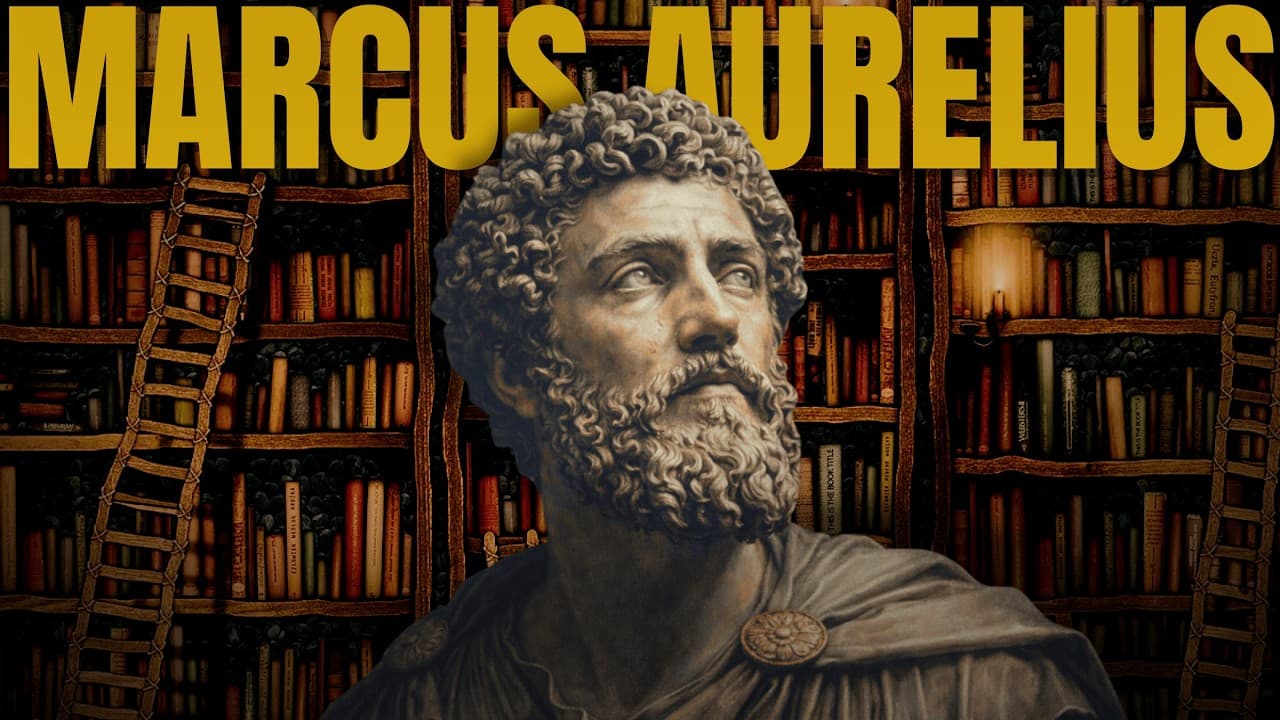
Nothing Lasts, and That Is the Point
Marcus Aurelius' Complete Philosophy
Enjoying the episode?
Occasional letters on philosophy, reading, and the examined life. No spam, ever.
Chapters
- 0:00:00Chapter 1: The Emperor Who Wrote to Himself
- 0:16:27Chapter 2: The Frontier and the Plague
- 0:32:53Chapter 3: The Stoic Inheritance
- 0:48:33Chapter 4: The Universe as a Living Whole
- 1:03:32Chapter 5: Virtue as the Only Good
- 1:18:07Chapter 6: Impressions, Assent, and the Discipline of Perception
- 1:32:58Chapter 7: Death, Impermanence, and the View from Above
- 1:48:44Chapter 8: Anger, Grief, and the Stoic Treatment of the Passions
- 2:04:40Chapter 9: The Social Animal and the Duty to Others
- 2:20:02Chapter 10: What Remains
Full Transcript
Chapter 01: The Emperor Who Wrote to Himself
Sometime in the winter of 170 or 171 CE, on the northern bank of the Danube River, the most powerful man in the world sat in a military tent and wrote a note to himself. Outside, the camp was quiet, or as quiet as a Roman legionary camp ever became: the low murmur of sentries, the distant sound of horses, the cold pressing against the leather walls. The emperor Marcus Aurelius, ruler of an empire stretching from Britain to Mesopotamia, from the Rhine to the Sahara, had spent the day doing what he had spent most of the past several years doing: managing a war he had never wanted, among soldiers he admired but could not fully become, against enemies who would not stop coming. The Antonine Plague was killing his troops faster than the Germanic tribes were. His treasury was strained. His body was failing. And in the lamplight, in Greek rather than Latin, he wrote not about strategy or supply lines but about the nature of the universe and how little any of this would matter in a hundred years.
The text he produced has no title that he gave it. Later tradition called it Ta eis heauton, which means roughly "to himself" or "things addressed to himself." We know it as the Meditations. It is one of the most unusual documents to survive from the ancient world. It is not a treatise. It is not a letter. It is not a diary in any conventional sense. It records almost nothing about the events of Marcus's life, the battles he fought, the decisions he made, the people he loved and lost. Instead, it is a philosophical exercise, a practice of self-discipline conducted in writing, in which the emperor returns again and again to the same set of convictions and tries to hold himself to them. The convictions are those of Stoic philosophy, a tradition already five centuries old by the time Marcus took it up. The practice is something more personal: the spectacle of a man who possesses everything the world can offer trying to persuade himself, over and over, that none of it matters except whether he acts with virtue.
This is the first and strangest thing about the Meditations. It was never meant to be read by anyone other than its author. There is no audience, no reader, no student being addressed. When Marcus writes, he writes to himself, and the tone is not that of a teacher instructing others but of a man reminding himself of what he already knows and keeps forgetting. The repetition that some readers find tedious is the entire point. Marcus does not repeat himself because he has run out of ideas. He repeats himself because the ideas keep slipping away under the pressure of daily life, and the writing is his way of pulling them back. It is, in Pierre Hadot's phrase, a series of spiritual exercises, a disciplined effort to transform not just what one thinks but how one sees, responds, and acts.
Marcus Aurelius was born on April 26, 121 CE, in Rome, into a family of Spanish origin that had risen to prominence over several generations. His birth name was Marcus Annius Verus. His father, Marcus Annius Verus III, died when Marcus was young, and the boy was raised primarily by his grandfather, Marcus Annius Verus II, who had served twice as consul and moved in the highest circles of Roman political life. The family was wealthy and well connected, but wealth and connection in second-century Rome carried obligations as heavy as their privileges. Roman aristocratic culture was intensely public. A boy born into this world was expected to master rhetoric, law, literature, and the complex choreography of political life. He was expected, eventually, to serve.
What set Marcus apart from other sons of the Roman elite was his temperament. The sources describe a boy who was serious beyond his years, inclined to study, and drawn to philosophy with an intensity that alarmed some of those around him. The Historia Augusta, a later and not always reliable source, reports that Marcus adopted the rough cloak of a philosopher as a teenager and slept on the ground until his mother persuaded him that a bed would not compromise his principles. Whether this specific anecdote is accurate matters less than what it illustrates: from an early age, Marcus was oriented not toward the pleasures and ambitions that his position made available but toward the question of how to live well, a question he would never stop asking.
His education was extraordinary, even by the standards of the Roman aristocracy. The emperor Hadrian, who had a keen eye for talent and a personal interest in Marcus's family, took notice of the boy early. Hadrian gave him the nickname Verissimus, meaning "most truthful," a play on his family name that also acknowledged something genuine in the boy's character. It was Hadrian who arranged for Marcus's eventual adoption into the imperial succession. In 138 CE, the dying Hadrian adopted Titus Aurelius Antoninus, a respected senator, on the condition that Antoninus in turn adopt two boys: Marcus, then sixteen, and Lucius Ceionius Commodus, the son of Hadrian's first choice for successor, who had died. Antoninus became emperor that same year and ruled for twenty-three years as Antoninus Pius. Marcus spent those years being trained, educated, and gradually prepared for the role that awaited him.
The tutors Hadrian and Antoninus provided were among the finest minds in the Roman world. Marcus Cornelius Fronto, the most celebrated Latin orator of his generation, taught Marcus rhetoric. Their surviving correspondence reveals a relationship of genuine warmth and intellectual seriousness. Fronto pushed Marcus to develop the powers of expression that any Roman statesman required. But rhetoric, for all its prestige, was not where Marcus's deepest interests lay. The turning point came when he encountered Stoic philosophy through a series of teachers who changed the direction of his life.
Junius Rusticus was perhaps the most important of these. A distinguished senator and philosopher, Rusticus introduced Marcus to the Discourses of Epictetus, the former slave whose teachings would become the single greatest philosophical influence on the Meditations. In Book One of the Meditations, where Marcus catalogues what he owes to each of his teachers, he thanks Rusticus for lending him his personal copy of the Discourses. This was not a casual loan. The Discourses of Epictetus, recorded by his student Arrian, were a rigorous and demanding exposition of Stoic philosophy as a way of life, not merely a set of doctrines to be studied but a daily practice of examining one's impressions, disciplining one's desires, and aligning one's will with the rational order of the universe. Marcus took this seriously. He took it more seriously than anything else.
Apollonius of Chalcedon, another Stoic teacher, reinforced the practical dimension of the philosophy. Marcus thanks him in Book One for demonstrating that one could be at once serious and relaxed, that the philosophical life did not require severity or ostentation but a quiet consistency of character. Alexander of Cotiaeum taught him grammar and literature. Sextus of Chaeronea, a grandson of Plutarch, showed him what benevolence and a settled household looked like. Claudius Maximus modeled dignity without pretension. Each teacher contributed something specific, and Marcus remembered each debt with precision and gratitude. The first book of the Meditations is, in effect, a map of the influences that made him who he was.
The shift from rhetoric to philosophy was decisive. Fronto's letters show a teacher who sensed he was losing his student to a rival discipline and tried, with increasing futility, to argue that rhetoric offered everything philosophy did and more. Marcus was gracious in his replies but unmoved. He had found what he was looking for, and it was not the art of persuasion. It was the art of living. The young man who had been trained to argue cases and compose speeches turned instead to the question of what kind of person he ought to be and what kind of life was worth living. This question, once it took hold, never released him.
The twenty-three years that Marcus spent under Antoninus Pius were, by all accounts, the most peaceful period of his life. He held public offices, as was expected, and married Faustina the Younger, Antoninus's daughter, around 145 CE. But the center of his existence was philosophical study and the cultivation of the inner life. He was being groomed for supreme power, and he knew it, and the Meditations suggests that the prospect weighed on him. The philosophical life he valued most was the life of contemplation, study, and moral self-examination. The life that awaited him was one of relentless public obligation.
On March 7, 161 CE, Antoninus Pius died, and Marcus Aurelius became emperor at the age of thirty-nine. His accession was remarkable for what he did immediately: he insisted on sharing the office with his adoptive brother, Lucius Verus, making Verus co-emperor with equal authority. This was unprecedented. The Roman principate had never formally had two emperors ruling simultaneously. Marcus's decision reflected both his Stoic commitment to justice, Verus had been raised with the same expectation of succession, and a practical recognition that the challenges ahead were too great for one man to manage alone.
Those challenges arrived without pause. Within months of Marcus's accession, the Parthian Empire invaded the Roman client state of Armenia and inflicted a devastating defeat on Roman forces in Syria. Lucius Verus was dispatched to command the eastern campaign, though in practice the war was directed by his generals. The Parthian war lasted until 166 CE and ended in Roman victory, but the returning legions brought something far worse than any military defeat. The Antonine Plague, almost certainly smallpox, swept through the empire beginning around 165 or 166 CE. It would rage intermittently for decades, killing perhaps five million people across the Roman world. Entire legions were hollowed out. Cities were depopulated. Tax revenue collapsed. The infrastructure of administration, which depended on a stable population of educated officials, was strained to the breaking point.
At the same time, the Germanic and Sarmatian tribes along the Danube frontier, sensing Roman weakness, launched a series of invasions that would define the rest of Marcus's reign. The Marcomanni, the Quadi, the Iazyges, and other peoples pushed across the river, raiding deep into Roman territory. In 167 CE, for the first time in centuries, barbarian forces penetrated into Italy itself, besieging the city of Aquileia at the head of the Adriatic. The shock was profound. Rome had not faced an invasion of Italy since the Cimbri and Teutones in the late second century BCE. Marcus, who had spent his life preparing to be a philosopher and an administrator, was forced to become a military commander.
He had no training for war. Nothing in his education had prepared him for the logistics of moving legions across difficult terrain, for the grim calculus of casualties and supply lines, for the experience of ordering men to their deaths. Yet he went to the frontier personally, and he stayed there. From roughly 168 CE until his death in 180, Marcus spent most of his time in the field, headquartered at places like Carnuntum and Vindobona along the Danube, directing what would become known as the Marcomannic Wars. He was often ill. Galen, the greatest physician of the age, attended him and recorded that Marcus suffered from chronic stomach ailments and relied on a daily dose of theriac, an opiate compound, to manage his pain.
It was in this setting, amid war and plague and physical suffering, that Marcus composed the Meditations. The text bears no dedication, follows no outline, and makes no argument in the way that a philosophical treatise does. It is a collection of notes, observations, and exhortations that Marcus wrote to keep himself philosophically and morally steady under conditions that tested every conviction he held. The emperor who could command armies and raise taxes and dispense justice over millions of lives wrote these notes not to display his learning or to instruct posterity but because he needed them. He needed to remind himself, every day, that the war, the plague, the dying soldiers, the dead children, and the crumbling frontier were not the things that ultimately mattered. What mattered was whether he could face them with clarity, with justice, and with the quiet composure that his philosophy demanded.
This is what makes the Meditations unlike any other text in ancient philosophy. We have Plato's dialogues, crafted with literary art for an audience of readers and students. We have Aristotle's treatises, dense with technical argument. We have Epictetus's Discourses, which are classroom lectures recorded by an admiring pupil. We have Seneca's letters, which are brilliant literary performances addressed to a friend but clearly intended for a wider readership. The Meditations is none of these things. It is a man talking to himself. It has the intimacy of something we were never supposed to see, and this is part of its power. When Marcus writes that he should stop complaining and get back to work, he is not performing humility for an audience. He is trying to get through the day. When he writes about the insignificance of fame, he is not posturing. He is the most famous man alive, and he is trying to convince himself that this does not matter. The gap between what the Meditations says and the circumstances under which it was written is what gives the text its extraordinary weight. Here is a man with every reason to believe that he is important, and he is spending his evenings trying to remember that he is not.
Chapter 02: The Frontier and the Plague
The Danube frontier in winter was a world designed to test the limits of endurance. The river itself, wide and gray, froze in the worst years, and the Germanic tribes sometimes crossed on the ice. The Roman camps were built for permanence but not for comfort: timber palisades, stone barracks where they could be managed, leather tents where they could not. The soldiers were professionals, most of them provincial recruits who had signed on for twenty-five years of service, and they lived with the discipline and the misery that such a commitment implied. Marcus arrived among them not as a warrior but as an administrator in armor, a man whose skills were in governance and philosophy, forced by circumstance into the role of military commander. He would spend the better part of twelve years in this world, far from Rome, far from the libraries and lecture halls where his mind was most at home.
The Marcomannic Wars, which consumed the last decade and a half of Marcus's reign, were not a single war but a rolling series of conflicts along the empire's northern border. The Marcomanni and the Quadi, Germanic peoples settled in what is now the Czech Republic and Slovakia, had long maintained an uneasy relationship with Rome. Pressure from other tribes further east, combined with the weakening of Roman frontier defenses during the Parthian war and the plague, pushed them to action. In the late 160s, a coalition of Germanic and Sarmatian tribes launched attacks across the Danube on a scale that Rome had not faced in generations. The penetration into Italy in 167, reaching as far as Aquileia, sent shockwaves through the Roman world. The frontier that had seemed secure for over a century was suddenly, terrifyingly, open.
Marcus's response was methodical and determined, if not brilliant in the military sense. He raised new legions, an expensive and logistically demanding process that required enrolling gladiators, slaves, and brigands when freeborn recruits were insufficient. He sold off imperial possessions to fund the war: Cassius Dio reports that Marcus held a two-month auction at the Forum of Trajan, selling palace furniture, gold vessels, silk garments, and even some of Faustina's jewelry and his own imperial robes. This was not mere symbolism. The treasury was genuinely strained. The plague had reduced tax revenue, the Parthian war had drained reserves, and the cost of maintaining large armies on the Danube was enormous. Marcus chose to sell his own property rather than raise taxes on a population already devastated by disease. Whether this reflects Stoic principle, political prudence, or both is difficult to separate, and perhaps the question is beside the point. The decision was characteristic of the man.
The wars themselves were grinding, unglamorous affairs. There were no decisive battles of the kind that Roman historians loved to narrate. Instead, there were long campaigns of attrition: Roman forces pushing across the Danube into tribal territory, establishing fortified positions, withdrawing when supply lines became untenable, then pushing again. Marcus directed these operations from his headquarters, relying on experienced generals for tactical execution while maintaining strategic oversight. The so-called Rain Miracle, depicted on the Column of Marcus Aurelius in Rome, illustrates the kind of story that attached to these campaigns. According to the account, a Roman legion was surrounded and dying of thirst when a sudden rainstorm provided water for the Romans and lightning scattered the enemy. Christians later claimed the miracle was the result of Christian soldiers' prayers. The column attributes it to Roman piety. What actually happened, if anything specific happened at all, is impossible to determine. The episode is useful mainly as evidence of how desperately people sought meaning in the chaos of frontier warfare.
Through all of this, the Antonine Plague continued its work. The disease, which modern scholars generally identify as smallpox based on Galen's clinical descriptions, was brought to the empire by soldiers returning from the Parthian campaign in 166 CE. Galen, who was in Rome when the plague arrived and later attended Marcus at the front, described fever, diarrhea, and a pustular skin eruption that appeared around the ninth day of illness. Mortality estimates are necessarily speculative, but the consensus among modern historians is that the plague killed between seven and ten percent of the empire's population during its most intense phases, with higher rates in cities and military camps where crowding facilitated transmission. Some scholars have argued for even higher figures. The impact on the army was severe. Legions that were already understrength from the Parthian war were further depleted, and the difficulty of replacing losses compounded with each year of campaigning.
The plague was not merely a military and economic catastrophe. It was an existential one. In a world without germ theory, epidemic disease was experienced as divine punishment, cosmic disorder, or both. The traditional Roman response to plague included public rituals of purification and appeals to the gods. Marcus participated in these rituals, as any Roman emperor would, regardless of his personal philosophical convictions. The relationship between his Stoic philosophy and traditional Roman religion was pragmatic rather than confrontational. He did not see the gods of Roman civic religion as incompatible with the Stoic conception of a rational, providential universe. He saw public religious observance as part of his duty as emperor, a duty that Stoic philosophy itself demanded he fulfill. The plague tested this framework. If the universe is rationally ordered, if everything happens according to providence, then what is the meaning of a disease that kills indiscriminately, that takes children and soldiers and philosophers alike? Marcus's answer, worked out in the pages of the Meditations, was not that the plague was good, but that the question itself was misconceived. The universe does not owe us an explanation for individual suffering. Our task is not to understand why this particular event happened but to respond to it with virtue.
The personal dimensions of Marcus's suffering were as severe as the public ones. Marcus and Faustina the Younger were married for over thirty years, and their marriage produced at least fourteen children. Of these, only five or six survived to adulthood. The rest died in infancy or childhood, a rate of loss that was tragically common in the ancient world but no less devastating for being common. Marcus does not write about his dead children directly in the Meditations. There is no passage where he names a child who has died or describes his grief. Instead, the theme of impermanence runs through the entire text like a low continuous note, and the reader who knows the biographical context cannot help but hear in Marcus's reflections on loss and transience the echo of very specific, very personal losses. When he writes about returning what has been given, about the inevitability of dissolution, about the foolishness of clinging to what cannot be held, he is not speaking abstractly. He is speaking from a life in which the things he loved were taken from him repeatedly, and in which the philosophy he practiced demanded that he accept each loss as natural.
Faustina herself died in the winter of 175 CE, in a small village called Halala in Cappadocia, during Marcus's journey to the eastern provinces. The circumstances of the journey were themselves dramatic. Avidius Cassius, one of Marcus's most capable generals, had declared himself emperor in the spring of 175, apparently on the basis of a false rumor that Marcus had died. The revolt collapsed quickly when Marcus was revealed to be alive and when Cassius's own officers assassinated him. Marcus's response to the revolt was notable for its restraint. He expressed sorrow rather than satisfaction at Cassius's death. He refused to read Cassius's private correspondence, ordering it burned so that he would not discover which senators and officials had supported the usurper. He traveled east to reassert his authority not through punishment but through presence and clemency. Cassius Dio reports that Marcus wished Cassius had survived so that he could demonstrate the virtue of forgiveness. Whether or not this account is embellished, the impulse it describes is consistent with everything we know about Marcus's character.
It was during this eastern journey that Faustina died. Marcus honored her extravagantly: he had the village where she died renamed Faustinopolis, he petitioned the Senate to deify her, and he established a charitable fund for girls in her name. The Historia Augusta and later sources spread rumors about Faustina's infidelity, alleging affairs with gladiators and sailors, and even suggesting that Commodus was not Marcus's biological son. Modern historians are largely skeptical of these claims, which fit a well-established pattern in Roman historiography of attacking imperial women through sexual slander. Marcus's own references to Faustina in the Meditations are warm and respectful. In Book One, he thanks the gods for giving him a wife who was "so obedient, so affectionate, so unaffected." The word translated as "obedient" carries connotations in the Greek that are closer to "compliant" or "agreeable." Whether this represents the full truth of a complex marriage or Marcus's public face for a relationship he chose not to examine in writing is something we cannot know.
The question of Commodus is perhaps the most painful problem in Marcus's legacy. Commodus, born in 161 CE, was the first Roman emperor in nearly a century to be succeeded by his biological son. The practice of adoptive succession, in which each emperor chose the most capable man available as his heir, had produced a remarkable sequence of competent rulers: Nerva, Trajan, Hadrian, Antoninus Pius, and Marcus himself. Marcus broke this pattern. He designated Commodus as his successor, made him co-emperor in 177, and left the empire in his hands upon his death in 180. Commodus would go on to become one of the most disastrous rulers in Roman history, a man who preferred the arena to the Senate, who fought as a gladiator in public spectacles, who renamed the months of the year after his own titles, and who was eventually strangled in his bath by a conspiracy of his own courtiers in 192 CE. His reign is generally considered the end of the Pax Romana and the beginning of the long crisis that would eventually transform the Roman Empire beyond recognition.
Why did Marcus choose Commodus? The question has troubled historians and philosophers for centuries. The most straightforward answer is that Marcus had limited options. The adoptive succession model had worked brilliantly, but it had worked in part because the previous four emperors had no surviving sons of their own. The choice to adopt was, in each case, partly a choice and partly a necessity imposed by biology. Marcus was the first emperor in this sequence who actually had a son, and the principle of dynastic succession, while not constitutionally mandated, carried enormous political weight in Roman culture. Bypassing Commodus in favor of an adopted heir would have risked civil war, since Commodus had his own supporters and his own claim to legitimacy. Marcus may have believed, or hoped, that the philosophical education he had arranged for Commodus would take hold. Cassius Dio suggests that Marcus was aware of his son's deficiencies but chose to trust in the possibility of improvement. If so, it was the most consequential misjudgment of his life.
There is another possibility, less comfortable but worth considering. Marcus's Stoic philosophy taught that a person's character is ultimately their own responsibility, that no one can be compelled to virtue, and that the wise person does what is within their power and accepts what is not. If Marcus genuinely believed these principles, then he may have understood that he could not guarantee his son's virtue any more than he could guarantee the outcome of a battle or the course of a plague. He could provide education, example, and opportunity. He could not provide wisdom. That was something Commodus would have to achieve or fail to achieve on his own. This is a philosophically coherent position. It is also, from the perspective of millions of people who would live under Commodus's rule, a deeply inadequate one. The gap between philosophical coherence and political responsibility is one of the central tensions in Marcus's life, and it does not admit of easy resolution.
The Fronto correspondence, which survives in fragmentary form, gives us a glimpse of Marcus before the crises consumed him. The letters reveal a young man who is playful, affectionate, and often anxious about his health. He writes to Fronto about his studies, his ailments, his family, and his love for his old teacher. There is a gentleness in these letters that the Meditations, with its relentless self-discipline, rarely allows. The man who wrote the Meditations is recognizably the same person who wrote to Fronto, but something has hardened, or perhaps focused, under the pressure of events. The warmth is still there, but it is directed inward, toward the project of maintaining moral integrity in conditions that make moral integrity extraordinarily difficult.
The years on the frontier were, by any measure, the crucible in which Marcus's philosophy was tested. He was not a young man discovering Stoicism in the comfort of a Roman villa. He was a middle-aged emperor, already ill, burying his children, watching his soldiers die of plague, fighting a war that seemed to have no end, and holding himself each night to the same standard: act justly, see clearly, accept what comes. The Meditations was the tool he used to maintain that standard. It was not written in tranquility. It was written in the space between crises, in the brief hours when the emperor could set aside the demands of the empire and attend to the demands of his own soul.
Chapter 03: The Stoic Inheritance
Around 300 BCE, a merchant from the city of Citium on the island of Cyprus lost everything in a shipwreck. His name was Zeno, and the cargo that went to the bottom of the Mediterranean was his livelihood. He washed up in Athens, the intellectual capital of the Greek world, and wandered into a bookshop. There he encountered the writings of Socrates, and something shifted. He began studying philosophy with the Cynic teacher Crates, then moved on to study with teachers from the Megarian and Academic schools. Eventually, he began teaching on his own, gathering students in a public colonnade in the Athenian agora known as the Stoa Poikile, the Painted Porch. His followers came to be called Stoics, after the place where they met. The school Zeno founded would endure for nearly five centuries, producing some of the most rigorous and influential philosophy in the Western tradition.
This is the tradition Marcus Aurelius inherited. He did not invent Stoicism. He did not significantly modify it as a philosophical system. What he did was practice it, with a seriousness and a sustained attention that made him, paradoxically, the most widely read Stoic philosopher despite being, in strictly theoretical terms, the least original. To understand what Marcus was doing in the Meditations, we need to understand what he was working with: the philosophical framework he received from his teachers, which they in turn had received from a chain of transmission stretching back to Zeno's Athens.
Stoicism was, from its founding, a comprehensive philosophical system divided into three interdependent parts: physics, logic, and ethics. The Stoics used various metaphors to describe the relationship among these parts. One likened philosophy to an egg: the shell is logic, the white is ethics, and the yolk is physics. Another compared it to a garden: the fence is logic, the fruit is ethics, and the soil and trees are physics. Another imagined it as a living animal: the bones and sinews are logic, the flesh is ethics, and the soul is physics. The metaphors vary, but the point is consistent. You cannot have one part without the others. Ethics without physics is a set of rules without foundations. Physics without logic is speculation without rigor. The system holds together as a whole, or it does not hold together at all. This is crucial for understanding Marcus, because the popular reception of Stoicism almost always extracts the ethics and discards the rest. Marcus did not do this. His Meditations presupposes the entire system, even when he does not make the presuppositions explicit.
The most important figure in the development of Stoic thought after Zeno was Chrysippus of Soli, who became the third head of the Stoic school around 232 BCE. Ancient sources credited Chrysippus with writing over seven hundred works, and they said of him that without Chrysippus, there would have been no Stoa. He was the systematizer, the philosopher who took the insights of Zeno and Cleanthes, the second head of the school, and built them into a rigorous philosophical architecture. Chrysippus developed the Stoic theory of logic, including a propositional logic that was in some respects more sophisticated than Aristotle's syllogistic. He elaborated the Stoic theory of physics, including the doctrines of fate, providence, and the conflagration. And he refined the ethical theory, clarifying the distinction between goods, evils, and indifferents with a precision that later Stoics would rely on. Almost all of Chrysippus's works are lost. We know his arguments primarily through fragments preserved by later authors, many of them hostile, and through the reports of doxographers who summarized philosophical positions for reference. This loss is one of the great tragedies of ancient intellectual history. We possess detailed summaries but almost none of the original argumentation. What we do know suggests a thinker of extraordinary precision and range, a philosopher who could argue both sides of a question with equal rigor and who insisted on following logical consequences wherever they led, even when the conclusions were counterintuitive or socially uncomfortable.
Cleanthes, who led the school between Zeno and Chrysippus, is remembered primarily for his Hymn to Zeus, one of the few substantial texts by an early Stoic that survives intact. The hymn addresses Zeus not as the anthropomorphic deity of Greek mythology but as the rational principle governing the cosmos. "Most glorious of immortals, many-named, all-powerful forever, Zeus, first cause of nature, governing all things by law," Cleanthes writes. The Zeus of Stoic theology is not a person in the sky. It is logos, the rational order of the universe itself, and Cleanthes's hymn is both a prayer and a philosophical statement, an expression of reverence for the rational structure of reality. Marcus would have known this hymn. The spirit that animates it, the identification of God with nature and reason, pervades the Meditations.
Between the founding generation and Marcus Aurelius, Stoicism evolved considerably. The so-called Middle Stoa, represented by figures like Panaetius and Posidonius in the second and first centuries BCE, adapted Stoic doctrine for a Roman audience and softened some of the more radical positions of the early school. Panaetius, who spent time in the circle of Scipio Aemilianus in Rome, placed greater emphasis on practical ethics and social duty, making Stoicism more palatable to Roman aristocrats who found the extreme positions of the early Stoics impractical. Posidonius, a polymath and traveler, expanded Stoic natural philosophy and integrated elements from Platonic and Aristotelian thought. By the time Stoicism reached Marcus, it had passed through several generations of adaptation and synthesis.
But the figure who mattered most to Marcus was Epictetus. Born around 50 CE in Hierapolis, a city in what is now western Turkey, Epictetus was enslaved as a young man and brought to Rome, where he served in the household of Epaphroditus, a powerful freedman and secretary to the emperor Nero. At some point during his enslavement, Epictetus studied Stoic philosophy under Musonius Rufus, the most prominent Stoic teacher in Rome. He was eventually freed, and after the emperor Domitian expelled philosophers from Rome in 93 CE, Epictetus settled in Nicopolis in northwestern Greece, where he taught for the rest of his life.
Epictetus wrote nothing. What we have of his teachings was recorded by his student Arrian of Nicomedia, who attended the lectures and compiled them into the Discourses, originally in eight books, of which four survive, and the Enchiridion, a condensed handbook of Stoic practice. The Discourses are not polished literary compositions. They have the rough energy of spoken teaching: vivid, colloquial, sometimes harsh, always direct. Epictetus was not interested in theoretical niceties. He was interested in transformation. His central message, repeated in a hundred different ways, was that we must distinguish between what is "up to us" and what is "not up to us." Our judgments, our desires, our choices: these are up to us. Our bodies, our reputations, our possessions, the actions of others: these are not. Freedom, for Epictetus, consists in aligning our will exclusively with what is in our power and releasing our attachment to everything else.
Marcus encountered Epictetus's Discourses through his teacher Junius Rusticus, and the impact was decisive. The Meditations references Epictetus more frequently than any other philosopher. Marcus adopted Epictetus's framework so thoroughly that it is sometimes difficult to tell where Epictetus ends and Marcus begins. The distinction between what is up to us and what is not, the emphasis on examining our impressions before assenting to them, the insistence that external events are morally neutral and that only our responses to them carry moral weight: all of this comes from Epictetus, filtered through Marcus's own temperament and situation.
Yet the relationship is not one of simple discipleship. Marcus and Epictetus were separated by everything except their philosophy. Epictetus was a former slave who taught in a small Greek town and who, according to tradition, was lame, possibly from abuse by his former master. Marcus was the ruler of the largest empire in the Western world, surrounded by courtiers, generals, and supplicants. Epictetus addressed students who were trying to become better people in their private lives. Marcus was trying to become a better person while simultaneously waging wars, administering provinces, dispensing justice, and managing the politics of an imperial court. The scale is entirely different, and this difference shapes the Meditations in ways that distinguish it from the Discourses. Marcus is more preoccupied with duty, with the obligations that come from holding power, with the tension between philosophical detachment and political responsibility. Epictetus could advise his students to withdraw from situations that compromised their virtue. Marcus could not withdraw. He was emperor. The role was not optional.
Seneca, the other great Roman Stoic, offers a different kind of comparison. Lucius Annaeus Seneca, born around 4 BCE in Cordoba and raised in Rome, was a politician, playwright, essayist, and advisor to the emperor Nero. His Letters to Lucilius and his moral essays, including On the Shortness of Life, On Anger, and On Tranquility of Mind, constitute the largest surviving body of Roman Stoic writing. Seneca was a brilliant prose stylist, and his works have a literary quality that the Meditations, with its rough, private, unpolished character, does not attempt. Seneca also had a complicated relationship with his own philosophy. He was one of the richest men in Rome, a fact that his critics, both ancient and modern, have pointed to as evidence of hypocrisy. How can you preach Stoic indifference to wealth while accumulating a fortune? Seneca's response, articulated in various places in his letters, was that Stoicism does not prohibit possessing wealth. It prohibits being possessed by it. The wise person can have money without being attached to it. Whether Seneca himself achieved this detachment is an open question.
Marcus does not cite Seneca directly in the Meditations, and there is no strong evidence that Seneca was a major influence on his philosophical formation. This is somewhat surprising given that Seneca had died only about fifty years before Marcus began writing, and his works were widely read in educated Roman circles. The two thinkers arrived at similar conclusions by somewhat different routes, and their temperaments were markedly different. Seneca was extroverted, rhetorical, and performative. His philosophy is addressed outward, to readers and friends, with the full apparatus of literary persuasion. Marcus was introverted, austere, and private. His philosophy is addressed inward, to himself, with no interest in persuading anyone else. The contrast is instructive. Seneca shows us what Stoic philosophy looks like when it is trying to convince. Marcus shows us what it looks like when it is trying to hold.
The differences between Greek and Roman Stoicism are worth noting briefly. The founders of the school, Zeno, Cleanthes, and Chrysippus, were rigorous theorists who developed elaborate accounts of physics, logic, and ethics as interconnected systems. They were interested in the technical details: the precise nature of propositions, the mechanics of fate and free will, the physical composition of the soul, the logical structure of valid arguments. The Roman Stoics, particularly Seneca, Epictetus, and Marcus, were less interested in these technical matters and more interested in practical application. How do I live well? How do I respond to misfortune? How do I fulfill my duties? This shift in emphasis is sometimes described as a decline from theoretical rigor to practical wisdom. A more generous reading is that the Roman Stoics were doing what philosophers have always done when they inherit a mature system: they were applying it, testing it against experience, and discovering which parts were most useful for the challenges of their own time and place. And it is worth noting that even the Roman Stoics who seem uninterested in physics and logic rely on the conclusions of those disciplines constantly. When Marcus invokes the rational order of the cosmos, he is invoking Stoic physics. When he examines the logical structure of his own impressions, he is invoking Stoic logic. The theoretical foundations are present even when they are not the subject of explicit discussion.
For Marcus, the inheritance was not purely intellectual. It was personal. His teachers were not abstractions in a textbook. They were men he had sat with, listened to, argued with, and loved. When he writes in Book One of the Meditations about what he learned from each teacher, the specificity is striking. From Rusticus he learned not to be distracted by philosophical showmanship. From Apollonius he learned to be the same person in moments of crisis and moments of calm. From Alexander the grammarian he learned not to correct other people's language in a way that humiliates them but to model correct usage by example. From Sextus he learned tolerance and family devotion. These are not abstract principles. They are the habits of specific people, observed over years of close contact, and internalized into a way of being. Marcus also thanks his adoptive father, Antoninus Pius, at unusual length, praising his mildness, his consistency, his indifference to flattery, and his attention to practical governance. The portrait of Antoninus in Book One is in many ways a portrait of the ruler Marcus wanted to become. The Stoic tradition came to Marcus not as a system of propositions but as a lineage of character, a chain of men who tried to live according to reason and passed the practice along to those who followed.
Chapter 04: The Universe as a Living Whole
The Stoics believed that the universe is alive. Not alive in a metaphorical sense, not alive as a poetic conceit, but alive in the most literal and radical way they could conceive. The cosmos, in Stoic physics, is a single, continuous, rational organism. Every stone, every leaf, every star, every human mind is a part of this organism, connected to every other part by a pervasive, intelligent substance that the Stoics called pneuma, a word that means "breath" or "spirit" and that referred to a blend of fire and air that penetrates all matter and gives it structure, cohesion, and, at its highest levels, rational awareness. This is the cosmological foundation on which everything else in Stoic philosophy rests. Without it, the ethics make no sense. Without the conviction that the universe is a rational whole, the Stoic claim that virtue consists in "living according to nature" is just a slogan. With it, the claim becomes a precise philosophical thesis: to live according to nature is to live in harmony with the rational principle that governs all things.
The Stoics called this rational principle logos, a Greek word with a range of meanings so wide that no single English translation captures it. Logos can mean "word," "reason," "account," "proportion," or "rational principle." For the Stoics, logos was the active, intelligent force that shapes and directs the cosmos. It is identical with nature, identical with fate, identical with providence, and identical with God. These are not four different things. They are four names for the same thing, viewed from different angles. When the Stoics say "God," they do not mean a person separate from the world who created it and watches over it from outside. They mean the rational order inherent in the world itself. God is the universe thinking. This is a materialist position, but it is not the kind of materialism that reduces everything to dead matter in mechanical motion. Stoic materialism is vitalist: matter is alive, matter is intelligent, matter is divine. There is no distinction between the natural and the supernatural because there is nothing above or beyond nature. Nature is all there is, and nature is rational.
This vision owes something to the pre-Socratic philosopher Heraclitus of Ephesus, who lived in the late sixth and early fifth centuries BCE. Heraclitus, whose writings survive only in fragments, argued that the fundamental principle of reality is change. "Everything flows," he said, or something close to it. The river metaphor attributed to him, that you cannot step into the same river twice because the water is always different, became one of the most famous images in Western philosophy. But Heraclitus did not think that change meant chaos. He believed that a rational order, which he also called logos, governed the process of change, and that this order was identical with fire, which he saw as the element that best embodied the unity of creation and destruction. The Stoics adopted much of this. They took Heraclitus's logos, his emphasis on flux, his identification of the cosmic principle with fire, and built them into their own system. Marcus quotes or alludes to Heraclitus repeatedly in the Meditations, more frequently than any other pre-Stoic thinker. "Time is a river of things that come to be, a violent current," Marcus writes in Book Four, in a passage that echoes Heraclitus directly. "No sooner is a thing seen than it has been swept away, and something else is being carried past, and that too will be swept away." The conviction that reality is constantly changing, that nothing is permanent, that stability is an illusion we impose on a world that is always in motion, is as much Heraclitean as it is Stoic. Heraclitus also held that opposites are necessary to each other: you cannot know health without sickness, rest without weariness, satiety without hunger. The Stoics absorbed this into their own framework. The apparent evils in the cosmos are not failures of the rational order. They are necessary parts of it. Without winter there is no spring. Without death there is no life.
Pneuma, the substance that holds the Stoic cosmos together, deserves closer attention. The Stoics were thoroughgoing materialists in the sense that they believed only bodies are real. Even the soul, even God, even qualities like justice and courage, are bodies for the Stoics, composed of the same basic matter as everything else. Pneuma is the active principle in this matter. It pervades all things, but it operates at different levels of tension and complexity. In inanimate objects like stones, pneuma provides hexis, meaning "holding" or "cohesion," the structural integrity that keeps the object from falling apart. In plants, pneuma operates at a higher level called phusis, meaning "nature" or "growth," which allows for nutrition, growth, and reproduction. In animals, pneuma manifests as psyche, meaning "soul," which adds sensation and impulse to the capacities of plants. And in human beings, pneuma reaches its highest expression as logos, rational thought, the ability to form concepts, make judgments, and reflect on one's own experience. This is not a hierarchy of separate substances. It is a hierarchy of complexity within a single continuum. The logos in a human mind is made of the same stuff as the hexis in a rock. The difference is in the degree of organization, not in the fundamental nature of the material.
Marcus engages with this cosmology throughout the Meditations, though he does so less as a theoretical physicist than as a man trying to draw practical consequences from cosmological commitments. The most revealing passages are those where he confronts the fundamental alternative: providence or atoms. This is Marcus's shorthand for the central question of ancient metaphysics as it appeared from a Stoic perspective. Either the universe is governed by a rational providence, as the Stoics claimed, or it is a random collision of atoms in a void, as the Epicureans claimed. These are the two options Marcus considers. Either logos pervades everything and everything happens for a reason, or everything is chance and nothing means anything at all.
What is remarkable about Marcus's treatment of this dilemma is that he does not try to prove that providence is true. He does not mount a philosophical argument against Epicurean atomism. Instead, he explores the practical consequences of each possibility and shows that they converge on the same ethical conclusion. If the universe is governed by providence, then whatever happens is part of a rational plan, and it would be absurd and impious to resist it. Your task is to play your part in the whole with grace and discipline. If the universe is nothing but atoms, if there is no plan and no meaning, then the human mind is the only source of order in a chaotic world, and your task is to exercise that order: to think clearly, to act justly, to maintain your rational composure against a backdrop of meaningless flux. Either way, the right response is the same: virtue. This is an extraordinarily powerful philosophical move. It makes the ethical imperative independent of the metaphysical question. You do not need to know whether the universe cares about you in order to know how to act. The answer is the same in both cases.
That said, Marcus's heart is clearly with providence. The atomist alternative appears in the Meditations as a kind of worst-case scenario, a floor beneath which things cannot fall. Even if everything is atoms and void, even if there is no divine plan, you can still be a decent person. But the providential view is the one Marcus returns to with warmth and conviction. He addresses the cosmos as something that can be spoken to: "Everything suits me that suits your designs, O my universe." He describes individual events as flowing from a single source, a unified rational cause that produces everything that happens, including the things that seem harmful or unjust from a limited perspective. The analogy he favors is organic. What appears to be a defect in an individual part may serve the health of the whole, just as the amputation of a limb may serve the health of the body. We cannot see the whole plan because we are too small a part of it. Our job is not to see the plan but to trust it and to act in accordance with it.
The Stoic doctrine of ekpyrosis, the conflagration, adds another dimension to this cosmology. The Stoics believed that the cosmos goes through a cycle of creation and destruction. At the end of each cycle, everything is consumed by fire, returning to the pure, undifferentiated state of the divine logos. Then the cycle begins again, and the same events unfold in exactly the same order. This is the Stoic version of eternal recurrence, and it carries profound implications for the understanding of death and impermanence. If everything recurs, then nothing is truly lost. Every person who has ever lived will live again, in exactly the same way. Every event that has ever occurred will occur again. Marcus alludes to this doctrine when he describes the repetitive nature of human experience: the same dramas, the same ambitions, the same conflicts, repeated endlessly across the ages. Whether he takes the conflagration literally or as a metaphorical expression of the cyclical nature of change is not entirely clear. The Meditations is not a work of systematic theology. It is a work of practice, and Marcus uses cosmological ideas instrumentally, as tools for maintaining philosophical composure, not as propositions to be defended in argument. Yet the fact that he keeps returning to these cosmological themes, that he cannot simply state the ethical conclusions and move on, suggests that the metaphysical questions genuinely troubled him. The Meditations is not a text of serene certainty. It is a text of disciplined uncertainty, of a mind returning again and again to the same foundational questions because the answers matter for everything else.
The contrast with Epicurean atomism is important for understanding what the Stoics were rejecting. Epicurus, writing about a generation after Zeno, proposed a radically different picture of reality. For Epicurus, the universe consists of atoms and void. There is no logos, no providence, no rational plan. The gods exist but are indifferent to human affairs, living in a state of perfect tranquility in the spaces between worlds. The soul is a configuration of atoms that dissolves at death. There is no afterlife, no judgment, no cosmic meaning. Epicurus drew ethical conclusions from this physics that were in some ways similar to the Stoic conclusions: both schools emphasized tranquility, both schools argued that the wise person is self-sufficient, both schools taught that most of what people fear is based on false beliefs. But the foundations were entirely different. The Stoics found meaning in the rational order of the cosmos. The Epicureans found meaning in the absence of cosmic order, in the freedom that comes from knowing that no one is watching and no one is keeping score.
For Marcus, the Epicurean alternative was not simply an intellectual option to be weighed dispassionately. It was a threat. If atomism is true, then the entire Stoic framework collapses: there is no logos to live in accordance with, no providence to trust, no rational whole to serve. The Meditations returns to this possibility with an anxiety that is palpable beneath the measured prose. Marcus does not resolve the anxiety. He manages it. He manages it by showing that even in the worst case, even if Epicurus is right and the universe is meaningless, the practice of virtue remains coherent. You can still choose to be rational. You can still choose to be just. You do not need the universe's permission to be a good person.
This cosmological framework also shapes Marcus's understanding of the relationship between the individual and the whole. The Stoics taught that each human being is a part of the cosmic organism, connected to every other part through the shared logos that pervades all things. Marcus returns to this idea frequently. He compares human beings to the limbs of a single body. When one person acts against another, it is like a hand attacking a foot: the parts are damaging the whole to which they both belong. The political implications of this organic cosmology are significant and will be explored in a later chapter, but the metaphysical point is what matters here. The individual human mind is not a separate, isolated entity. It is a fragment of the universal logos, a spark of the same divine fire that governs the stars. This is why virtue, for the Stoics, is not arbitrary. It is not a set of rules imposed from outside. It is the natural expression of what we are. To act with reason is to act in harmony with our own deepest nature, which is also the nature of the cosmos. To act against reason is to be at war with ourselves and with reality simultaneously.
This is the landscape of meaning within which Marcus Aurelius thought and wrote. The universe is not a stage on which human dramas play out. It is a living being of which human dramas are a vanishingly small part. The stars are not decorations. They are made of the same logos that makes your thoughts possible. The plague that is killing your soldiers is not a punishment or a random catastrophe. It is a transformation of matter from one form to another, governed by the same rational necessity that governs the seasons. This may sound cold. It is not intended to be. For Marcus, the recognition that everything is connected, that everything is part of one living whole, was a source not of indifference but of a strange and quiet reverence.
Chapter 05: Virtue as the Only Good
Imagine a man who holds the most powerful office in the known world. He can command armies, reshape laws, distribute fortunes, elevate or destroy careers with a word. Every pleasure the ancient world had to offer is available to him. And he sits down and writes, in his private notebook, that none of it is good. Not the power, not the pleasure, not the wealth, not the fame, not even his own health or the lives of the people he loves. The only thing that is genuinely good, the only thing that can make a human life truly successful, is virtue. Everything else is, in the technical Stoic term, adiaphora, meaning "indifferent," the things that do not constitute or diminish genuine well-being. This is the central claim of Stoic ethics, and it is far more radical than most people realize.
The word "virtue" in modern English has connotations of sexual propriety or vague moral goodness that are entirely misleading in a Stoic context. The Greek word is arete, which means something closer to "excellence" or "the quality of being what a thing is meant to be." A knife has arete when it cuts well. An eye has arete when it sees clearly. A human being has arete when the distinctively human capacity, reason, functions at its highest level. For the Stoics, virtue in this sense is fourfold. Wisdom, sophia, is the knowledge of what is truly good, truly evil, and truly indifferent. Justice, dikaiosyne, is the disposition to give each person what they are owed and to act rightly in social relationships. Courage, andreia, is the capacity to endure what must be endured and to face what must be faced without being deflected by fear. Temperance, sophrosyne, is the regulation of impulse, the ability to desire and avoid in accordance with reason rather than appetite. These four virtues are not separate capacities that can be possessed independently. The Stoics held that they are unified: to truly have one is to have all, and to lack one is to lack all. The wise person is simultaneously just, courageous, and temperate, because all four virtues flow from the same root, which is the correct understanding of reality. This unity of virtue thesis was another point of controversy with other schools. Aristotle had allowed that a person could be brave without being particularly wise, or temperate without being notably just. The Stoics denied this. Their argument was that genuine courage, for instance, requires knowing what is truly worth fearing and what is not, and this knowledge is wisdom. Without wisdom, what looks like courage might be mere recklessness or stubbornness.
The claim that virtue is the only good has a precise corollary: vice is the only evil. Sickness is not evil. Poverty is not evil. Pain is not evil. Death is not evil. These things are naturally to be avoided, and the Stoics did not pretend otherwise. They called them "dispreferred indifferents." In the same way, health, wealth, comfort, and long life are "preferred indifferents." The terminology is important because it preserves a crucial distinction. To say that health is "preferred" is to acknowledge that it is natural and reasonable to pursue it. To say that it is "indifferent" is to deny that it has any bearing on whether your life goes well in the deepest sense. You can be perfectly healthy and perfectly vicious. You can be deathly ill and perfectly virtuous. The two axes are independent. Happiness, in the Stoic sense of eudaimonia, meaning "flourishing" or "living well," depends entirely on the exercise of virtue and not at all on the presence or absence of preferred indifferents.
The Stoic position was controversial in antiquity, and it remains controversial. The Peripatetics, followers of Aristotle, objected that it was psychologically unrealistic and morally perverse to claim that a person being tortured could be happy. The Epicureans objected that it ignored the obvious role of pleasure in human life. Even within the Stoic school, there were debates about how strictly the indifferents framework should be applied. Panaetius, the Middle Stoic who adapted Stoicism for a Roman audience, softened the distinction between goods and preferred indifferents in ways that some scholars have argued amount to a de facto abandonment of the original position. But the orthodox view, the view that Marcus inherited through Epictetus and that pervades the Meditations, holds firm.
This is where the divergence from Aristotle is most visible. Aristotle agreed that virtue is necessary for happiness. But he argued that it is not sufficient. A person also needs certain external goods: health, wealth, friends, good fortune, a reasonable lifespan. A virtuous person who is tortured to death on the rack is not, in Aristotle's view, happy, no matter how virtuous they remain under torture. The Stoics disagreed explicitly and emphatically. The virtuous person on the rack is happy, because happiness consists in virtue and in nothing else. The rack is a dispreferred indifferent. It is something no rational person would choose. But it does not touch the part of the person that matters: the rational soul, the capacity for moral judgment, the ability to maintain virtue under pressure.
Marcus's engagement with this framework in the Meditations is not theoretical. It is personal and urgent. He is a man who possesses all the preferred indifferents in abundance: power, wealth, status, the respect of the Roman world. And he is a man who is losing them. His children are dying. His body is failing. His empire is under siege. The philosophy tells him that none of these losses are real losses, that the only thing he can lose is his virtue, and that this is the one thing that no one can take from him. Whether Marcus fully believed this, whether anyone can fully believe this, is one of the questions that makes the Meditations so compelling. There are moments in the text where the conviction rings clear and strong. There are other moments where the repetition itself betrays a kind of desperation, as though Marcus is trying to talk himself into a position that his experience keeps undermining.
The Stoic theory of value included an important technical distinction between two kinds of right action. The first is kathēkon, often translated as "appropriate action" or "proper function," pronounced roughly as ka-TAY-kon. A kathēkon is an action that accords with nature and can be rationally justified. Eating when hungry, taking care of one's health, serving one's community, honoring one's parents: these are all kathēkonta. They are actions that any rational being in the relevant circumstances would reasonably perform. The second kind of right action is katorthōma, or "perfect action," which is the same action performed with full wisdom, with perfect understanding of its place in the rational order, and with the correct inner disposition. The difference is not in what you do but in how you do it and why. A prokoptōn, meaning one who is "making progress," a term the Stoics used for anyone who was studying and practicing philosophy but had not yet achieved perfect wisdom, might perform all the same outward actions as a sage but without the sage's complete understanding and stability of character. The actions would be appropriate. They would not be perfect.
This distinction mattered because the Stoics held that perfect virtue, the state of being a sophos or wise person, was extraordinarily rare. Some Stoics questioned whether it had ever been achieved by any actual human being. Socrates and Heracles were sometimes offered as possible examples, but even these cases were debated. The sage was an ideal, a standard of measurement, not a description of any known person. Marcus would never have claimed to be a sage. The entire Meditations is the work of a prokoptōn, a person making progress, struggling daily with the gap between what he knows to be right and what he actually manages to do. "Not to be sidetracked by my interest in rhetoric. Not to write about theoretical questions, or deliver little moralizing sermons, or pose as the ascetic or the philanthropist," Marcus writes to himself in Book One, listing the temptations he is trying to resist. The self-criticism is relentless. He knows the theory. He is trying to live it. And the trying is the practice. The Stoics did not expect perfection. They expected effort.
Living "according to nature," the Stoic formula for the good life, has been misunderstood more than almost any other phrase in ancient ethics. It does not mean living in the wilderness, rejecting civilization, or following instinct. The Stoics were emphatically not primitivists. The "nature" they had in mind is rational nature, the nature that distinguishes human beings from animals and connects human beings to the cosmos. To live according to nature is to exercise reason well: to perceive accurately, to judge correctly, to act justly, and to accept the rational order of the universe as it actually is rather than as we wish it to be. Nature, for the Stoics, is not something to return to. It is something to realize. It is the potential for rational excellence that exists in every human being and that the practice of philosophy aims to develop.
Marcus applied this framework concretely. When he asks himself, in Book Five, why he finds it so hard to get out of bed in the morning, his answer draws on the entire structure of Stoic ethics. He tells himself that he was not born to stay warm under the blankets but to do the work of a human being, that every creature exists to fulfill its function, and that his function, as a rational social being, is to act in accordance with reason for the benefit of the community. The passage is often quoted on social media as simple motivational advice, stripped of its philosophical context and presented as though Marcus is just saying "work hard." In context, it is the application of a comprehensive philosophical system. The claim that he has a function follows from Stoic teleology. The claim that his function is rational activity follows from Stoic psychology. The claim that rational activity includes service to the community follows from Stoic cosmopolitanism. The claim that fulfilling this function is the only genuine good follows from the Stoic theory of value. Every sentence in the passage presupposes decades of philosophical argument.
The indifferents framework raises an obvious objection. If health, wealth, family, and life itself are genuinely indifferent to happiness, why pursue them at all? Why not simply stop eating, stop working, stop caring? The Stoic answer is subtle. Preferred indifferents are "according to nature" in the sense that a rational being has natural impulses toward self-preservation, toward social connection, toward the continuation of life. These impulses are appropriate and should be followed, so long as following them does not require compromising virtue. The wise person pursues health, but not at the cost of justice. The wise person prefers life to death, but not at the cost of moral integrity. An analogy the Stoics used involves an archer shooting at a target. The archer does everything in their power to hit the mark: they aim carefully, account for the wind, release cleanly. But once the arrow is in the air, the outcome is no longer in their control. A gust of wind may deflect it. The target may move. The wise archer does their best and accepts the result, because their virtue lies in the quality of the effort, not in whether the arrow lands. Marcus, governing an empire beset by plague and invasion, was that archer. He could govern as justly as he knew how. He could not guarantee that the empire would survive. The key is that the attitude toward these things must be one of willingness to release them. Marcus uses the metaphor of borrowing. The things we call ours, our bodies, our relationships, our positions, are on loan. They were never truly ours to begin with. They belong to the cosmos, and the cosmos will take them back. The question is not whether they will be taken but whether, when they are, we will hand them over gracefully or clutch at them in futile resistance.
This is not an easy philosophy. It was not intended to be easy. The Stoics knew that the indifferents framework was counterintuitive, that it went against the grain of ordinary human feeling, and that only sustained practice could bring a person closer to living it. Marcus did not write the Meditations because he had mastered the art of detachment. He wrote it because he had not. The text is evidence of the struggle, not the victory. It is a record of a man who knew what the right answer was and kept finding himself unable to live it fully, who returned each evening to the same truths because each day had pushed them out of reach again. And this is precisely what gives it its authority. A sage who had already achieved perfect indifference would have had no need to write these notes. It is the person still fighting, still failing, still pulling himself back to the philosophical position he keeps slipping away from, who speaks to us across the centuries.
Chapter 06: Impressions, Assent, and the Discipline of Perception
The Stoic account of how the mind works begins with a claim that sounds modest but carries radical consequences. The world presents itself to us through impressions. The Greek word is phantasia, meaning roughly "appearance" or "presentation," and referring to the way objects and events register in consciousness. You see a snake on the path: that is an impression. You hear that a friend has spoken ill of you: that is an impression. You feel a pain in your chest: that is an impression. The Stoics argued that we do not control which impressions arise. They come to us from outside, from the world, from our bodies, from other people's words and actions. But we do control what we do with them. And what we do with them, according to the Stoics, is the whole of moral life.
The critical step is assent. The Greek term is sunkatathesis, meaning the act of agreeing with or affirming an impression. When an impression arises, it carries with it an implicit proposition, a claim about the world. The snake on the path comes with the implicit judgment: "This is dangerous, and I should be afraid." The report about the friend comes with the implicit judgment: "I have been wronged, and I should be angry." The pain in the chest comes with the implicit judgment: "Something bad is happening to me." The Stoics argued that the impression and the judgment can be separated. The snake is on the path. That is a bare fact. Whether it is dangerous, whether fear is the appropriate response, whether you should run or stand still: these are judgments, and you can choose whether to assent to them or not.
This theory was developed in its most rigorous form by Chrysippus and transmitted to Marcus primarily through Epictetus. The opening line of Epictetus's Enchiridion, his handbook of Stoic practice, states the principle with maximum compression: "Some things are up to us and some things are not up to us." What is up to us, Epictetus explains, is our use of impressions: the judgments we make, the values we assign, the interpretations we construct. What is not up to us is everything else: our bodies, our possessions, our reputations, the behavior of other people, the course of events in the external world. Freedom consists in recognizing this boundary and restricting our concern to the side of it that we control.
The faculty that performs this operation of assent or refusal is what the Stoics called the hegemonikon, meaning "the ruling part" or "the commanding faculty," pronounced roughly as heh-geh-MON-ih-kon. This is the rational center of the soul, the part that receives impressions, judges them, and issues commands to the body. The Stoics located it physically in the heart, not the brain, reflecting ancient medical theories that modern science has superseded. But the location matters less than the function. The hegemonikon is the seat of moral agency. It is the part of you that is "you" in the deepest sense, the rational core that can be maintained intact even when everything external is in disarray. Marcus writes frequently about maintaining the purity of the hegemonikon, keeping it free from false judgments, protecting it from the contamination of mistaken values. In Book Nine, he instructs himself to "have reverence for the capacity that forms your opinions." This capacity is the hegemonikon, and it is, for Marcus, the most precious thing a person possesses, because it is the only thing that is genuinely under one's control.
The practical consequence of this theory is a technique that Marcus practices relentlessly in the Meditations. He calls it, in various formulations, stripping away the story, removing the value judgment, or describing the thing as it actually is. The idea is simple in principle and extraordinarily difficult in practice. When an event occurs and an emotional response begins to form, stop. Examine the impression. Separate the bare fact from the judgment you are adding to it. Describe only what happened, without the narrative of injury, loss, fear, or desire that your mind is constructing around it. Someone insulted you. That is all that happened. A person made sounds with their mouth, and air vibrated. The sense of injury, the wounded pride, the desire for retaliation: all of this is added by your own judgment. Remove the judgment, and the emotion dissolves. What remains is a bare event, morally neutral, awaiting your rational assessment.
Marcus applies this technique to some of the most valued experiences of Roman life, and the results are deliberately startling. In a famous passage in Book Six, he describes luxury foods as the corpses of fish, dead birds, and the stuffed entrails of a pig. Imperial purple, the most prestigious fabric in the Roman world, becomes sheep hair dipped in the blood of a shellfish. Sexual intercourse becomes "the friction of a piece of intestine and, following a sort of convulsion, the expulsion of some mucus." These descriptions are intentionally deflating. They are meant to strip away the narrative of value that makes these things desirable and reveal the physical reality underneath. Marcus is not being cynical. He is not saying that food, beauty, and intimacy are worthless. He is demonstrating a philosophical technique: the practice of seeing through the impression to the thing itself, of refusing to let the mind's storytelling add value that is not inherent in the object. The technique has antecedents in Cynic philosophy, which delighted in shocking people out of conventional valuations. But Marcus's purpose is more disciplined than the Cynic desire to provoke. He is training his mind to resist the seductive power of appearances, to see what is actually there rather than what culture, habit, and desire tell him is there. The emperor who is served elaborate meals at state dinners looks at the table and sees dead animals arranged on plates. The effect is not disgust. It is a kind of philosophical sobriety, a clearing of the mental palate that allows him to enjoy or not enjoy the meal without being enslaved by the enjoyment.
This is not a technique for achieving indifference in the modern sense of not caring. It is a technique for achieving clarity. The Stoics believed that most human suffering is caused not by events but by the judgments people make about events. A person who is insulted and feels rage is suffering not from the insult but from the judgment that the insult constitutes a real harm. A person who loses money and feels despair is suffering not from the loss but from the judgment that money is necessary for happiness. Strip away the judgment, and you strip away the suffering. This does not mean that the event did not happen. It means that the event, in itself, has no power to disturb you. Only your assent to the judgment has that power. And assent is up to you.
The connection between this ancient practice and modern cognitive behavioral therapy is not accidental. Aaron Beck and Albert Ellis, the founders of cognitive therapy in the mid-twentieth century, both acknowledged their debt to Stoic philosophy, and to Epictetus in particular. The core insight of cognitive therapy, that emotional disturbance is caused by irrational or distorted beliefs about events rather than by events themselves, is a reformulation of the Stoic theory of impressions and assent. The therapeutic technique of identifying and challenging automatic negative thoughts parallels the Stoic practice of examining impressions before assenting to them. The parallel is not perfect: cognitive therapy operates within a modern psychological framework and does not share the Stoic metaphysical commitments. But the structural similarity is striking, and it suggests that the Stoics had identified something genuinely important about the relationship between thought and emotion.
Marcus's practice goes beyond simply challenging negative impressions. He also practices a more comprehensive form of what Pierre Hadot calls the discipline of desire. This involves not only stripping impressions of false value when they arise but training oneself in advance to expect and accept whatever happens. Marcus reminds himself that the people he loves will die, that his body will fail, that the empire he governs will eventually crumble, that everything he has built will be forgotten. This is not pessimism. It is preparation. By rehearsing the worst in advance, by familiarizing himself with the reality of impermanence, he aims to reduce the shock of loss when it comes. The Stoics called this praemeditatio malorum, the premeditation of adversity, and it was a standard exercise in Stoic practice. Marcus employs it with particular intensity in passages about his family. In Book Eleven, he instructs himself: "When you kiss your child, say to yourself: perhaps tomorrow you will be dead." This is not morbid indulgence. It is the disciplined refusal to take for granted what can be taken away. Seneca recommended it as well, advising Lucilius in his letters to imagine each day that his possessions could be taken, his friends could die, his health could fail. The point is not to live in a state of dread but to live in a state of readiness, so that when loss arrives, it arrives not as a surprise but as something already understood and already accepted.
The Stoic theory of katalēpsis, meaning "grasping" or "comprehension," adds an epistemological dimension to the practice. The Stoics distinguished between ordinary impressions, which may or may not be accurate, and "cataleptic impressions," which are so clear and distinct that they compel assent. A cataleptic impression stamps itself on the mind with a force that leaves no room for doubt. The example the Stoics used was seeing an object in good light at close range. The impression is so vivid and complete that error is, for practical purposes, impossible. Cataleptic impressions served as the Stoic criterion of truth, the standard against which other impressions were measured. The wise person assents only to cataleptic impressions and withholds assent from everything unclear, uncertain, or ambiguous. In practice, this means suspending judgment far more often than most people are accustomed to. It means saying "I do not know" when you do not know, rather than filling the gap with opinion. It means treating your own snap judgments with suspicion and testing them against the evidence before allowing them to govern your actions.
Marcus applies this epistemological caution throughout the Meditations. He is constantly reminding himself to examine his impressions, to test his judgments, to ask whether what seems true is actually true or merely seems that way because of habit, desire, or fear. "Do not say more to yourself than the initial impressions report," he writes. "You have been told that someone has spoken ill of you. This is the report. But that you have been harmed: this has not been reported." The discipline is to stay with the initial impression and refuse to add the interpretive layer that transforms a neutral event into a source of suffering. This is harder than it sounds. The mind's tendency to elaborate, to construct narratives of injury and injustice, to project future catastrophes from present inconveniences, is powerful and automatic. The Stoic practice does not aim to eliminate this tendency. It aims to catch it in the act, to notice the moment when the mind moves from observation to interpretation, and to intervene before the interpretation hardens into conviction.
What makes this discipline specifically philosophical, rather than merely therapeutic, is its connection to the broader Stoic cosmology. The reason we should examine our impressions is not simply that it reduces suffering, though it does. The reason is that accurate perception is our connection to the logos, to the rational principle that governs the universe. To see clearly is to participate more fully in the rational order of things. To be deceived by false impressions is to be alienated from reality, cut off from the cosmic logos by a fog of our own making. The discipline of perception is therefore not a coping mechanism. It is a form of alignment with the nature of reality itself.
There is something both admirable and troubling in this practice. Admirable because it demands an extraordinary degree of self-awareness and intellectual honesty. Marcus does not allow himself the comfort of automatic reactions. He insists on examining every response, questioning every judgment, refusing to take anything at face value. This is a standard of mental discipline that few people in any era have attempted, let alone sustained under the pressures Marcus faced. Troubling because one can reasonably ask whether this relentless self-monitoring is sustainable, whether a person can live their entire life examining every impression without a certain exhaustion of the spirit. The Meditations itself provides evidence on both sides. There are passages of remarkable clarity and composure, passages where Marcus seems to have achieved genuine equanimity. And there are passages of weariness, of a man who is tired of the same dramas, tired of his own failings, tired of the gap between what he knows and what he manages to do. The discipline of perception, like the other Stoic disciplines, was not a technique that produced results and could then be set aside. It was a lifelong practice, renewed each morning, tested each day, and the Meditations is the record of that renewal.
Chapter 07: Death, Impermanence, and the View from Above
No philosopher in the Western tradition thinks about death as persistently as Marcus Aurelius. The Meditations returns to mortality in almost every one of its twelve books. Some entries are a single sentence: remember that you will die. Others extend into sustained meditations on the transience of all things, the vanity of fame, the dissolution of the body, the forgetting of every name. The cumulative effect is unlike anything else in ancient philosophy. Seneca writes eloquently about death. Epicurus constructs a logical argument against fearing it. Plato dramatizes Socrates facing it with serenity. But Marcus does something different. He does not argue about death or dramatize it. He practices it. He trains himself, entry by entry, to see death not as a future event that threatens him but as the fundamental condition of existence, present in every passing moment, woven into the fabric of every experience.
The first of Marcus's arguments about death is the simplest: death is natural. It belongs to the same order of events as birth, growth, digestion, and sleep. A body that has been assembled from elements will be disassembled into elements. This is not a catastrophe. It is a transformation, a rearrangement of matter from one configuration to another. Marcus writes in Book Four: "Loss is nothing else but change, and change is nature's delight." The word "delight" is striking. Marcus is not saying that death is merely tolerable. He is saying that it is part of the process that the rational cosmos finds, if the word can be applied to a universe, satisfying. The elements that compose your body were once part of something else, a tree, a river, a star, and they will be part of something else again. You are a temporary pattern in the flux, and the dissolution of that pattern is no more tragic than its formation was miraculous. Both are natural. Both are the logos doing what the logos does.
The second argument is about proportion. Marcus compiles lists of the dead with a frequency that borders on obsession. In Book Four: "The court of Augustus: wife, daughter, grandsons, stepsons, sister, Agrippa, relatives, friends, Areius, Maecenas, doctors, priests. The whole court, dead." In Book Six: "Think of the time of Vespasian. People marrying, raising children, getting sick, dying, fighting wars, celebrating festivals, trading, farming, flattering, being arrogant, being suspicious, scheming, praying for the death of others, grumbling about their lot, falling in love, hoarding money, coveting public office. And now that life of theirs is nowhere to be found." He does this again and again, cataloguing the names of the famous and the names of the forgotten, and drawing the same conclusion: they are all equally gone. Alexander the Great and his mule driver arrived at the same place. The brilliant orator and the illiterate soldier are equally silent. Marcus includes himself in these lists. He knows that Marcus Aurelius, emperor of Rome, will be a name that means nothing to someone, and then a name that means nothing to anyone.
This is not nihilism. It is an exercise in perspective. By placing his own life alongside the lives of those who came before, Marcus is testing the impression that his own concerns are important. Are they? From the perspective of a single human life, yes: the war matters, the plague matters, the dying children matter. From the perspective of centuries, the significance fades. From the perspective of the cosmos, it vanishes entirely. Marcus puts it with characteristic directness in Book Seven: "Look at the past, the great empires that have risen and fallen. You can foresee the future too, for it will be entirely of the same pattern." The repetition of human affairs across the ages is, for Marcus, further evidence that attachment to outcomes is misguided. The same dramas have played out countless times before and will play out countless times again. This shift in perspective is not meant to make Marcus stop caring. It is meant to clarify what is worth caring about. If fame is meaningless because everyone is forgotten, then pursuing fame is irrational. If wealth is meaningless because every fortune is dispersed, then pursuing wealth is irrational. What is not meaningless, what survives the test of cosmic perspective, is whether you acted well in the moment you had. Virtue does not become less valuable because the virtuous person will be forgotten. It becomes, if anything, more valuable, because it is the only thing that cannot be reduced to dust by the passage of time. Virtue is not a possession that can be lost. It is an act, performed in the present, and the present is the only moment that exists.
This leads to Marcus's third and most philosophically interesting argument: death is not a future event. It is present in every moment. Marcus writes that we lose only what we have, and what we have is always and only the present instant. The past is gone. The future has not arrived. The present moment is infinitesimally brief. To die is to lose the present moment, which is the same thing we lose with every passing second. Life, understood correctly, is a continuous series of tiny deaths, a constant dissolution of what was into what is becoming. The long life and the short life lose the same thing in the end: one present moment. Marcus draws a startling consequence from this observation: it does not matter whether you live for three years or for three thousand. The only moment you can live is the current one, and the current one is the same for everyone.
This argument has parallels in other philosophical traditions, from the Buddhist emphasis on impermanence to Heidegger's analysis of being-toward-death. But Marcus's version is distinctive in its Stoic framing. The reason each moment is equally significant is that each moment is an opportunity for the exercise of virtue. If virtue is the only good, and if virtue can be exercised in any moment regardless of circumstances, then the length of a life is genuinely irrelevant to its quality. A single moment of perfect virtue is, in Stoic terms, as good as an eternity of it. The quantitative dimension drops away. What matters is the quality of the present act. This is one of the most philosophically rigorous implications of the Stoic theory of value. If only virtue is good, and if virtue can be exercised fully in a single moment, then a life of three years in which virtue is exercised is not worse than a life of ninety years in which virtue is exercised. The sage who dies young is not less happy than the sage who dies old. They have both achieved the only thing worth achieving. The brevity of life, which terrifies most people, is rendered philosophically irrelevant.
The "view from above" is a technique Marcus uses to reinforce these insights. He imagines himself rising above the earth and looking down on human affairs from a great height. From this vantage point, the things that consume us, our ambitions, our quarrels, our territorial disputes, our accumulation of wealth, shrink to the size of ants swarming on a clod of earth. Marcus extends the exercise temporally as well as spatially. He imagines looking down across centuries and watching civilizations rise and fall, watching cities that once seemed eternal crumble into ruin, watching languages and customs and memories dissolve. "Asia, Europe: corners of the cosmos. The ocean: a drop. Mount Athos: a clod of dirt. The present: a split second of eternity." The aim of the exercise is not to produce despair. It is to produce proportion. The things we fight over are small. The things we grieve over are temporary. The one thing that is not small and not temporary, because it exists in the present and the present is all there is, is the quality of our response to what is happening right now.
The view from above was not Marcus's invention. It has roots in earlier Stoic practice and possibly in Platonic philosophy. Plato's Theaetetus describes the philosopher as someone who regards the affairs of the city from a great height, as though observing from another world. Seneca employs a similar technique in his Natural Questions, imagining the mind ascending through the atmosphere to look down on the earth. But Marcus integrates the exercise more consistently into his daily practice than any other ancient philosopher. He uses it not once or twice but repeatedly, in different contexts, as a way of resetting his perspective when the pressures of governance and warfare threaten to distort his sense of what matters.
The philosophical function of the death meditations is closely connected to the Stoic cosmology. If the universe is in a state of perpetual flux, as both Heraclitus and the Stoics taught, then permanence is an illusion. Nothing holds its form indefinitely. Stars burn out. Rivers change course. Mountains erode. Species emerge and disappear. The Stoic doctrine of conflagration reinforces this point. If the entire cosmos is periodically consumed by fire and then reborn, then everything, not just individual human lives but entire worlds, is transient. The human lifespan is, within this framework, a microscopically brief eddy in an unimaginably vast current. Marcus uses this sense of cosmic scale not to diminish human life but to locate it accurately. You are not separate from the process of change. You are part of it. Your death is not something that happens to you from outside. It is something you are doing, continuously, as a participant in the transformation of matter that constitutes the life of the cosmos.
The Epicurean approach to death offers an instructive contrast. Epicurus argued that death is nothing to us because "when we are, death is not; when death is, we are not." There is no moment at which we experience death, because experience requires existence, and death is the absence of existence. Therefore, Epicurus concluded, death cannot be a harm. The logic is tight, and it has persuaded many people across the centuries. But the Stoic approach is different, and Marcus does not seem to find the Epicurean argument compelling or sufficient. The Stoic concern is not with the experience of death, which the Stoics would agree we will not have. The concern is with the attitude toward mortality that shapes how we live. The question is not "Should I fear death?" but "How should the awareness of death inform the way I act, the way I value things, the way I relate to other people and to the cosmos?" For Marcus, the awareness of death is not an intellectual conclusion to be accepted and then set aside. It is a practice to be cultivated daily, a lens through which every experience is filtered.
The lists of the dead serve a specific philosophical function beyond mere memento mori. They are evidence for the Stoic claim that fame and reputation are not genuine goods. Marcus does not simply assert that fame is worthless. He demonstrates it. Here are the names of people who were famous in their day: Camillus, Caeso, Volesus, Dentatus. Do you recognize them? Marcus did not expect his readers to recognize them either, because there were no readers. He did not expect even himself to remember them all. That is the point. These were people who mattered enormously to their contemporaries, who were discussed and debated and praised and blamed. Now they are entries in a catalogue of the forgotten. And Marcus, by placing his own name alongside theirs, acknowledges that the same fate awaits him. "Soon you will have forgotten everything," he writes, "and everything will have forgotten you."
The meditation on death in the Meditations carries an emotional weight that the philosophical framework does not fully account for. Marcus is not simply a philosopher thinking about mortality in the abstract. He is a man who has buried most of his children. He is a man watching his soldiers die of plague. He is a man who knows that his own body is failing. The theoretical claim that death is natural and that the loss of the present moment is the only loss we ever experience is one thing. Living that claim while holding a dying child is another. The Meditations does not resolve this tension. It holds it. Marcus writes about impermanence with the calm of a philosopher and the weight of a man who has experienced what impermanence actually costs. The combination is what gives these passages their power. They are not serene detachment. They are hard-won composure, maintained against the pressure of very real grief.
There is a passage in Book Two that captures this with particular force. Marcus writes: "Think of yourself as dead. You have lived your life. Now take what is left and live it properly." The phrase "think of yourself as dead" is not an invitation to morbidity. It is a technique for liberation. If you are already dead, then you have nothing to lose. If you have nothing to lose, then fear, which is the anticipation of loss, has no purchase on you. What remains is the present moment and the choice of how to fill it. Marcus does not ask for more time. He asks for better use of the time that remains. This is not the attitude of a man who has conquered the fear of death through philosophical argument alone. It is the attitude of a man who has lived among the dying for so long that death has become familiar, not welcome, but known, and who has decided that familiarity with death is one of the conditions of living fully.
Chapter 08: Anger, Grief, and the Stoic Treatment of the Passions
The Stoic theory of the passions begins with a distinction that modern readers often find counterintuitive: passions are not feelings. The Greek word is pathē, and it refers not to the raw experience of emotion but to a specific kind of cognitive event. A pathos, in Stoic psychology, is a movement of the soul that results from assenting to a false judgment about what is good or bad. Anger is the judgment that someone has wronged you and that retaliation is appropriate, combined with a desire to punish. Grief is the judgment that something genuinely bad has happened, combined with a contraction of the soul. Fear is the judgment that something bad is approaching, combined with an impulse to flee. Desire is the judgment that something genuinely good is before you, combined with an impulse to seize it. Each passion has the same structure: a false evaluation of an external object as good or bad, followed by an irrational movement of the soul in response to that evaluation. The Stoics classified the passions into four basic types: appetite, which is the irrational reaching toward a perceived future good; fear, which is the irrational shrinking from a perceived future evil; pleasure, which is the irrational elation at a perceived present good; and distress, which is the irrational contraction at a perceived present evil. Under these four headings, the Stoics catalogued dozens of specific passions. Anger falls under appetite, since it involves a desire for retaliation. Grief falls under distress, since it involves a judgment that something bad has happened. Envy, jealousy, hatred, and pity are all classified and analyzed according to the same framework. The comprehensiveness of the system is impressive. It is also, to many readers, startling: the Stoics are saying that emotions we consider natural and healthy, like grief for a dead loved one, are in fact based on cognitive errors.
This analysis means that the Stoic approach to the passions is cognitive rather than suppressive. The Stoics are not asking people to clamp down on their feelings through willpower. They are asking people to examine the judgments that produce the feelings. If the judgment is corrected, the feeling dissolves on its own. You do not need to suppress your anger at an insult if you genuinely understand that the insult has not harmed you. The anger simply does not arise, because the judgment that generated it is no longer operative. This is the theory, at any rate. In practice, the retraining of deeply ingrained evaluative habits is one of the most difficult tasks a person can undertake, and the Meditations is evidence that Marcus found it as difficult as anyone.
Marcus devotes more attention to anger than to any other passion. This is revealing. He was, by all accounts, a mild-tempered man, but he lived in an environment that generated provocations constantly. As emperor, he was surrounded by courtiers, advisors, and officials who maneuvered for advantage, deceived, flattered, and occasionally betrayed. His philosophical principles required him to respond to all of this without anger, and the Meditations records his ongoing struggle to do so. His strategies for managing anger draw directly on the Stoic framework of impressions and assent, applying the discipline of perception to the specific case of interpersonal conflict.
The first strategy is understanding. When someone acts badly, Marcus reminds himself that the person is acting according to their own judgments, which may be mistaken. They are not evil. They are confused. They believe, incorrectly, that what they are pursuing is good. Anger at a confused person is like anger at a blind person for not seeing. It is irrational because it holds the person responsible for something that is, in a philosophical sense, not their fault. No one does wrong willingly, Socrates had argued centuries earlier. The Stoics adopted this position. Vice is always the result of ignorance, of a failure to perceive correctly what is truly good and truly evil. If the person who wronged you genuinely understood that their action was wrong, they would not have done it. They would have chosen virtue instead, because virtue is the only thing that truly benefits a person. Marcus writes in Book Nine: "When another blames you or hates you, or people voice similar criticisms, go to their souls, penetrate inside and see what sort of people they are. You will realize that there is no need to be racked with anxiety that they should hold any particular opinion about you." This is not contempt for others. It is an exercise in empathy of a particular kind: the empathy of understanding how someone else's judgments work, which allows you to stop taking those judgments personally. The person who insults you is trapped in their own web of false evaluations. Seeing this clearly makes anger at them seem as misplaced as anger at a person stumbling in the dark.
The second strategy is kinship. Marcus reminds himself that the person who offended him is a fellow human being, a participant in the same logos, a member of the same cosmic community. To be angry at another person is to be angry at a part of yourself, since all rational beings are parts of a single whole. "We were born to work together, like feet, hands, and eyes, like the two rows of teeth," Marcus writes in Book Two. "To obstruct each other is unnatural." Anger, in this framework, is not just irrational. It is a form of self-harm, a kind of autoimmune response in which the organism attacks itself.
The third strategy is mortality. Both you and the person who offended you will be dead soon. Marcus deploys this awareness not as a reason to forgive, exactly, but as a reason to recognize the disproportion between the offense and the response. You have a limited number of moments remaining in your life. Do you want to spend them nursing a grievance? The brevity of life makes anger look foolish, like a man on a sinking ship arguing about who gets the better cabin. There are more important things to attend to, and the awareness of death clarifies what they are.
The fourth strategy is self-examination. Marcus frequently turns the accusation back on himself. You are angry at someone for being dishonest? You have been dishonest yourself. You are offended by someone's arrogance? You have been arrogant yourself. This is not a counsel of moral relativism. Marcus is not saying that because everyone is flawed, nothing matters. He is saying that the anger we direct at others often depends on a refusal to see the same faults in ourselves. If you acknowledge your own failings, the fury you feel at another person's failings tends to diminish. It does not disappear. But it loses its self-righteous edge, and without that edge, it is easier to examine the underlying judgment and withdraw assent from it.
Grief presents a harder case. The Stoic position on grief is, by the standards of most ethical traditions, severe. Grief, like anger, is classified as a passion. It is the judgment that something genuinely bad has happened. But the Stoic theory of value holds that nothing external is genuinely bad. The death of a loved one is a dispreferred indifferent, not an evil. The correct Stoic response to bereavement is not grief but acceptance: the recognition that what happened was natural, that the person who died was a temporary configuration of matter that has now been returned to the elements, and that the bereaved person's task is to continue living virtuously.
Whether Marcus achieved this response when his children died is one of the most humanly important questions about the Meditations. The text does not give a clear answer. What it gives instead is the sound of a man practicing. He reminds himself that his children were mortal. He reminds himself that attachment to what cannot be kept is the source of suffering. He reminds himself that the universe did not owe him children who would live to adulthood. He frames the loss in cosmological terms: what was given has been returned. "A little flesh, a little breath, and a reason to rule all: that is myself," he writes in Book Two, reducing even his own existence to its bare components. If his own life can be described in such spare terms, then the lives of others can be too. And if the lives of others are, at the physical level, just flesh and breath and a bit of reason, then their loss is a rearrangement of matter, not a cosmic injustice.
The question is whether Marcus believed this. The repetition in the Meditations suggests that if he did believe it, the belief required constant reinforcement. He does not say once that loss is natural and then move on to other topics. He says it dozens of times, in dozens of formulations, across all twelve books. This repetition can be read two ways. On the charitable reading, it is evidence of rigorous Stoic practice: the philosopher returning daily to the same exercises, deepening his understanding each time. On the more skeptical reading, it is evidence that the exercises were not working, that Marcus kept returning to these themes because the grief kept returning, and no amount of philosophical reasoning could fully overcome the pain of losing a child. Both readings are probably true. The practice was real, and the pain was real, and the Meditations holds both without resolving the tension.
The Stoic goal with respect to the passions is apatheia, a word that has been so thoroughly misunderstood that it requires careful explanation. Apatheia means "freedom from the pathē," freedom from the passions, from the false judgments that produce irrational emotional disturbances. It does not mean "apathy" in the modern English sense of emotional blankness, indifference, or numbness. The Stoics were not advocating for the elimination of all feeling. They distinguished the pathē, which are irrational and based on false judgments, from a set of responses they called eupatheiai, often translated as "good emotions" or "correct feelings," pronounced roughly as yoo-PA-thay-eye. There are three eupatheiai: rational joy, which replaces irrational pleasure; rational wish or willing, which replaces irrational desire; and rational caution, which replaces irrational fear. There is no eupatheia corresponding to grief because, in Stoic theory, there is no rational form of distress. The sage does not grieve because the sage does not make the false judgment that a genuine evil has occurred. The sage may feel something in the presence of loss. The Stoics acknowledged that even the wise person may experience what they called "preliminary movements" or "pre-passions," involuntary physiological responses that precede rational evaluation: a start of surprise, a flush of the skin, tears that rise before the mind has formed a judgment. These are not passions because assent has not been given. They are the body's automatic reactions, and they pass quickly if the mind does not ratify them.
Seneca's treatment of anger in his essay De Ira offers a useful comparison with Marcus's approach. Seneca argues, with characteristic forcefulness, that anger is never useful, never rational, and never justified. He catalogues the damages anger causes: it distorts judgment, it damages relationships, it leads to actions that are disproportionate and regrettable. He recommends a series of techniques for managing anger: delay your response, remove yourself from the situation, consider the offense from the other person's perspective, reflect on your own mortality. Many of these techniques overlap with Marcus's strategies. The difference is in tone and audience. Seneca writes for others, crafting arguments designed to persuade. Marcus writes for himself, deploying arguments designed to hold him steady in the moment of temptation. Seneca's anger is a problem to be argued away. Marcus's anger is a problem to be practiced away, through the daily discipline of examining impressions and refusing assent to false judgments, one provocation at a time.
The tension between the Stoic theory of the passions and ordinary human experience is perhaps the most persistent criticism of the Stoic ethical project. The Peripatetics, following Aristotle, argued that the passions are not inherently bad but need to be moderated. Aristotle's doctrine of the mean holds that the virtuous person feels anger at the right time, toward the right people, to the right degree, and for the right reason. A person who never feels anger is not virtuous but deficient. The Stoics rejected this flatly. Any anger, however moderate, is based on a false judgment and is therefore irrational. But many readers, both ancient and modern, have found the Aristotelian position more realistic. Can a person who feels no grief at the death of a child really be called wise? Can a person who feels no anger at injustice really be called virtuous? The Stoic answer is yes, because the wise person does not feel nothing. The wise person feels eupatheiai. They feel rational caution where others feel fear. They feel rational wish where others feel desperate desire. They respond to injustice not with anger but with a calm, clear-eyed determination to act justly. Whether this distinction is a genuine psychological possibility or a philosopher's fiction is a question that twenty-three centuries of debate have not settled. Marcus's Meditations does not settle it either. But the sincerity of his attempt to live it gives the question a weight that abstract argument alone cannot provide.
Chapter 09: The Social Animal and the Duty to Others
One of the most persistent misunderstandings of Stoicism is that it is a philosophy of withdrawal, an invitation to retreat from the world into an impregnable inner fortress and let everything else burn. This reading has some basis in the popular reception of the tradition, where phrases like "control what you can control" and "focus on yourself" circulate as though the Stoics were advocating a sophisticated form of selfishness. But the actual Stoic position is almost exactly the opposite. The Stoics were among the first philosophers to develop a systematic account of cosmopolitanism, the idea that all human beings belong to a single community by virtue of their shared rationality. And Marcus Aurelius, far from being a philosopher of withdrawal, spent his entire adult life in the most demanding form of public service the ancient world had to offer.
The Stoic argument for cosmopolitanism begins with the physics. If the universe is a single rational organism, and if every human being participates in the same logos, then the boundaries we draw between nations, races, and social classes are, from a cosmic perspective, arbitrary. The Stoics used the concept of oikeiōsis, pronounced roughly as oy-KAY-oh-sis, meaning "appropriation" or "familiarization," to describe the natural process by which rational beings come to recognize their kinship with one another. Oikeiōsis begins with self-preservation: every organism naturally tends toward its own maintenance and development. In rational beings, this self-concern expands outward as reason develops. You come to recognize that your family shares your rational nature. Then your community. Then your nation. And ultimately, all rational beings everywhere. The Stoic sage, at the culmination of this process, regards every human being as a fellow citizen of the cosmic city. Hierocles, a Stoic of the second century CE roughly contemporary with Marcus, described this expansion of concern as a series of concentric circles: the self at the center, then family, then friends, then fellow citizens, then all humanity. The task of the philosopher is to draw the outer circles closer to the center, to extend to strangers the same concern you feel for those nearest to you.
Marcus affirms this cosmopolitan vision repeatedly. "My nature is rational and social," he writes in Book Six. "My city and my country, as Antoninus, is Rome; as a human being, the world." He insists on the metaphor of the body: human beings are like limbs of a single organism, designed to cooperate, and when one person acts against another, it is as unnatural as a hand attacking the foot to which it is attached. This is not a vague sentimentality about human brotherhood. It is a metaphysical claim grounded in Stoic physics. If the logos truly pervades all things, then every rational being is literally a part of the same whole, and damage to any part is damage to the whole.
The practical expression of this cosmopolitanism, for Marcus, was duty. He understood his role as emperor in explicitly Stoic terms: he had been assigned a position in the rational order of the cosmos, and his task was to fulfill the obligations of that position as well as he could. This did not mean that he enjoyed it. The Meditations makes clear that Marcus found the demands of imperial life exhausting, frustrating, and often repellent. In Book Five, the passage about struggling to get out of bed in the morning carries an undertone of genuine reluctance. He does not want to face another day of governance. He would rather stay in the warmth of his blankets. But he gets up, because he was made for work, because work is the function of a rational social being, and because failing to fulfill his function would be a betrayal of his nature. This tension between the philosophical longing for contemplation and the practical demand for action runs through the entire Meditations. Marcus envied the philosophical life but did not believe he was entitled to choose it. The cosmos had placed him on the throne. His job was not to wish for a different assignment but to fulfill the one he had been given. The Stoic concept of duty is, in this sense, deeply anti-individualistic. It does not ask what you want. It asks what the whole requires of you.
Justice, dikaiosyne, is the virtue that governs our relationships with others, and it occupies a special place in Marcus's moral hierarchy. Of the four cardinal virtues, Marcus gives justice the most sustained attention in the Meditations. Wisdom is the foundation, the correct understanding of what is good and evil. Courage and temperance are necessary for maintaining that understanding under pressure. But justice is where virtue meets the world. It is the virtue of action in community, the virtue that determines how you treat other people, what you owe them, and how you respond when they fail you.
In practical terms, Marcus's commitment to justice expressed itself in several ways that the historical sources record. He was known for the seriousness with which he discharged his judicial responsibilities, spending days at a time hearing cases and taking care to ensure fair treatment. Cassius Dio reports that he allocated up to eleven or twelve days to certain cases, sometimes sitting in judgment past midnight. He expanded the legal rights of certain vulnerable populations, including children and slaves. He showed consistent clemency toward defeated enemies and political rivals. His treatment of Avidius Cassius's supporters after the failed revolt of 175 was notable for its restraint. He also reduced the brutality of gladiatorial games where he could, ordering that gladiators fight with blunted weapons and expressing discomfort with the spectacle. These measures were limited. Marcus did not abolish slavery, did not end the games, did not restructure the fundamentally hierarchical and exploitative nature of the Roman imperial system. He was a reformer within the system, not a revolutionary against it. He worked to make the existing structures more humane, but he did not question the structures themselves. The empire was built on conquest, maintained by military force, and sustained by the labor of enslaved people. Marcus accepted all of this as given. The Stoics had argued that slavery was philosophically irrelevant, that a slave could be as virtuous as an emperor and that external status had no bearing on moral worth. This is true as far as it goes, but it also serves, perhaps inadvertently, to justify the continuation of an institution that the same cosmopolitan principles might have been used to condemn. The gap between Stoic cosmopolitan ideals and the realities of Roman imperial power is substantial, and it would be dishonest to pretend otherwise.
The most troubling instance of this gap is the persecution of Christians under Marcus's reign. Christians were an illegal religious community in the Roman Empire. Their refusal to participate in the traditional civic cults was seen as a threat to social order, and emperors varied in how aggressively they enforced the laws against them. Under Marcus, enforcement was real. The most documented episode is the persecution of Christians at Lugdunum, modern Lyon, in 177 CE, where a group of Christians were arrested, tortured, and executed in the amphitheater. The details, preserved in a letter from the churches of Lyon and Vienne that Eusebius later included in his Ecclesiastical History, are harrowing. Blandina, a slave woman, was tortured for an entire day, suspended on a stake, and eventually thrown to wild animals. Others were killed in various ways designed for public spectacle.
Marcus's personal responsibility for these events is debated by historians. He did not issue a new edict against Christians. The persecutions at Lyon appear to have been driven by local officials and popular hostility rather than by direct imperial command. But Marcus was the ultimate legal authority, and the persecutions occurred under his watch, using Roman legal mechanisms that he had the power to reform. His one reference to Christians in the Meditations is dismissive. In Book Eleven, he mentions the readiness of the Christians to face death but attributes their courage to "mere obstinacy" or "sheer contrariness" rather than to reasoned philosophical conviction. This is a revealing remark. Marcus, the Stoic, values facing death with rational composure. He sees the Christians facing death but judges that their composure is based on irrational fanaticism rather than philosophical understanding. From his perspective, they are dying bravely but for the wrong reasons. From the Christian perspective, and from the perspective of many modern readers, the distinction is morally irrelevant. People were being killed, and the philosopher-emperor did nothing to stop it.
The tension here is genuine and should not be minimized. A man who believed all rational beings are members of a single community, who practiced clemency toward military enemies and political rivals, who spent his evenings writing about the importance of treating others with understanding and compassion, presided over an empire that persecuted a religious minority. Several explanations are possible, and they are not mutually exclusive. Marcus may have regarded Christianity as a genuine threat to the social fabric that held the empire together, and he may have believed that maintaining civic order was itself a requirement of justice. The Stoics did not teach that justice requires tolerating every belief or practice. They taught that justice requires giving each person their due, and what is "due" is determined in part by social context and political reality. Marcus may have concluded that the stability of the empire, which he was responsible for maintaining, required enforcing the laws against Christians even if those laws were unjust by an abstract standard. This is a recognizable political argument. It is not a satisfying one.
Another possibility is that Marcus simply did not extend his philosophical universalism to its logical conclusion. The Stoic commitment to the unity of all rational beings was, in principle, incompatible with the persecution of any group for their beliefs. But principles and practice diverge, in philosophy as in everything else. Marcus may have held the principle sincerely without recognizing, or without being willing to recognize, that it applied to the Christians as well as to his Stoic colleagues and Roman subjects. This kind of moral blind spot is not unique to Marcus. It is a feature of moral life that appears in every era and in every philosophical tradition: the inability to extend one's own principles to their full logical scope. The Enlightenment philosophers who wrote about universal human rights while owning slaves. The democratic theorists who excluded women from the franchise they championed. The pattern recurs because the distance between a principle and its application is always greater than the principle's advocates realize. Acknowledging this does not require denying the genuine achievements of Marcus's moral philosophy. It requires holding both truths at once: Marcus was a serious philosopher of universal human kinship, and Marcus presided over the persecution of people whose only crime was their faith.
The Stoic concept of duty also shaped Marcus's understanding of his relationship to Commodus. Stoic duty, kathēkon in its general form, required a person to fulfill the obligations of their natural and social roles: as a parent, as a citizen, as an emperor. Marcus's duty to Commodus was both parental and political. As a father, he was obligated to educate and guide his son. As an emperor, he was obligated to provide for the succession of power in a way that preserved the stability of the state. Whether these two obligations pointed in the same direction or pulled in opposite directions was the practical dilemma Marcus faced. He chose to fulfill both by making Commodus his heir and providing him with the best philosophical education available. That the education did not take, that Commodus became one of the worst emperors in Roman history, does not necessarily mean that Marcus chose wrong. It may mean that certain outcomes are beyond the reach of even the most conscientious effort. This is, in fact, exactly what Stoic philosophy teaches. You control your actions and your intentions. You do not control their results.
Marcus's social philosophy is, in the end, inseparable from his metaphysics. The reason we owe each other justice, the reason we should treat even our enemies with understanding, the reason we should work for the common good rather than our private advantage, is that we are all parts of a single rational organism. The universe is not a collection of separate individuals who happen to live in proximity. It is a community, held together by the logos that gives each of us the capacity to think, to choose, and to recognize our kinship with one another. When Marcus writes that we were "born to work together," he is not making a political argument. He is making a cosmological one. And the failure to live up to that cosmology, whether in the persecution of Christians, the succession of Commodus, or the ordinary cruelties of imperial administration, is not a refutation of the philosophy. It is evidence of how difficult the philosophy is to practice, and of how far even the most serious practitioner can fall short. The social dimension of Marcus's Stoicism is, in the final analysis, both its most inspiring and its most humbling feature. Inspiring because it demands that we see every other person as kin, as a fellow participant in the rational life of the cosmos. Humbling because Marcus himself, with all his sincerity and all his philosophical training, could not fully live up to that demand. The demand remains.
Chapter 10: What Remains
Marcus Aurelius died on March 17, 180 CE. The place was probably Vindobona, the site of a legionary fortress on the Danube in what is now Vienna, though some sources suggest Sirmium, further to the southeast. The cause was almost certainly the Antonine Plague, the same disease that had been killing his soldiers for more than a decade. Cassius Dio reports that in his final days, Marcus refused food and drink, hastening his own death, perhaps because he knew the end was inevitable and preferred to face it on his own terms. He commended Commodus to the care of his senior generals and advisors. His last reported words were directed to the captain of the guard: "Go to the rising sun, for I am already setting." Whether these words are historically accurate or a literary embellishment by Cassius Dio or a later source, they have the quality of something Marcus might have said. They are quiet, measured, and unsentimental, a metaphor drawn from nature rather than from religion or personal feeling. The sun rises. The sun sets. This is what suns do. This is what people do.
Marcus was fifty-eight years old. He had been emperor for nearly nineteen years, and he had spent the last twelve of those years away from Rome, on the frontier, fighting a war that was not yet finished. He left behind the Meditations, which he had never intended anyone to read, and an empire whose fate he had entrusted to a son who was not equal to the task.
Commodus's reign was a disaster by almost any measure. He abandoned the Danube campaigns within months of his father's death, negotiating a peace with the Germanic tribes that reversed much of what Marcus's years of warfare had achieved. He returned to Rome and devoted himself to spectacle, appearing in the arena as a gladiator, fighting wild animals, and demanding to be worshipped as the incarnation of Hercules. He renamed the months of the year after his own titles and renamed Rome itself Colonia Commodiana. The Senate, the army, and the court all suffered under his arbitrary and increasingly erratic rule. He was assassinated on December 31, 192 CE, strangled in his bath by a conspiracy that included his wrestling partner. His death plunged the empire into the Year of the Five Emperors, a period of civil war that ended only with the rise of Septimius Severus, a military strongman who founded a new dynasty on very different principles from those Marcus had tried to uphold.
The question of what Commodus's reign says about Marcus's philosophy is one that the tradition has never been able to set aside. Marcus was the test case for the ancient ideal of the philosopher-king, a concept that goes back to Plato's Republic, where Socrates argues that the perfect state would be governed by those who have achieved philosophical wisdom. Marcus was as close to this ideal as any historical figure has come: a man trained in philosophy from childhood, genuinely committed to the practice of virtue, wielding supreme political power. And the result, judged by the most basic criterion of political success, was failure. His son destroyed everything he had built. His wars were abandoned. His reforms were reversed. The dynasty he represented ended in blood.
One response to this is to argue that Marcus's failure was not a failure of philosophy but a failure of circumstance. He was operating within a political system that provided no mechanism for removing an incompetent heir without civil war. He had no surviving sons other than Commodus. The alternatives, adopting an outsider, deposing his own child, were politically dangerous and personally agonizing. Given the constraints, his decision to educate Commodus and hope for the best may have been the least bad option available. Another response is that the failure illustrates a limitation of Stoic philosophy itself: its emphasis on individual virtue and acceptance of what cannot be controlled may produce admirable individuals but does not produce sound institutions. Marcus could control his own character. He could not control his son's. And a political philosophy that has nothing to say about institutional design, about how to structure power so that it does not depend on the virtue of the person who holds it, is incomplete as a guide to political life. This criticism has force. The Stoics were brilliant moral psychologists. They were not political engineers.
The Meditations survived its author by a path that is almost improbable. The text was unknown in antiquity. None of the major ancient commentators on Stoic philosophy cite it. It does not appear in any ancient catalogue of important works. The earliest certain reference to it comes from the Suda, a Byzantine encyclopedic lexicon compiled in the tenth century. The text was transmitted through a single manuscript tradition, and the principal manuscript, now known as Codex Vaticanus Graecus 1950, dates to the fourteenth century. This means that the most intimate philosophical document of the ancient world survived by the thinnest of threads. If that one manuscript had been lost, as thousands of ancient texts were lost in the medieval period, we would know Marcus Aurelius only as a name in Cassius Dio and the Historia Augusta: a good emperor who fought on the Danube and died of plague. The Meditations would have disappeared, and Marcus would be remembered for his reign, not his thought.
The text was first published in print in 1559, in an edition by Wilhelm Xylander based on a now-lost manuscript. It was read immediately with interest, though it did not achieve widespread popularity until the seventeenth and eighteenth centuries. Since then, it has been continuously in print and has been translated into virtually every major language. Its readership has been remarkably diverse. Statesmen have read it: Frederick the Great, Bill Clinton, and James Mattis have all been reported as readers. Military figures have been drawn to it: the connection between Marcus's experience of command under extreme conditions and the experience of soldiers in later wars is obvious. Prisoners of war have turned to Stoic philosophy in captivity. James Stockdale, an American naval aviator shot down over Vietnam and held prisoner for over seven years, credited Epictetus, not Marcus specifically, with giving him the intellectual framework to survive torture, solitary confinement, and the constant temptation to despair. But Stockdale was part of a broader tradition of people in extremis finding in Stoic philosophy a practical resource for endurance.
The most significant development in the reception of the Meditations in recent decades has been the popular Stoicism movement. Beginning roughly in the early 2010s and accelerating through social media, Marcus Aurelius has become one of the most quoted figures on the internet. His face appears on motivational graphics. His words are printed on T-shirts, coffee mugs, and tattoo parlor walls. Ryan Holiday's The Obstacle Is the Way and subsequent books brought Stoic ideas to a mass audience. The "Daily Stoic" brand built a media empire around daily quotations from Marcus, Seneca, and Epictetus. Silicon Valley executives, professional athletes, and military special operations communities adopted Stoic language and practices.
Much of this popularization has been valuable. It has introduced millions of people to a philosophical tradition that might otherwise have remained confined to university classrooms. It has given people practical tools for managing anxiety, anger, and grief. It has made Marcus Aurelius a household name in a way he has not been since antiquity. But the popularization has also distorted the philosophy in significant ways. The version of Stoicism that circulates on social media is almost exclusively ethical, and within ethics, it focuses on a narrow set of themes: control what you can control, don't worry about what others think, embrace adversity as an opportunity. The cosmological foundations have been stripped away. The radical claim about virtue being the sole good has been softened into a vague preference for being a good person. The unflinching confrontation with mortality has been replaced by a more palatable emphasis on resilience and mental toughness. The full philosophical system, in which ethics depends on physics and physics depends on logic, in which the universe is a living rational organism and every human being participates in its logos, has been reduced to a set of coping strategies.
There is also a darker dimension to the contemporary appropriation of Marcus Aurelius. In certain corners of the internet, Stoicism has been co-opted by communities that use it to reinforce a particular model of masculinity: stoic in the colloquial sense of emotionally suppressed, self-reliant to the point of isolation, contemptuous of vulnerability. The "sigma male" appropriation of Marcus turns the Meditations into a handbook for hardness, for cutting off emotional ties, for treating other people as threats or tools. This is a profound misreading of a text whose author spent more time writing about his debts to the people he loved than about any other single topic. The first book of the Meditations is a catalogue of gratitude. Marcus thanks his mother, his grandfather, his teachers, his wife, and the gods for the relationships that shaped him. The man who wrote this text was not advocating emotional isolation. He was advocating emotional discipline, which is an entirely different thing.
The connection between Stoic philosophy and cognitive behavioral therapy, discussed earlier in the context of the impression-assent model, has given the ancient tradition a new kind of legitimacy in clinical psychology. CBT is one of the most empirically supported forms of psychotherapy, and its foundational insight, that emotional disturbance results from irrational beliefs about events rather than from events themselves, is a modern formulation of the Stoic theory of passions. Albert Ellis, who developed Rational Emotive Behavior Therapy in the 1950s, explicitly cited Epictetus as an intellectual ancestor. Aaron Beck, the founder of cognitive therapy, acknowledged the same influence. This clinical validation has given Stoic ideas a practical credibility that pure philosophical argument might not have achieved on its own.
The question that underlies all of these contemporary engagements with Marcus Aurelius is the question that the Meditations itself poses on almost every page: can philosophy actually make you good? Can the sustained practice of examining your impressions, disciplining your desires, aligning your will with the rational order of the universe, and accepting what comes with equanimity actually produce the kind of person that Marcus was trying to become? Or does philosophy only make you better at describing what goodness would look like, without bringing you any closer to achieving it?
Marcus himself seems to have been unsure. The Meditations is not the work of a man who has arrived. It is the work of a man who is still traveling. The same doubts, the same exhortations, the same reminders recur across all twelve books, not because Marcus is forgetful but because the practice is never complete. You do not achieve Stoic virtue and then move on. You practice it, every day, in every situation, and you fail, and you practice again. The Meditations has no conclusion because the practice has no conclusion. The last entry in Book Twelve, "What is this thing in itself, in its own constitution? What are its elements of substance and material, and of cause? What is its function in the world? How long does it exist?", is a question, not an answer. Marcus is still practicing the discipline of perception, still stripping impressions to their bare components, still asking the questions that his philosophy taught him to ask. He has not finished. He will never finish. That is the point.
This is ultimately what distinguishes the Meditations from the motivational content that now bears Marcus's name on the internet. The motivational version offers answers: do this, think that, be strong, stay focused. The Meditations offers a practice: examine, question, discipline, accept. The answers are embedded in the practice, but they are not separable from it. You cannot extract the conclusions and discard the method, because the conclusions only hold when the method is active. The moment you stop examining your impressions, the old judgments return. The moment you stop reminding yourself that preferred indifferents are not genuine goods, the old attachments reassert themselves. The moment you stop contemplating your mortality, the old illusion of permanence settles back into place. Philosophy, for Marcus, is not something you learn and then have. It is something you do and then do again.
The Meditations was written by lamplight in a military tent, or in the cold hours before dawn in a frontier garrison, or in the brief interludes between audiences and dispatches and judicial hearings. It was written by a man who was tired, who was sick, who was grieving, who was responsible for the lives of millions, and who was trying, with the limited tools of human reason and will, to be better than he was. He did not always succeed. The philosophy he practiced did not prevent him from presiding over persecution, from making a catastrophic decision about his successor, or from failing to close the gap between Stoic ideals and imperial reality. But he kept practicing. He kept writing. He kept returning to the same questions, night after night, because that is what the philosophy demanded: not perfection, but persistence. Not answers, but the willingness to keep asking.
The sun rose over the Danube the morning after Marcus died. The camp continued its routines. The war continued. The plague continued. The empire, for a while longer, continued. And in some corner of the dead emperor's effects, among the dispatches and the reports and the personal belongings that would be catalogued and packed and sent back to Rome, there was a collection of notebooks that no one had been meant to see. They survived. Against all probability, they survived. And they are still being read, not because they contain the secret to a good life, but because they contain the record of one man's honest, imperfect, unfinished attempt to live one.
Sources & Works Cited
Related Episodes
Stoic Philosophy for Sleep
Marcus Aurelius governed the Roman Empire and wrote private notes reminding himself that none of it mattered. Seneca amassed enormous wealth and wrote letters on the poverty of the soul. Epictetus was born a slave and taught that no one had ever been enslaved who understood what was truly their own. This episode traces Stoic philosophy from its origins with Zeno in the Painted Stoa through its three great Roman practitioners. It examines the dichotomy of control, the four cardinal virtues, the Stoic understanding of emotion and desire, the discipline of assent, the practice of premeditatio malorum, the cosmopolitan vision of a world citizenry, and passages from the Meditations, the Letters to Lucilius, and the Enchiridion that have helped people endure difficulty for two thousand years.
From Logic to Ethics
Aristotle spent twenty years studying under Plato, then walked away and built a rival system that would dominate Western thought for two millennia. This episode traces his life from the court physician's son in Stagira, through the Academy, his years tutoring Alexander the Great, and the founding of the Lyceum in Athens. It examines his major contributions across logic, metaphysics, ethics, politics, and poetics: the categories of being, hylomorphism, the four causes, the unmoved mover, the function argument, eudaimonia as the highest good, the doctrine of the mean, practical wisdom, and the vision of the good life laid out in the Nicomachean Ethics. Dante called him the Master of Those Who Know, and for centuries no one in the Western or Islamic world could think seriously about the world without first thinking through Aristotle.
One Must Imagine Sisyphus Happy
What if a man condemned to push a boulder up a mountain for eternity is actually happy? This question opens Albert Camus's philosophy of the Absurd, the confrontation between our need for meaning and the universe's profound silence. Over four hours, we follow Camus from sun-drenched Algeria through wartime France, through The Stranger and The Plague, through his philosophical essays and his break with Sartre. We distinguish absurdism from both nihilism and existentialism, and discover why accepting meaninglessness might liberate us to live more fully than we ever imagined.