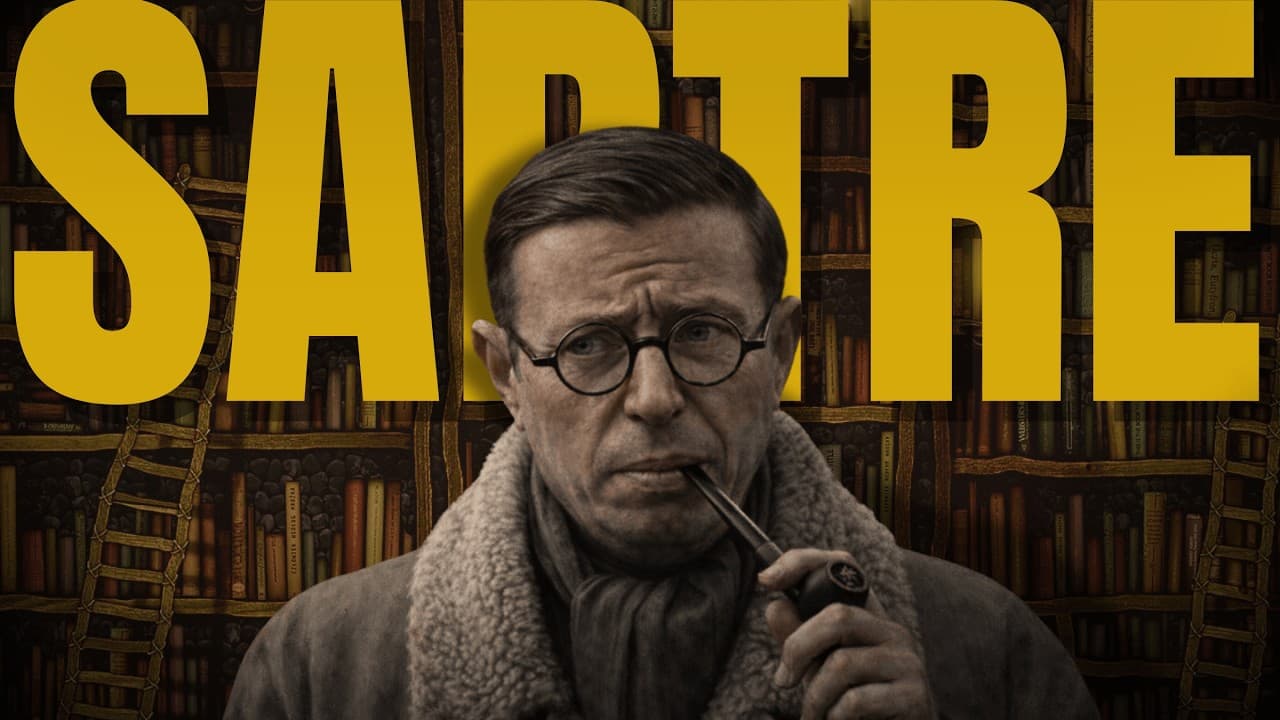
On Sartre, Nothingness, and the Life You Pretend to Live
Freedom, Bad Faith & Existentialism | Philosophy for Sleep
Enjoying the episode?
Occasional letters on philosophy, reading, and the examined life. No spam, ever.
Chapters
- 00:00:00Paris, War, and the Making of an Existentialist
- 00:21:39Phenomenology and the Discovery of Consciousness
- 00:45:22Being and Nothingness, The Architecture of Existence
- 01:07:29Existence Precedes Essence, The Existentialist Manifesto
- 01:28:22Bad Faith and the Flight from Freedom
- 01:49:00Authenticity and the Acceptance of Freedom
- 02:10:54The Other and the Problem of Intersubjectivity
- 02:31:44Nausea, Contingency, and the Absurd
- 02:53:15Engagement, Politics, and Existential Marxism
- 03:15:44Legacy and the Existentialist Movement
Full Transcript
Chapter 01: Paris, War, and the Making of an Existentialist
There is a particular kind of dread that arrives not with danger but with clarity. It is the feeling that descends when a person realizes, with sudden and irreversible certainty, that no god, no tradition, no authority, and no inherited set of values is going to tell them who they are or what they ought to do. They stand alone with their freedom, and that freedom is total. This was the central provocation of Jean-Paul Sartre's philosophy, and it emerged not from a peaceful study but from a life lived through catastrophe, resistance, and the ruins of a continent.
The feeling has a history, and that history begins in Paris.
Jean-Paul Sartre was born on June 21, 1905, in the sixteenth arrondissement of Paris. His father, Jean-Baptiste Sartre, was a naval officer who died of a fever when Sartre was barely fifteen months old. The boy was raised by his mother, Anne-Marie Schweitzer, in the household of her father, Charles Schweitzer, a language teacher of Alsatian origin and a man of considerable intellectual vanity. The young Sartre grew up surrounded by books. His grandfather's library became his landscape, and he read voraciously from an early age, consuming novels, plays, and adventure stories with an appetite that would never diminish.
The absence of a father marked Sartre deeply, though not in the way one might expect. He did not mourn the father he had never known. Instead, he experienced fatherlessness as a kind of liberation. No paternal authority stood over him, dictating values, imposing expectations, or modeling a destiny. The absence left a vacuum where a commanding presence might have been, and into that vacuum the young Sartre poured his imagination. He would later reflect that the death of Jean-Baptiste freed him from the weight of a father's judgment and, in some sense, left him without a predetermined role to fulfill. It was an early, unconscious rehearsal of the philosophical insight that would define his mature work: that there is no given authority that tells us who we are.
In his autobiography The Words, published in 1964, Sartre described his childhood as a kind of performance. He learned to play the role of the gifted child, the prodigy whose intelligence delighted the adults around him. But beneath the performance, he sensed something hollow. He was not what they saw. He was not the precocious grandson, not the little genius. He was, as he would later put it, nothing at all until he made himself into something. The seeds of existentialism were already germinating in this early sense of theatricality and self-invention, this suspicion that identity is not given but constructed.
Sartre was small, nearly blind in one eye from a childhood illness, and physically unremarkable. He compensated with intellect and personality. His wit was sharp, his energy immense, and his ambition boundless. He entered the prestigious Ecole Normale Superieure in Paris in 1924, one of the great training grounds of French intellectual life. There he studied philosophy with an intensity that set him apart even among brilliant peers. He read Descartes, Kant, Hegel, and Bergson, absorbing the Western philosophical tradition while already beginning to push against its limits.
It was at the Ecole Normale that Sartre encountered the two intellectual currents that would define his early work. The first was the phenomenology of Edmund Husserl, which he would discover more fully a few years later. The second was the emerging tradition of existential thought, rooted in the writings of Soren Kierkegaard and Friedrich Nietzsche. Both currents shared a conviction that philosophy had become too abstract, too removed from the concrete texture of lived experience. Both insisted that thinking must begin not with systems but with the individual, the existing person caught up in the world.
But the most consequential encounter of these years was not with a philosopher. It was with Simone de Beauvoir.
Sartre met Beauvoir in 1929, while both were preparing for the agregation, the fiercely competitive examination that determined entry into the French teaching profession. Beauvoir was among the youngest candidates ever to sit the exam. She placed second. Sartre placed first, though he had failed the previous year. Their intellectual partnership began almost immediately, and it would last until Sartre's death in 1980. They never married and never shared a household in any conventional sense. Instead, they forged what they called an essential love, a bond that was primary and permanent, alongside which they both pursued other relationships with varying degrees of openness and complication.
Beauvoir was not merely Sartre's companion. She was his most rigorous interlocutor, his first and most demanding reader, and an original philosopher in her own right. Her work The Second Sex, published in 1949, would extend existentialist analysis into the domain of gender and oppression with a depth and precision that Sartre's own work never achieved in that area. Their relationship was one of genuine intellectual reciprocity, though it was also marked by asymmetries of power, fame, and public attention that Beauvoir addressed with increasing candor over the decades.
The pact they established was unconventional by any standard. They agreed that their relationship would be "necessary" while other attachments would be "contingent." They would tell each other everything. They would never lie. They would maintain their bond as the central fact of their emotional lives while remaining free to pursue other loves. This arrangement, which lasted in various forms for over fifty years, was as much a philosophical experiment as a personal one. It was an attempt to live according to the principles of freedom and honesty that both of them would later articulate in their philosophical works. Whether it succeeded is a question that Beauvoir herself grappled with throughout her memoirs, and the answer is not simple.
After completing the agregation, Sartre took up a teaching post in Le Havre, a port city in Normandy that he found dreary and provincial. He taught philosophy to lycee students while writing fiction and philosophical essays in his spare hours. These years in Le Havre were formative in a way that Sartre himself later recognized. The grayness of the city, the monotony of bourgeois life, and the sense of purposelessness that pervaded his daily existence fed directly into the novel that would become his first major literary work.
Sartre also published a collection of short stories during this period, The Wall, which appeared in 1939. The title story depicts a prisoner during the Spanish Civil War who is given overnight to await his execution. The story is a brilliant phenomenological study of how consciousness relates to its own death, how the body becomes alien under extreme duress, and how the approach of nonexistence transforms the meaning of everything a person has lived. These early literary works established Sartre's reputation well before the systematic philosophical work that would make him world-famous.
That novel was Nausea, published in 1938, and it announced the arrival of a writer who could fuse philosophical argument with literary form in a way that French letters had not seen since the Enlightenment. The novel's protagonist, Antoine Roquentin, is a solitary historian living in a coastal town not unlike Le Havre, who gradually becomes overwhelmed by the sheer factuality of existence. Objects lose their familiarity. The world becomes strange, excessive, and nauseating in its brute presence. Roquentin discovers that things simply are, without reason or justification, and that his own existence shares the same groundless contingency. The novel is a phenomenological exploration disguised as fiction, and its publication established Sartre as a literary figure of the first rank.
But before Nausea, there was a crucial detour. In 1933, Sartre traveled to Berlin on a fellowship to study the phenomenology of Edmund Husserl at the French Institute. This year in Berlin was transformative. Sartre immersed himself in Husserl's work, particularly the Logical Investigations and Ideas Pertaining to a Pure Phenomenology. He also encountered the philosophy of Martin Heidegger, whose Being and Time had been published in 1927 and was reshaping the landscape of continental thought. From Husserl, Sartre took the method of phenomenological description, the practice of attending carefully to the structures of experience as they present themselves to consciousness. From Heidegger, he absorbed a sense of the existential weight of human being, the idea that our existence is always at stake for us in a way that the existence of mere objects is not.
Sartre returned to France with the conceptual tools that would enable his greatest philosophical work. He spent the mid-1930s teaching and writing, producing not only Nausea but also a series of philosophical studies that laid the groundwork for his major ontological project. He published a short treatise on the imagination, an essay on the emotions, and his first phenomenological study, The Transcendence of the Ego. Each of these works refined his understanding of consciousness and prepared the philosophical framework that would culminate in Being and Nothingness. Meanwhile, the political situation in Europe was deteriorating. The rise of fascism in Germany, Italy, and Spain cast a long shadow over French intellectual life, though Sartre was slow to engage with politics. He was, by his own later admission, largely apolitical during the 1930s, absorbed in his philosophical and literary projects and relatively indifferent to the gathering storm.
But history was about to intervene.
In September 1939, Germany invaded Poland, and France entered the Second World War. Sartre was mobilized and assigned to a meteorological unit in the French army, a role that was largely sedentary and that left him ample time to write in his notebooks. During the long months of the so-called Phoney War, before the German offensive began in earnest, Sartre filled notebook after notebook with philosophical reflections, literary sketches, and observations on the nature of war, freedom, and the human condition. These war diaries, portions of which were published posthumously, reveal a mind in transition. The private, apolitical writer of the 1930s was beginning to grapple with questions of collective responsibility and historical engagement that would define the second half of his career. In June 1940, he was captured by German forces and spent nine months as a prisoner of war in Stalag XII-D in Trier, Germany. The experience of captivity was paradoxically liberating in an intellectual sense. Surrounded by other prisoners, stripped of his normal routines and social roles, Sartre confronted the question of freedom in its most stark and immediate form. How could a person be free when they were literally imprisoned? The answer he arrived at, and which would become central to his philosophy, was that even in captivity, consciousness retains its freedom. A prisoner can still choose how to interpret their situation, what attitude to adopt, what meaning to assign to their suffering. Physical constraint does not abolish the fundamental freedom of consciousness.
Sartre was released in March 1941, having secured his freedom through a medical ruse. He returned to occupied Paris and resumed teaching, now at the Lycee Condorcet. He also became involved in the Resistance, though the nature and extent of his participation have been debated by historians. He cofounded a small resistance group called Socialisme et Liberte with Beauvoir and Maurice Merleau-Ponty, among others. The group produced pamphlets and attempted to organize intellectual resistance to the Nazi occupation. It dissolved after a relatively short time, partly because of the dangers involved and partly because it lacked the organizational infrastructure of larger resistance networks. Sartre's resistance activity was modest compared to that of figures who risked their lives in armed struggle. But the experience of occupation, of living under a regime that demanded collaboration or at least silent acquiescence, deepened his thinking about freedom, responsibility, and the inescapability of moral choice.
During the occupation, Sartre wrote at a furious pace. He completed his magnum opus, Being and Nothingness, which was published in 1943. He also wrote his most famous play, No Exit, which premiered in May 1944 at the Theatre du Vieux-Colombier. The play depicts three characters confined together in a single room that turns out to be hell. There are no flames, no demons, no instruments of torture. The torment is purely interpersonal. Each character is trapped in the gaze of the others, unable to escape the judgments and projections that the others impose. The play's most famous line, "Hell is other people," became one of the most quoted and most misunderstood phrases in twentieth-century philosophy. Sartre later clarified that the line does not mean that other people are inherently hellish. It means that when we allow our self-understanding to be determined entirely by how others see us, we enter a kind of damnation.
The liberation of Paris in August 1944 brought Sartre into the center of French intellectual and cultural life with an abruptness that even he found startling. Almost overnight, existentialism became the dominant intellectual current in postwar France. Sartre was its most visible representative, its public face and chief spokesman. He gave lectures, wrote essays and editorials, founded the journal Les Temps Modernes with Beauvoir, Merleau-Ponty, and Raymond Aron, and held court at the Cafe de Flore on the Boulevard Saint-Germain. The atmosphere was one of intense excitement and urgency. Europe lay in ruins. The old certainties of religion, progress, and bourgeois morality had been shattered by the war. People were searching for new frameworks of meaning, new ways of understanding what it meant to be human in a world that had demonstrated its capacity for systematic cruelty on an unprecedented scale.
Existentialism offered something that other philosophies of the moment did not. It acknowledged the horror and the absurdity without retreating into despair. It insisted that even in a world without God, without predetermined meaning, without guarantees of progress or redemption, human beings remained free and therefore responsible. Freedom was not a gift to be celebrated but a burden to be shouldered. We were, in Sartre's memorable phrase, condemned to be free. This was not optimism. It was something harder and more demanding than optimism. It was a refusal to accept any excuse for failing to choose, for failing to act, for failing to take responsibility for the shape of one's own existence.
In October 1945, Sartre delivered a public lecture at the Club Maintenant in Paris that would become one of the defining documents of the existentialist movement. Published the following year under the title Existentialism Is a Humanism, the lecture was Sartre's attempt to present his philosophy in accessible terms and to defend it against its critics. Marxists accused existentialism of bourgeois individualism. Christians accused it of nihilism and despair. Sartre responded by arguing that existentialism was, in fact, the most demanding and optimistic of philosophies, because it placed the full weight of responsibility on the individual and refused to allow any escape into determinism or divine providence.
The lecture drew an enormous crowd, far exceeding the organizers' expectations. People packed the hall and spilled into the streets. Fights broke out over seats. It was an extraordinary scene for a philosophical talk, and it confirmed existentialism's status as not merely an academic movement but a cultural phenomenon. Sartre became the most famous philosopher in the world, a celebrity intellectual whose opinions on everything from literature to politics to personal morality were sought and debated with a fervor that few thinkers have ever inspired.
Existentialism also became, in the popular imagination, associated with a particular style of life. The jazz cellars of Saint-Germain-des-Pres, the black turtlenecks, the late-night conversations in smoky cafes, the novels and poems and plays that poured from the pens of young writers who called themselves existentialists: all of this contributed to the sense that existentialism was not merely a philosophy but a way of being, a stance toward the world that encompassed art, politics, personal relationships, and the smallest details of daily conduct. Sartre was ambivalent about this cultural phenomenon. He welcomed the public attention that made it possible to disseminate his ideas to a wide audience. But he was also aware that the popular image of existentialism often bore only a superficial resemblance to the rigorous philosophical work from which it derived.
Yet even at the height of this fame, Sartre maintained a discipline of work that was almost inhuman in its intensity. He wrote constantly, producing novels, plays, philosophical treatises, literary criticism, political essays, and screenplays at a rate that exhausted even his closest associates. He fueled this output with tobacco, coffee, and amphetamines, a regimen that would eventually take a severe toll on his health. But in the late 1940s and through the 1950s, he seemed inexhaustible. The world was demanding answers, and Sartre was determined to provide them.
This, then, was the making of an existentialist. A boy raised among books, who sensed early that identity is a performance. A student who absorbed the Western philosophical tradition and then discovered, in the phenomenology of Husserl and the existential analytics of Heidegger, the tools to dismantle it. A prisoner of war who found in captivity a confirmation of his deepest intuition about freedom. A writer who could move between philosophy and literature with equal facility. And a public intellectual who emerged from the ruins of occupied Europe to declare that human beings are free, that they are responsible, and that no authority in heaven or on earth can relieve them of that burden.
The philosophy that Sartre built on these foundations is the subject of what follows. It begins, as Sartre himself insisted it must, with consciousness.
Chapter 02: Phenomenology and the Discovery of Consciousness
In a cafe in Berlin, sometime in the autumn of 1933, Sartre's friend and fellow philosopher Raymond Aron pointed to a glass of apricot cocktail and said something that changed the course of twentieth-century French philosophy. Aron had been studying in Berlin and had encountered the phenomenology of Edmund Husserl. He told Sartre that phenomenology made it possible to philosophize about this very glass, about the concrete things of everyday experience, and to derive genuine philosophical insight from doing so. Sartre turned pale with excitement. This was exactly what he had been looking for: a philosophy that began not with abstract principles but with the things themselves, with the texture and structure of lived experience as it actually presents itself to a conscious being.
The story, recounted by Beauvoir in her memoir The Prime of Life, captures something essential about Sartre's philosophical temperament. He was never content with philosophy that operated at a distance from experience. He wanted a method that could lay bare the structures of consciousness as we actually live them, not as some theoretical model says they ought to be. Husserl's phenomenology promised exactly this. It offered a way of investigating experience from the inside, attending to how things appear to consciousness without first assuming a metaphysical framework that dictates what reality must be like.
Edmund Husserl, born in 1859 in the town of Prossnitz in Moravia, had spent decades developing phenomenology as a rigorous method of philosophical inquiry. His central insight was deceptively simple. All consciousness, Husserl argued, is consciousness of something. This principle, which he called intentionality, meant that consciousness is never a blank container waiting to be filled with sense data. It is always already directed toward objects, always already engaged with a world. When we perceive a tree, we do not first have a bundle of sensations that we then interpret as a tree. We perceive the tree directly, as a unified object in our experiential field. Consciousness reaches out toward things. It intends them, in the technical phenomenological sense.
This concept of intentionality had its roots in the work of Husserl's teacher, the philosopher and psychologist Franz Brentano, who had revived the medieval notion that mental acts are characterized by their directedness toward objects. Brentano argued that what distinguishes the mental from the physical is precisely this directedness. A physical event, like a stone falling, is not about anything. It simply happens. But a mental event, like a perception or a thought or a desire, is always about something. It points beyond itself toward an object, whether that object is a real thing in the world or an imagined entity that exists nowhere outside the mind. Husserl took this idea and made it the foundation of an entire philosophical method. The phenomenological reduction, or epoche, involved setting aside our ordinary assumptions about whether the objects of experience exist independently of consciousness. The point was not to deny the external world but to attend carefully to how objects present themselves to us, to the structures of appearance as such, before layering on metaphysical commitments about what exists and what does not.
Sartre seized on intentionality with an enthusiasm that quickly outran Husserl's own intentions. For Husserl, intentionality was primarily an epistemological principle, a way of understanding how knowledge of the world is possible. For Sartre, it became something more radical, a revelation about the very character of conscious life. If consciousness is always consciousness of something, then consciousness itself is not a thing. It is not a substance with properties. It is not a container filled with mental contents. It is pure directedness, pure openness toward the world. Consciousness has no substantial content of its own. It is entirely defined by its relation to what lies outside it. Sartre would later describe it as a wind blowing toward objects, an image that captures the restless, outward-facing character of awareness as he understood it.
This interpretation appears in one of Sartre's earliest philosophical essays, published in 1939 under the title "Intentionality: A Fundamental Idea of Husserl's Phenomenology." The essay is brief and exuberant, almost celebratory in its tone. Sartre presents intentionality as a liberation from what he calls the digestive philosophy of the French tradition, the tendency to think of consciousness as a kind of stomach that ingests and assimilates the external world. Against this, Sartre insists that consciousness is nothing but a movement toward what is outside it. It does not contain representations of things. It is a direct relation to things themselves. To be conscious is to be outside oneself, to be in the world among things, not locked in an inner theater of mental images.
The philosophical implications of this reading of intentionality are far-reaching. If consciousness has no substantial content of its own, then it cannot be studied as if it were a thing with measurable properties. It cannot be reduced to brain states, to patterns of behavior, or to a collection of mental images stored inside the skull. Consciousness is not an object that can be pinned down and examined from the outside. It is a perpetual movement toward the world, always already engaged with what lies beyond it, always slipping past any attempt to fix it in place. This insight, drawn from Husserl but pushed further than Husserl intended, would become the foundation of Sartre's entire ontology in Being and Nothingness. For now, it remained a phenomenological observation about the distinctive character of awareness.
But before arriving at that major work, Sartre produced a short but remarkably dense philosophical study that pushed his reading of Husserl in a direction the master would not have sanctioned. The Transcendence of the Ego, written during Sartre's fellowship year in Berlin and published in 1936, represents Sartre's first decisive break with Husserl's phenomenology. The central argument is radical in its simplicity. Husserl had maintained that behind all acts of consciousness there lies a transcendental ego, a pure "I" that serves as the source and unifier of experience. Sartre denied this. There is no ego lurking behind consciousness, no "I" that stands as the subject of experience. The ego, Sartre argued, is not in consciousness. It is in the world, as an object among objects.
What does this mean? Consider the experience of reading. When absorbed in a book, there is consciousness of the words on the page, consciousness of the unfolding narrative, perhaps consciousness of a sound in the next room. But there is no separate "I" sitting behind this experience, watching it happen. The "I" appears only when we reflect on what we were doing. We say, "I was reading," but this reflective awareness comes after the fact. In the original, unreflective experience, there was just the reading, just the consciousness of the page. The ego is produced by reflection, not presupposed by it.
This seemingly technical argument has enormous consequences, and Sartre pursued them with characteristic boldness. If there is no ego at the heart of consciousness, then consciousness is radically impersonal in its primary mode. It is an anonymous flow of awareness directed toward the world. The personal self, the "I" with its character traits, its history, its habits and dispositions, is not the foundation of experience but a construction within experience. It is something consciousness produces when it turns back on itself. This means that the self is not a fixed, inner essence that determines who we are. It is an object that we encounter in reflection, and like all objects of consciousness, it can be questioned, doubted, and reconceived.
Sartre's rejection of the transcendental ego also has implications for the problem of solipsism, the philosophical worry that one can only be certain of the existence of one's own mind. If there is no private inner ego that grounds experience, then consciousness is already a relation to what is outside it. It is already in the world, already among things and other people, before any question of solipsism can arise. The problem of other minds, which had troubled philosophy since Descartes, is dissolved at its root. We do not start from an isolated ego and then try to prove that other minds exist. We start from consciousness as a worldly activity and discover the ego as one object among others in that world.
The Transcendence of the Ego also introduces a theme that will pervade all of Sartre's subsequent work: the experience of anguish. If there is no fixed ego that determines our choices and actions, then we cannot appeal to our character or our nature as a justification for what we do. We cannot say, "I acted this way because that is the kind of person I am." The kind of person we are is itself something we are continually creating through our choices. This recognition produces anguish, a vertiginous awareness of our own freedom that we spend much of our lives trying to avoid. The concept of anguish will reappear in Being and Nothingness as a central structure of human existence, but its philosophical origin lies here, in this early dismantling of the ego.
The implications for ethics and for the understanding of freedom are also significant, though Sartre would not fully develop them until later works. If the ego is a constructed object rather than a founding subject, then the moral agent is not a stable self that makes decisions from a fixed standpoint. The moral agent is a consciousness in perpetual movement, creating and recreating its identity through its choices. There is no bedrock of character underneath the choices we make. The choices are all there is, and the self is nothing more than the pattern they trace. This is a deeply unsettling idea, and Sartre embraced it with a kind of exhilarated resolve that marks everything he wrote.
Sartre's engagement with Husserl was not limited to the question of the ego. He also drew on phenomenological method in his study of the imagination, producing two works on the subject. The first, Imagination: A Psychological Critique, published in 1936, examined and criticized existing theories of the mental image, from Descartes through the British empiricists to Bergson. The second, The Imaginary: A Phenomenological Psychology of the Imagination, published in 1940, offered Sartre's own positive account.
The key insight of The Imaginary is that imagination is not a weakened form of perception. When we imagine a friend's face, we are not perceiving a faint copy of that face somewhere inside our heads. Imagination is a fundamentally different act of consciousness from perception. In perception, an object presents itself with an inexhaustible richness of detail. We can always look more closely, notice something we missed, discover a new aspect. In imagination, the object is given all at once, with exactly the features we intend it to have and no more. The imagined face has no hidden sides, no details waiting to be discovered. It is, in Sartre's terms, an "irreal" object, present to consciousness not as a thing in the world but as a kind of absence.
This analysis of imagination reveals something crucial about the nature of consciousness. To imagine is to step back from what is actually present and entertain what is not. A being that could only perceive, that was entirely absorbed in the present reality of things, could never imagine. Imagination requires a capacity for withdrawal, a power to hold the given at a distance and posit what is absent. Consciousness, Sartre realized, is not confined to registering what lies before it. It can also disengage from the actual, entertain the possible, and hold the world at arm's length. This capacity for negation, for stepping beyond the immediate deliverances of perception, would prove central to the systematic philosophy that Sartre was already beginning to envision. In Being and Nothingness, it would be given a technical name and a pivotal role in the architecture of human existence.
Alongside his studies of imagination, Sartre also produced a phenomenological analysis of the emotions. The Emotions: Outline of a Theory, published in 1939, argued against the prevailing view that emotions are involuntary physiological responses to external stimuli. For Sartre, an emotion is not something that happens to consciousness but something that consciousness does. It is a way of relating to the world, a strategy by which consciousness transforms its situation when practical action seems blocked or inadequate. A person who faints from fear, for example, is not simply overcome by a physiological reflex. They are adopting a mode of engagement with the world that annihilates the threatening situation by withdrawing from it entirely. Emotion, on this account, is a form of consciousness, not a disruption of it. This analysis reinforced Sartre's emerging conviction that consciousness is always active, always choosing its relation to the world, even in moments that seem most passive and involuntary.
Sartre's appropriation of Husserl was therefore highly creative and highly selective. He took the method of phenomenological description and the concept of intentionality but rejected the transcendental ego and the idealist tendencies that Husserl developed in his later work. Where Husserl moved increasingly toward a form of transcendental idealism, arguing that the structures of consciousness constitute the meaning of the world, Sartre moved in the opposite direction, toward a realism in which consciousness is nothing and the world is everything that consciousness is not.
The influence of Martin Heidegger was also crucial in shaping this trajectory. Heidegger's Being and Time, published in 1927, had reframed the question of being in terms of human existence. Heidegger used the term Dasein, literally "being-there," to describe the distinctive mode of existence that characterizes human beings. Dasein is not a subject contemplating an external world. Dasein is always already in the world, engaged with tools, projects, and other people. Its being is an issue for it in a way that the being of a stone or a hammer is not. Dasein exists by projecting itself toward possibilities, by taking up its past and pressing forward into a future that is always uncertain and always at stake.
Heidegger also broke with Husserl in insisting that the primary mode of our engagement with the world is not theoretical contemplation but practical involvement. We do not first perceive objects and then decide what to do with them. We encounter things as ready-to-hand, as tools and obstacles and opportunities within a web of practical significance. The hammer is encountered first as something for hammering, not as a physical object with measurable properties. Theoretical perception, in which we detach from practical engagement and contemplate objects as present-at-hand, is a secondary and derivative mode of being-in-the-world. This emphasis on practical engagement over theoretical contemplation appealed to Sartre, who shared the conviction that philosophy must begin with lived experience rather than abstract speculation.
Sartre was deeply impressed by Being and Time, but he also departed from Heidegger in important ways. Where Heidegger sought to overcome the subject-object distinction by dissolving both terms into the more primordial structure of being-in-the-world, Sartre retained a sharp distinction between consciousness and its objects. For Sartre, consciousness could never be fully absorbed into the world it inhabited. It always stood at some distance from things, always maintained a separation from the objects it encountered. This insistence on the irreducibility of consciousness as something distinct from the world of things would become one of the defining features of Sartre's philosophy. Heidegger had tried to move beyond the dualism of subject and object; Sartre, in a sense, reinstated it, though in a new form that owed more to phenomenology than to Descartes.
Heidegger also shaped Sartre's understanding of death, temporality, and authenticity, though Sartre would develop these themes in distinctly different directions. Where Heidegger's analysis of being-toward-death emphasized the individualizing power of mortality, the way in which the anticipation of death reveals each person's existence as irreducibly their own, Sartre was less interested in death as a philosophical theme and more focused on the way freedom structures every moment of conscious life. For Sartre, it is not death that reveals the stakes of existence but the perpetual possibility of choosing otherwise, the fact that at every moment we are making ourselves into what we are.
It is worth noting that Sartre was not the only French philosopher to take up phenomenology in this period. Maurice Merleau-Ponty, who was Sartre's contemporary and friend, developed a phenomenological philosophy of his own that took Husserl's work in a markedly different direction. Where Sartre emphasized the transparency and activity of consciousness, Merleau-Ponty focused on the ambiguity of embodied experience, on the way in which the body mediates our engagement with the world in ways that are neither fully conscious nor fully mechanical. Their divergent readings of Husserl would produce a rich and sometimes contentious dialogue. But in the early 1940s, both thinkers were still working out the implications of a shared discovery.
The phenomenological tradition, then, provided Sartre with his philosophical vocabulary and his method of investigation. From Husserl he learned to attend to the structures of consciousness. From Heidegger he absorbed a sense of the existential weight of human being and the primacy of being-in-the-world. But Sartre's own philosophical voice is distinct from both. His insistence on the nothingness of consciousness, his rejection of the transcendental ego, and his uncompromising emphasis on freedom as the fundamental character of human existence are his own contributions, developed through a sustained engagement with phenomenological method but leading to conclusions that neither Husserl nor Heidegger would have endorsed.
There is one further aspect of Sartre's phenomenological formation that deserves mention. His encounter with Husserl and Heidegger did not merely provide him with philosophical tools. It also gave him a way of doing philosophy that was fundamentally different from the dominant modes of French academic thought. The French philosophical tradition of the early twentieth century was dominated by neo-Kantian rationalism and Bergsonian vitalism. Sartre found both traditions unsatisfying, the first because it was too abstract and formalistic, the second because it tended toward an irrationalism that Sartre distrusted. Phenomenology offered a middle path: a rigorous method of description that remained faithful to the structures of experience without either reducing them to logical categories or dissolving them into a flux of intuition. This methodological commitment would remain constant throughout Sartre's career, even as the specific content of his philosophy evolved from the pure phenomenology of the early works to the existential ontology of Being and Nothingness and the dialectical social theory of the Critique.
By the early 1940s, Sartre had assembled the conceptual apparatus for his most ambitious project. He had a theory of consciousness as intentional, egoless, and wholly defined by its directedness toward the world. He had an analysis of imagination that revealed consciousness's remarkable capacity for withdrawal and negation. He had a phenomenology of emotion that treated feelings as active engagements with the world rather than passive reactions. He had absorbed Heidegger's emphasis on being-in-the-world and the existential character of human existence. And he had the literary skill to render these abstractions in vivid, concrete terms. All that remained was to bring these elements together in a systematic philosophical work that would transform phenomenological insights into a comprehensive ontology of human existence, laying bare not just the character of consciousness but the fundamental structures of being itself. That work would be Being and Nothingness.
Chapter 03: Being and Nothingness - The Architecture of Existence
Being and Nothingness appeared in 1943, published by Gallimard during the German occupation of France. Its full title is Being and Nothingness: An Essay on Phenomenological Ontology, and the subtitle signals both its method and its ambition. Sartre intended nothing less than a complete account of the fundamental structures of reality as they are revealed through phenomenological description. The book runs to over seven hundred pages in its original French edition. It is dense, demanding, and frequently brilliant, moving between abstract ontological argument and vivid phenomenological descriptions of everyday experience with a virtuosity that remains remarkable even for readers who find its conclusions disputable.
The phenomenological tools Sartre had developed over the preceding decade now served a new and grander purpose. The work begins with a question that seems almost childishly simple. What is being? Or more precisely, what is the being of the things we encounter in experience, and what is the being of the consciousness that encounters them? Sartre's answer to these questions takes the form of a fundamental distinction between two regions of being, which he calls being-in-itself and being-for-itself. This distinction is the architecture on which the entire edifice of Being and Nothingness is constructed, and grasping it is essential to understanding everything that follows.
Being-in-itself, or l'etre-en-soi, is the mode of being that characterizes things. A stone, a table, a glass of water: each of these exists in the mode of being-in-itself. Being-in-itself is massive, opaque, and complete. It simply is what it is. It has no inner life, no awareness, no distance from itself. Sartre describes it with three terse formulations: being is, being is what it is, and being is in-itself. These formulations are deliberately tautological. They express the fact that being-in-itself admits of no negation, no lack, no possibility of being otherwise. A stone does not aspire to be a different kind of stone. A table does not regret its tableness. Being-in-itself is full positivity, with no crack or gap in its being through which nothingness might enter.
The very description of being-in-itself is significant in its austerity. Sartre deliberately avoids attributing any dynamism, any internal structure, any potentiality to the being of things. Being-in-itself does not develop, does not aspire, does not tend toward anything. It is not the Aristotelian substance that contains within itself the potential for change and growth. It is sheer actuality, with no unactualized potential, no horizon of what it might become. This is a more radical conception of material being than most Western philosophers had proposed, and it sets the stage for the sharp contrast with being-for-itself that structures the entire work.
This might seem obvious, even trivial. Of course a stone is just a stone. But Sartre is making a deeper point. Being-in-itself is not merely the everyday observation that things are what they are. It is the ontological foundation of the world as a realm of inert, self-identical factuality. The world of things is a world of plenitude, of being that is entirely present to itself without remainder. There is no mystery at the heart of the stone, no hidden depth behind the surface of the table. Being-in-itself is all surface, all actuality, with nothing held in reserve.
Against this stands being-for-itself, or l'etre-pour-soi, the mode of being that characterizes consciousness. Here the phenomenological observations about intentionality and directedness that Sartre had been developing for a decade are transformed into a full ontological claim. Being-for-itself is everything that being-in-itself is not. Where being-in-itself is full and self-identical, being-for-itself is shot through with nothingness. Where being-in-itself simply is, being-for-itself exists at a distance from itself, always separated from its own being by a thin film of negation. Consciousness is never simply what it is. It is always also what it is not. It is always projecting beyond the present moment, always entertaining possibilities that are not yet actual, always aware of absences and lacks and alternatives. This capacity for negation is the nothingness at the heart of being-for-itself, and it is identical with freedom.
Consider a simple example. A person sits at a desk, writing. They are conscious of the words forming on the page, of the pressure of the pen, of the light falling through the window. But they are also aware that they could stop writing. They could stand up, leave the room, begin a different task entirely. This awareness of possibilities, this sense that the present situation is not the only possible situation, is an expression of the nothingness that Sartre locates at the core of consciousness. Consciousness does not merely register what is. It is perpetually aware of what is not, what could be, what might be otherwise. This awareness of the negative, this power of nihilation, is what distinguishes being-for-itself from being-in-itself and what makes human existence fundamentally different from the existence of things.
The distinction between these two modes of being is not merely a theoretical classification. It structures the entire argument of the book and determines how Sartre approaches every subsequent topic, from time to emotion, from the body to other people. To grasp the distinction is to hold the key that unlocks the architecture of the work as a whole.
Sartre introduces the concept of nothingness through a carefully chosen example. He asks us to consider the experience of going to a cafe to meet a friend, Pierre, and discovering that Pierre is not there. The cafe is full of people, full of tables and chairs and noise and movement. But what strikes us, what we experience most forcefully, is Pierre's absence. We perceive the cafe as lacking Pierre. This absence is not a mere logical judgment, a mental calculation that Pierre's name does not appear on the list of those present. It is a lived experience, a felt quality of the situation. The cafe presents itself as the ground from which Pierre's absence stands out as a figure. We experience nothingness directly, not as a concept but as a feature of the world as we encounter it.
This example is meant to demonstrate that nothingness is not something we import into the world through our judgments. It is disclosed within experience itself. And the being through which nothingness comes into the world, the being that has the power to experience absence, to posit what is not, to imagine alternatives to what is, is consciousness, being-for-itself. Human reality, as Sartre calls it, is the being through which nothingness enters the world.
The relationship between being-in-itself and being-for-itself is not one of equal and independent coexistence. Being-for-itself arises against the background of being-in-itself. Consciousness is always consciousness of something, always directed toward the world of things. But it is never identical with what it is conscious of. There is always a gap, a withdrawal, a tiny but unbridgeable distance between consciousness and its objects. Sartre calls this gap neantisation, the process by which consciousness separates itself from being through negation. Consciousness is the nothingness that separates being from itself, the crack in the fullness of being through which freedom, temporality, and meaning enter the world.
This ontological structure has profound implications for how we understand human existence. If being-for-itself is essentially characterized by nothingness, then human beings have no fixed essence. A thing has an essence in the sense that it has a set of properties that define what it is. A paper knife, to use one of Sartre's examples from a later lecture, is designed with a specific purpose in mind. Its essence, its nature as a paper knife, precedes its existence. Someone conceived of its function before it was made, and it exists in order to fulfill that function. But human beings are not like this. We are not designed for a purpose. We are not created according to a blueprint. We exist first, and only then do we create ourselves through our choices and actions. Our existence precedes our essence.
This principle will be elaborated more fully in the next chapter, but its roots are here, in the ontological distinction between being-in-itself and being-for-itself. Because consciousness is nothingness, because it has no fixed nature, human beings are radically free. Freedom is not a property that we possess alongside other properties. It is the very structure of our being. We are our freedom.
Sartre introduces another pair of concepts that clarify the human condition: facticity and transcendence. Facticity refers to the brute facts of our situation, the given circumstances into which we are thrown and which we did not choose. We did not choose our bodies, our parents, our historical moment, our nationality, our native language. These facts constitute the facticity of our existence. They are features of being-in-itself that constrain and shape our lives. We cannot simply wish them away or pretend they do not exist.
But facticity does not determine us. Alongside facticity, there is transcendence, the capacity of being-for-itself to surpass the given, to project beyond the present situation toward future possibilities. A person born into poverty is not defined by that poverty. They can interpret it, resist it, transform it, or accept it, but in every case they are going beyond the bare fact of their economic condition and giving it a meaning that the fact itself does not contain. Transcendence is the movement by which consciousness perpetually exceeds its facticity, reaching toward a future that is not yet determined.
The human condition, for Sartre, is characterized by the perpetual tension between facticity and transcendence. We are always both what we are, in the sense of our facticity, and what we are not yet, in the sense of our transcendence. We can never collapse entirely into our facticity, as that would mean becoming a thing, a being-in-itself with a fixed and determined nature. And we can never escape our facticity entirely, as that would mean becoming a pure transcendence, a consciousness without a situation, which is equally impossible. We exist in the space between these two poles, and much of the drama of human existence arises from the difficulty of inhabiting that space honestly.
The interplay between facticity and transcendence also illuminates the experience of choice. When a person faces a decision, they bring their facticity to the moment: their history, their capacities, their relationships, the whole weight of who they have been. But the decision itself is an act of transcendence, a reaching beyond what is given toward a possibility that does not yet exist. The choice is never fully determined by what came before it, no matter how heavy the weight of the past. There is always a gap between the person's facticity and the decision they make, and that gap is the space of freedom. Sartre argued that this gap can never be closed. Every effort to explain a choice entirely by reference to prior causes, to psychological dispositions, to social conditioning, or to the pressure of circumstances leaves something out. It leaves out the moment of transcendence in which consciousness surpasses the given and commits itself to a future that could have been otherwise.
This tension between facticity and transcendence is closely related to another fundamental structure of being-for-itself: temporality. Consciousness is not merely situated in time in the way that a stone is situated in time, passively enduring as moments pass. Consciousness lives time from within. It retains the past, anticipates the future, and exists the present as a perpetual movement from what it was toward what it will be. The past is not simply gone. It is preserved in consciousness as what Sartre calls "the facticity of the for-itself," the accumulated weight of previous choices and experiences that constitute what we have been. But the past does not determine the present. At every moment, consciousness is free to interpret the past differently, to assign new significance to old events, to break with patterns that seemed fixed.
The future, similarly, is not a set of predetermined events waiting to happen. It is a field of possibilities that consciousness projects before itself. We exist toward the future, perpetually ahead of ourselves, reaching toward goals and projects that we have chosen and that give meaning to our present activity. The present is the moment of engagement, the point at which past and future converge in the act of choosing. But the present is also, paradoxically, the most elusive dimension of time, because consciousness can never fully coincide with the present moment. There is always a slight slippage, a tiny gap between consciousness and its present experience, which is another manifestation of the nothingness at the heart of being-for-itself.
This analysis of temporality distinguishes Sartre sharply from the common-sense view that time is an external framework in which events occur. For Sartre, temporality is not a container. It is a structure of being-for-itself, a way in which consciousness exists. We do not move through time the way a ball rolls down a hill. We temporalize ourselves, we create the three dimensions of past, present, and future through our manner of existing. This means that temporal experience is always shaped by our projects, by the orientation of our freedom toward the goals we pursue. A person eagerly awaiting a reunion experiences the passage of time differently from a prisoner counting the days of a sentence, not because the clock moves at different speeds but because their projects structure their temporal experience in fundamentally different ways.
Sartre's analysis of temporality reveals that human existence is fundamentally project. We do not merely exist in time. We temporalize ourselves through our projects, the goals and purposes that organize our experience and give direction to our lives. A project is not simply a plan or an intention. It is the fundamental orientation of consciousness toward the future, the way in which being-for-itself perpetually exceeds what it is in the direction of what it is not yet. Every action, every choice, every interpretation of our situation is part of a project, a movement of transcendence by which we give meaning to our existence.
But there is a deeper project that underlies all particular projects, a fundamental project that Sartre calls the desire to be God. This is one of the most striking and most frequently misunderstood claims in Being and Nothingness. Sartre is not making a theological point. He is describing a structural feature of being-for-itself. Consciousness desires to be a being that combines the fullness of being-in-itself with the freedom of being-for-itself. It wants to be a consciousness that is also complete, self-grounded, and necessary, a being that is both free and fully determined, both for-itself and in-itself. This combination is what theological tradition has called God: a being that is its own foundation, that exists by necessity, and that is fully conscious of itself without any gap or lack.
But this project is doomed to failure. Being-in-itself-for-itself is a contradiction in terms. Consciousness can never achieve the solidity and completeness of a thing without ceasing to be consciousness. The desire to be God is a futile passion, and Sartre concludes Being and Nothingness with the declaration that "man is a useless passion." This declaration is often read as a statement of despair, but Sartre did not intend it as such. It is a description of a structural impossibility, not a counsel of hopelessness. The fact that the fundamental project fails does not mean that particular projects are pointless. It means that the ultimate ground of human striving is an unresolvable tension, and that honesty requires us to acknowledge this rather than disguise it with comforting illusions.
The concept of the fundamental project also helps to explain the phenomenon of conversion, the radical transformation that occurs when a person fundamentally reorients their existence. A person who has lived for decades in pursuit of wealth may suddenly find that wealth no longer organizes their world. The projects that once gave their life its structure and direction collapse, and they are confronted with the necessity of choosing anew. Sartre called such moments "radical conversions," and he saw them as demonstrations of the underlying freedom that even the most habitual existence cannot entirely extinguish. The fundamental project is not a prison. It is a way of being that consciousness has chosen and that consciousness can, in principle, un-choose. The possibility of conversion is always present, even when it seems most remote.
The architecture of Being and Nothingness also includes a detailed analysis of the body. Sartre rejects the Cartesian dualism of mind and body. Consciousness is not a separate substance inhabiting a physical machine. The body is the way consciousness exists in the world, the way it is situated among things and exposed to the gaze of others. Sartre distinguishes three dimensions of the body. The first is the body as lived, the body as it is experienced from the inside, as the center of our orientation in the world. We do not ordinarily perceive our bodies as objects. We live through them, using them as instruments of engagement with the world. The second dimension is the body as seen by others, the body as it appears from the outside, as a physical object with properties and characteristics. The third dimension is the body as we experience it under the gaze of the other, the body as it is revealed to us through the other's perception. These three dimensions of embodiment will become crucial when Sartre turns to the problem of intersubjectivity.
Being and Nothingness is, finally, a work of relentless honesty about the human condition. It refuses every comforting fiction, every excuse, every alibi. Human beings are free, and this freedom is not a blessing but a condition that must be confronted without evasion. We are responsible for what we make of ourselves, and no appeal to nature, to society, to God, or to the unconscious can relieve us of that responsibility. The book's power lies not in its system, impressive as that system is, but in its unflinching insistence that we look directly at the structures of our existence without turning away.
Chapter 04: Existence Precedes Essence - The Existentialist Manifesto
On an October evening in 1945, Sartre stood before a packed auditorium in Paris to deliver a lecture that would become the most widely read introduction to existentialist philosophy ever produced. The audience at the Club Maintenant was so large that people fainted from the heat and crush of bodies. Chairs were broken. Latecomers pressed against the doors. A philosophical lecture had become an event of almost rock-concert intensity, and the ideas Sartre presented that evening, later published as Existentialism Is a Humanism, would carry the existentialist message far beyond the academic world in which it had originated.
The central claim of the lecture is contained in a single phrase that Sartre placed at the heart of his argument: existence precedes essence. The phrase is a reversal of a metaphysical assumption that had dominated Western thought for over two thousand years. From Plato through the medieval scholastics to the rationalists of the seventeenth century, the dominant view held that things have essences, fixed natures that define what they are, and that these essences are prior to or at least simultaneous with their existence. A knife has the essence of knife-ness. A horse has the essence of horse-ness. A human being has a human nature, a set of defining characteristics that make us what we are and that were determined, depending on the thinker, either by God, by reason, or by nature itself.
Sartre's reversal of this priority is the founding gesture of his existentialism. For human beings, he argued, there is no essence that precedes existence. We are not designed. We are not created according to a concept. We simply appear in the world, find ourselves existing, and only then begin to define ourselves through our choices, our actions, and our commitments. There is no human nature that tells us in advance what we are or what we ought to be. We are, first and last, what we make of ourselves.
To illustrate the traditional view, Sartre used the example of a paper knife. When an artisan produces a paper knife, the conception of the object precedes its manufacture. The artisan knows what a paper knife is for, what properties it should have, what design it should follow. The essence of the paper knife, its definition and purpose, exists in the mind of the artisan before the object itself comes into being. One can therefore say that, for the paper knife, essence precedes existence. The same logic, Sartre observed, had traditionally been applied to human beings. In the Christian tradition, God plays the role of the artisan, conceiving of human nature before creating human beings. Even among Enlightenment philosophers who dispensed with God, the assumption persisted that there is a universal human nature, a set of fixed characteristics shared by all people in all times and places.
Existentialism begins by rejecting this assumption. If there is no God, and Sartre was an atheist who took this premise seriously, then there is no divine artisan who conceived of human nature before creating human beings. And if there is no universal human nature given in advance, then when a human being appears in the world, they are initially nothing. They have no predetermined purpose, no assigned role, no essence waiting to be fulfilled. They must create their own essence through the way they live.
This claim is both exhilarating and terrifying. It means that human beings are radically free in a sense that no other being is free. A stone cannot choose to be other than it is. An animal is largely determined by its instincts and its environment. But a human being, because consciousness is nothingness and has no fixed nature, is perpetually confronted with the necessity of choosing. Every moment of conscious life involves choice, even when we do not recognize it as such. To remain in one's chair is a choice. To continue in one's job is a choice. To maintain a relationship, to hold a belief, to follow a habit: each of these is sustained by an ongoing act of choosing, even if the choice has become so habitual that it no longer feels like one.
Sartre drew from this radical freedom three consequences that he described as the emotional coloring of the existentialist condition: anguish, abandonment, and despair.
Anguish is the feeling that arises from the awareness of our own freedom. It is not the same as fear. Fear has an object: we fear a specific danger, a particular threat. Anguish has no object in this sense. It is directed at ourselves, at our own capacity for choice. Sartre illustrated anguish with the example of a man walking along a narrow path on the edge of a precipice. The man fears falling, but his anguish arises from something different: the recognition that nothing prevents him from throwing himself off the edge. No barrier, no instinct, no fixed nature stands between him and the abyss. He is free to jump, and he knows it. This vertiginous awareness of freedom is anguish.
The anguish of the precipice is not a pathological condition. It is a truthful response to the structure of human existence. Most people, most of the time, manage to avoid feeling it. They cling to guardrails, both literal and figurative, that conceal the abyss of their own freedom. They surround themselves with habits, routines, and social expectations that create the illusion of a determined path. But the anguish is always there, just beneath the surface, ready to break through whenever the usual supports are removed.
Anguish also manifests in relation to the future. A gambler who has resolved to stop gambling feels anguish when he approaches the gaming table, because he recognizes that his past resolution has no power to determine his present choice. He made the resolution yesterday. Today he is free to honor it or to break it. Nothing in his nature compels one course of action over the other. The resolution exists only as a factical element of his past, not as a force that constrains his present freedom. He must choose again, now, in this moment, and no previous commitment can make the choice for him.
Abandonment is Sartre's term for the condition of being without God, without a cosmic moral order, without any external authority that could validate our choices or tell us what we ought to do. If God does not exist, then we cannot appeal to a divine commandment as the foundation of morality. We cannot say that certain actions are right because God wills them, or that certain values are objective because they are inscribed in the nature of things. We are abandoned in the sense that we must choose our values without any guarantee that our choices are correct. There is no moral compass built into the structure of the universe. There is only the freedom to choose and the responsibility that comes with that freedom.
Sartre offered a striking illustration of abandonment in the lecture. He described a student who came to him during the occupation, torn between two courses of action. The student's brother had been killed in the German offensive of 1940, and the student wanted to join the Free French Forces to avenge his brother and fight for his country. But his mother, devastated by the loss of one son, depended on him entirely. If he left, she would be alone and possibly destroyed by grief. Which duty should he honor: the universal duty to fight injustice, or the particular duty to care for his mother?
The example of the student is one of the most frequently discussed passages in Existentialism Is a Humanism, and it captures the existentialist position on moral choice with vivid economy. Sartre's point was that no ethical theory could resolve this dilemma for the student. Kantian ethics, with its emphasis on universalizability, would point one way. A utilitarian calculation might point another. Christian charity might counsel staying with the mother. Revolutionary commitment might counsel joining the resistance. But in the end, the student had to choose, and no amount of philosophical reasoning could spare him the burden of that choice. The very fact that he came to Sartre for advice was already a choice, since he must have had some sense of what advice Sartre would give. We do not discover our values in the world. We create them through our decisions.
Abandonment also means that we cannot appeal to human nature as a guide to action. If there is no fixed human nature, then there is no set of natural inclinations or rational principles built into our being that tells us what to do. The moral theories that claim to derive ethical principles from human nature, whether Aristotelian virtue ethics or natural law theory, are built on a foundation that existentialism rejects. We must create our values from scratch, in each situation, with nothing to rely on but our own freedom and our own judgment. This is what makes the existentialist predicament so demanding. We are not merely free to choose. We are obligated to choose, because there is no default option, no neutral position that we can occupy while waiting for guidance to arrive.
The third consequence is despair, though Sartre gave this term a more specific and less dramatic meaning than its everyday connotation suggests. Despair, in the existentialist sense, means acting without hope, or more precisely, limiting oneself to what lies within one's own will to accomplish. It means recognizing that we can rely only on our own choices and actions, not on the cooperation of others, the benevolence of the universe, or the inevitable triumph of the good. We cannot count on the world to conform to our projects. We can only commit ourselves to our actions and accept whatever consequences follow.
Despair is closely related to what Sartre called the spirit of seriousness, a concept he criticized sharply. The spirit of seriousness is the attitude that treats values as given features of the world, as properties that belong to things independently of human choice. The serious person believes that bread is genuinely desirable in itself, that success has objective value, that moral rules are inscribed in the nature of things. For Sartre, this is a fundamental error. Values are not found in the world like stones or trees. They are created by human beings through the act of valuing. When we treat values as objective, we disguise our own freedom from ourselves. We pretend that we are compelled to pursue certain goals when in fact we have chosen them.
The existentialist response to the spirit of seriousness is not relativism. Sartre was not claiming that all values are equally valid or that moral choice is arbitrary. He was claiming that values have their source in human freedom and that acknowledging this source is a condition of honest moral engagement. When we choose a value, we are not merely expressing a preference. We are choosing for all humanity. Sartre made this point explicitly in the lecture: "In choosing myself, I choose man." Every choice we make is an image of what we think a human being ought to be. If I choose to join the resistance, I am affirming that resistance is a value worth pursuing. If I choose to collaborate, I am affirming collaboration. In either case, I am legislating not just for myself but for everyone, proposing my choice as a model of human conduct.
This claim has been controversial from the moment Sartre uttered it. Critics have asked how an individual choice can bind all of humanity, and whether Sartre's argument here slides from existentialism into a disguised form of Kantianism. These are fair questions, and Sartre's answer, that in choosing we necessarily affirm the value of what we choose and thereby propose it as universal, is more suggestive than rigorous. But the underlying point stands: freedom is not license. It carries with it a weight of responsibility that increases rather than diminishes when we recognize that there is no external standard against which our choices can be measured.
The lecture also addressed the charge of pessimism that had been leveled against existentialism from multiple directions. Marxist critics accused Sartre of wallowing in bourgeois individualism, of focusing on subjective experience at the expense of material conditions and collective struggle. Christian critics accused him of denying the transcendent values that give life meaning. Conservatives accused him of undermining the moral order. Sartre responded to all of these charges with the argument that existentialism is, properly understood, the most optimistic of philosophies, because it refuses to accept that human beings are determined by their circumstances, their biology, their class position, or the will of God. It insists that we are free and that we can change.
This is not easy optimism. Sartre was not saying that everything will turn out well. He was saying that the power to act, to choose, to create meaning is inalienable. Even in the worst circumstances, even under oppression, even in the face of death, human beings retain the capacity to choose how they respond to their situation. This capacity does not guarantee happiness. It does not promise progress. But it does mean that we are never merely victims, never merely objects of forces beyond our control. We are always also agents, always also the authors of the meaning our lives express.
The lecture introduced one more concept that deserves attention: the idea of commitment, or engagement. Sartre argued that freedom is not merely an abstract philosophical principle. It is a call to action. To be free is to be responsible, and to be responsible is to be engaged in the world. The existentialist cannot retreat into contemplation, cannot withdraw from political and social life into a private world of personal authenticity. Freedom demands commitment, a willingness to act in the world and to accept the consequences of one's actions.
This emphasis on engagement marked a significant development in Sartre's thought. Being and Nothingness had been primarily concerned with the structures of individual consciousness. The lecture of 1945 signaled a turn toward the social and political dimensions of freedom that would dominate Sartre's work for the rest of his life. If we are responsible not only for ourselves but for the image of humanity that our choices project, then moral life is necessarily political life. Every choice is a political act, whether or not we recognize it as such, because every choice takes place in a social world and has consequences for others.
The principle that existence precedes essence also carries implications for how we understand the past and the future. If there is no fixed human nature, then the past does not determine the present. A person who has lived as a coward for thirty years is not condemned to cowardice. At any moment, they can choose to act with courage, and in doing so, they redefine who they are. The past provides the material from which the present must work, the facticity of our situation, but it does not dictate the meaning we assign to that material. Similarly, the future is not predetermined. It is a field of open possibilities that we project through our choices, and the shape it takes depends on the decisions we make now.
The relationship between past and present is therefore one of interpretation, not determination. A person who was raised in poverty may interpret that fact as a source of shame, as a motive for ambition, as a basis for solidarity with others in similar circumstances, or as an irrelevant detail of their biography. The fact itself does not dictate the interpretation. The person chooses, in every moment, what their past means and how it bears on their present activity. This does not mean that the past is unreal or that it can be wished away. It means that the past's significance is always a function of the present project that illuminates it.
This radical openness of the future is both the source of our freedom and the source of our anguish. We cannot know in advance what our choices will lead to. We cannot guarantee that our projects will succeed. We act in uncertainty, and the results of our actions are never entirely within our control. But this uncertainty is not a defect in the human condition. It is its essential structure. A being whose future was predetermined would not be free, and a being without freedom would not be human in the existentialist sense.
Sartre's lecture was not without its weaknesses. He himself later expressed dissatisfaction with it, calling it a popularization that oversimplified his views. The example of the paper knife, while effective as an illustration, can be misleading if taken too literally, since it suggests a simpler picture of essence and existence than the ontology of Being and Nothingness actually supports. The claim that in choosing we choose for all of humanity is suggestive but underdeveloped. And the lecture's polemical tone, shaped by the need to respond to hostile critics, sometimes obscures the subtlety of the underlying philosophy.
But the lecture endures because it captures something essential about the existentialist vision. Existence precedes essence. We are not what we were made to be. We are what we make of ourselves. This is not a comfortable doctrine. It offers no resting place, no secure identity, no fixed moral code to follow. It demands that we confront our freedom honestly and take responsibility for the lives we lead. And it insists that this confrontation, however difficult, is preferable to any form of evasion, any retreat into the comforting fiction that our nature, our God, our society, or our circumstances have decided who we are.
The question that follows naturally is what happens when human beings refuse this confrontation, when they flee from their freedom rather than embracing it. That flight has a name in Sartre's vocabulary, and it is one of his most penetrating and enduring concepts.
Chapter 05: Bad Faith and the Flight from Freedom
A waiter in a Parisian cafe moves through his duties with exaggerated precision. His gestures are a little too crisp, a little too deliberate. He carries his tray with a flourish that suggests a performance rather than a task. He bends toward the customers with an eagerness that is studied, rehearsed, almost mechanical. His movements have the quality of a ceremony. He is playing at being a waiter.
This scene, one of the most famous passages in Being and Nothingness, is Sartre's introduction to the concept of bad faith, or mauvaise foi, and it remains one of the most vivid and penetrating analyses of self-deception in the history of philosophy. The waiter is not simply doing his job. He is trying to be a waiter in the way that a stone is a stone or a table is a table, fully and completely, with no gap between himself and his role. He wants his identity as a waiter to be solid, fixed, and exhaustive, so that he does not have to confront the disturbing truth that he is not a waiter in the way that an inkwell is an inkwell. He is a free consciousness who has chosen this role and who could, at any moment, choose otherwise.
Bad faith is Sartre's term for the various strategies by which human beings conceal their freedom from themselves. It is not ordinary lying, in which one person deceives another while knowing the truth. Bad faith is a lie to oneself, a peculiar form of self-deception in which the deceiver and the deceived are the same person. This creates a paradox that Sartre addresses directly. How can a person deceive themselves? To lie, one must know the truth that one is concealing. But if one knows the truth, how can one simultaneously believe the lie? The puzzle of bad faith is the puzzle of a consciousness that manages to hide from itself what it already knows.
Sartre resolves this paradox, or at least illuminates it, by pointing to the dual structure of being-for-itself. Consciousness is both facticity and transcendence, both what it is and what it is not. Bad faith exploits this duality. It plays one aspect of human reality against the other, affirming facticity when transcendence is at issue and affirming transcendence when facticity is at issue. The person in bad faith slides between these two dimensions of their being, never resting in either one honestly, always using one to escape the demands of the other.
Sartre illustrates this with a second example that has become almost as famous as the waiter. A young woman is on a first date. Her companion takes her hand. She knows perfectly well what this gesture signifies. It is a sexual advance, or at least a step toward intimacy. But she does not want to confront the decision that this gesture demands. She does not want to accept or refuse, because either response would require her to acknowledge the situation for what it is and to take responsibility for her reaction. So she leaves her hand in his, but she does not notice it. She continues the conversation as if the hand-taking had not occurred. Her hand lies inert in his, like a thing, like an object without significance. She has reduced her hand to a piece of facticity, a mere physical object, in order to avoid the transcendence that would require her to interpret the gesture and respond to it freely.
At the same time, the woman may be enjoying the intellectual conversation, living entirely in the realm of ideas and elevated sentiments, treating herself as pure transcendence, a consciousness floating above the merely physical. She is both too much a body, when it comes to her hand lying inert, and too little a body, when it comes to the meanings she refuses to acknowledge. She oscillates between facticity and transcendence, using each to avoid the demands of the other, and this oscillation is the structure of bad faith.
The waiter and the woman on the date are not unusual cases. Sartre's point is that bad faith is a pervasive feature of human existence. Most people, most of the time, are in some form of bad faith. They play their social roles as if those roles defined them exhaustively. They treat their character traits as fixed properties that determine their behavior. They appeal to external authorities, to religion, to social convention, to psychological necessity, as if these forces relieved them of the burden of choosing. Bad faith is the default mode of human existence, the path of least resistance in a world where genuine freedom is difficult to bear.
The prevalence of bad faith is not surprising when one considers the alternative. To live without bad faith, to exist in full awareness of one's freedom and responsibility, is exhausting and often terrifying. It means accepting that every action is a choice, that every choice could have been otherwise, and that no external authority can validate or excuse what we do. Most people find this condition intolerable, at least in its fullness, and they develop elaborate strategies for concealing it from themselves. These strategies are not conscious deceptions in the ordinary sense. They operate at the pre-reflective level of consciousness, shaping our experience of ourselves and the world before we have a chance to examine them critically.
Consider the person who says, "I cannot help it. That is just the way I am." This statement, so common and so apparently innocent, is a paradigm of bad faith. It treats the self as a thing with fixed properties, a being-in-itself whose behavior flows necessarily from its nature. But human beings are not things with fixed properties. They are beings-for-themselves, consciousnesses that are perpetually choosing and perpetually free to choose otherwise. To say "that is just the way I am" is to deny one's transcendence, to pretend that one is determined by one's character in the way that a stone is determined by its physical constitution. It is a flight from freedom disguised as honest self-knowledge.
Equally common is the person who appeals to their emotions as if they were forces of nature. "I was angry." "I was in love." "I was too afraid." In each case, the emotion is presented as something that happened to the person rather than something they adopted. The passive construction is revealing. It transforms an active relationship to the world into a passive suffering, converting agency into victimhood. This is not to deny that emotions are powerful or that they can feel overwhelming. It is to insist that the relationship between a person and their emotions is always one of freedom, however constrained that freedom may feel in the moment.
Bad faith also operates in the opposite direction, through an excessive emphasis on transcendence at the expense of facticity. The person who refuses to acknowledge the weight of their situation, who insists that they can be anything they want to be regardless of circumstances, who denies the reality of social constraints, economic conditions, and bodily limitations, is also in bad faith. They are pretending that facticity does not matter, that consciousness is pure freedom without a situation. This is no more honest than the denial of freedom. Genuine lucidity requires acknowledging both facticity and transcendence without collapsing into either one.
Sartre distinguished bad faith from what he called sincerity, but he argued that sincerity, understood as the demand to coincide with oneself, to be what one is, is itself a form of bad faith. When someone declares, "I am a coward" or "I am a good person," they are attempting to pin down their being, to fix their identity in a judgment that would settle the matter once and for all. But being-for-itself can never coincide with itself in this way. The person who says "I am a coward" is not a coward in the way that a stone is a stone. The very act of declaring oneself a coward involves a consciousness that stands at a distance from the cowardice and could, in the next moment, act with courage. Sincerity demands that we be what we are, but the fundamental structure of consciousness means that we can never fully be what we are. We are always in excess of any label or category.
This analysis leads to a troubling conclusion. If bad faith is a lie to oneself, and sincerity is itself a form of bad faith, is there any escape from self-deception? Sartre was aware of this difficulty, and Being and Nothingness does not offer a simple resolution. The closest Sartre comes to describing an alternative is the concept of authenticity, which he mentions but does not fully develop in that work. Authenticity involves a clear-eyed acknowledgment of the structures of being-for-itself: freedom, facticity, transcendence, and the impossibility of coinciding with oneself. The authentic person does not pretend to be a thing, does not hide behind roles or excuses, and does not deny the ambiguity of their condition. But Sartre recognized that authenticity is not a stable achievement. It is not a state one reaches and then maintains. It is a perpetual task, a continual effort to resist the pull of bad faith, which never fully lets go.
The concept of bad faith also has a social dimension that Sartre explored through his analysis of social roles and institutions. Every society assigns roles to its members: worker, parent, citizen, believer. These roles come with expectations, norms, and scripts that tell people how to behave. The danger, from an existentialist perspective, is that people come to identify with their roles so completely that they forget the freedom that lies beneath the role. The worker who thinks of himself as nothing but a worker, the soldier who reduces himself entirely to his military function, the priest who becomes indistinguishable from his office: all of these are instances of bad faith in its social form.
Sartre was particularly incisive in his analysis of how social institutions encourage and sustain bad faith. Hierarchical organizations, from the military to the bureaucracy to the church, depend on individuals accepting their assigned roles without question. The functionary who says "I am just following orders" is in bad faith, because he is denying the freedom that makes him responsible for his compliance. He is treating himself as a cog in a machine, as a being-in-itself whose actions are determined by the structure in which he is embedded. But he is not a cog. He is a consciousness that has chosen to comply, and his choice is his responsibility.
The institutional dimension of bad faith is particularly important because institutions create environments in which self-deception becomes systematic rather than individual. A bureaucracy, for example, distributes responsibility so widely that no single person feels accountable for the outcomes of the system as a whole. Each functionary performs their narrow role and disclaims responsibility for the broader consequences. The result is a structure in which bad faith is not merely tolerated but actively encouraged, because the system functions more smoothly when its members do not ask uncomfortable questions about the purposes they serve. Sartre saw this institutional bad faith as one of the most dangerous features of modern social organization, a theme he would develop further in his later political philosophy.
This analysis had particular resonance in the context of postwar France, where questions of collaboration and resistance during the German occupation were raw and unresolved. Sartre's insistence that bad faith cannot excuse compliance with evil was a direct challenge to the millions of French citizens who had accommodated themselves to the occupation and who now sought to minimize or excuse their behavior. The collaborator who says "I had no choice" is in bad faith. The functionary who administered racial laws while telling himself that he was merely doing his job is in bad faith. Bad faith is not merely a philosophical concept. It is a moral failing, a refusal of the responsibility that freedom entails.
The analysis of bad faith extends to the realm of emotions as well. Sartre rejected the view that emotions are involuntary responses to external stimuli, forces that happen to us rather than things we choose. In his early work The Emotions: Outline of a Theory, published in 1939, he argued that emotions are strategies of consciousness, ways of transforming the world when practical action seems impossible. A person who faints in fear is not overcome by a mechanical response. They are adopting a magical strategy of annihilating the threatening situation by withdrawing from consciousness altogether. The emotional response is chosen, though not in the deliberate, reflective sense of choosing what to have for dinner. It is a pre-reflective choice, a spontaneous orientation of consciousness that serves a purpose even when it appears involuntary.
This view of emotions is one of the most provocative aspects of Sartre's philosophy, and it has been both praised and criticized. It captures something important about the way emotions function in our lives, the way anger can serve as a strategy for dominating a conversation, the way sadness can serve as a way of eliciting sympathy, the way anxiety can serve as a justification for inaction. But critics have argued that Sartre overstates the case, that there are aspects of emotional life, particularly in cases of trauma, neurological disorder, or severe depression, that resist assimilation to the model of strategic choice. These criticisms have some force, and they point to a broader tension in Sartre's philosophy between the absoluteness of his claims about freedom and the complexity of actual human experience.
This view of emotions nonetheless reinforces the analysis of bad faith. If emotions are strategies rather than involuntary reactions, then the person who says "I was overcome by anger" or "I could not control my jealousy" is in bad faith. They are attributing to their emotions a power that emotions do not have, a power to determine behavior independently of freedom. In reality, the angry person has chosen anger as a way of dealing with a situation, and they are responsible for that choice. This is not to say that emotions are easy to control or that changing one's emotional response is a simple matter. Sartre never suggested that freedom means effortless self-mastery. Freedom means that we are responsible for our responses, even when those responses feel compulsive or automatic.
Bad faith also manifests in what Sartre called the spirit of seriousness, the attitude that treats values as objective properties of things rather than as creations of human freedom. The serious person does not merely have values. They believe that values exist independently of human choice, that they are features of the world itself rather than projections of human freedom. When the serious person says that wealth is desirable or that duty is sacred, they mean that these values have a claim on us that is independent of our choosing. For Sartre, this is a form of bad faith because it disguises the human origin of values. We do not discover values in the world like we discover stones or trees. We create them, and we are responsible for them.
The spirit of seriousness is particularly insidious because it masquerades as moral depth. The serious person appears to be deeply committed to their values, passionately devoted to what they believe is right. But their commitment rests on a lie, the lie that their values are given rather than chosen. When the lie is exposed, when the serious person is forced to confront the fact that they have chosen their values and could have chosen differently, they often react with anger or despair. The ground beneath their moral life has been pulled away, and they have nothing to stand on but their own freedom.
The analysis of the spirit of seriousness connects Sartre's account of bad faith to broader questions about ideology and social control. When a society's dominant values are treated as objective truths rather than human creations, dissent becomes not merely unwelcome but incomprehensible. The person who questions the value of wealth in a society organized around the accumulation of capital is not merely disagreeing. They are challenging the ontological status of a value that the serious person experiences as self-evident. This is why challenges to dominant values often provoke such intense emotional reactions: they threaten not just a preference but an entire way of organizing experience.
Sartre's analysis of bad faith has been enormously influential, extending far beyond the boundaries of professional philosophy. It has shaped thinking in psychology, sociology, literary criticism, and political theory. The concept provides a powerful lens for understanding self-deception in all its forms, from the personal to the institutional, from the intimate to the political. It explains why people so often act against their own interests, why they accept conditions they could resist, why they cling to identities that constrain them, and why they resent those who remind them of the freedom they are trying to deny.
But bad faith is only half the story. If consciousness perpetually flees from its freedom, it also perpetually recognizes that freedom, even in the act of fleeing. The very possibility of bad faith depends on a prior awareness of the truth that bad faith tries to conceal. We could not lie to ourselves about our freedom if we did not, at some level, already know that we are free. This underlying awareness is what makes the project of authenticity conceivable. If bad faith were total, if self-deception could be complete, then there would be no possibility of breaking free from it. But bad faith is always unstable, always threatened by the truth it tries to suppress. The question that remains is what it would look like to stop fleeing, to turn and face the freedom that bad faith conceals.
Chapter 06: Authenticity and the Acceptance of Freedom
What would it mean to live without the consolations of bad faith? This question animates some of the most searching passages in Sartre's work, though he was notably more eloquent in describing the evasions of bad faith than in specifying the positive content of the authentic life. Authenticity, for Sartre, is not a state of being but a manner of existing. It is the ongoing effort to acknowledge the structures of freedom, facticity, and transcendence without collapsing into either pole or seeking refuge in pre-given identities and values. The authentic person does not pretend to be a thing. Neither do they deny the weight of their situation. They hold both dimensions of their existence in view, lucidly and without flinching.
Being and Nothingness gestures toward authenticity without providing a detailed account of it. Sartre promised a work on existentialist ethics that would develop the concept more fully, but that work was never completed. What we have instead are fragments, notebook entries, and indications scattered across his published writings. From these fragments, supplemented by the accounts of commentators like Thomas Anderson and David Detmer who have reconstructed Sartre's ethical thought, a picture emerges of what authentic existence might look like.
The first condition of authenticity is the recognition of freedom. The authentic person does not deny that they are free. They do not attribute their choices to external forces, to their nature, to God's will, or to social pressures. They acknowledge that they are the authors of their actions and that no authority can validate or excuse those actions. This recognition is not comfortable. It involves confronting the anguish that accompanies genuine awareness of freedom. Where the person in bad faith flees from anguish into the security of fixed roles and predetermined values, the authentic person endures anguish as the price of lucidity.
But the recognition of freedom is not enough by itself. Authenticity also requires the acknowledgment of facticity. The authentic person does not pretend to be unconditioned. They recognize that they exist in a specific situation, with a particular body, a particular history, particular social and economic circumstances, and that these facts shape the field within which their freedom operates. Freedom does not mean the absence of constraints. It means the capacity to interpret, respond to, and transcend those constraints in ways that are genuinely one's own. The authentic person works with their facticity rather than pretending it does not exist.
This double acknowledgment, of freedom and facticity together, is what Sartre means by lucidity. The authentic person sees clearly. They do not inflate their freedom into an illusion of omnipotence, and they do not reduce their situation to an excuse for passivity. They hold the tension between what they are and what they might become, and they act within that tension with full awareness of its difficulty.
Sartre's notebooks from the early 1940s, published posthumously as Notebooks for an Ethics, offer some of the most sustained reflections on authenticity that we have from his hand. In these notebooks, Sartre explored the possibility of an ethics grounded in the recognition of freedom, both one's own and that of others. The key move in these reflections is the extension of the principle of freedom from the individual to the interpersonal. If I recognize my own freedom as the fundamental structure of my existence, then I must also recognize the freedom of others. To treat another person as a mere object, as a means to my ends, as a being-in-itself without freedom, is to deny a truth about them that I have already acknowledged in my own case. Authenticity therefore involves not only lucidity about oneself but also a certain respect for the freedom of others.
This idea represents an important development beyond the apparent individualism of Being and Nothingness. In that work, the encounter with the other is described primarily in terms of conflict: the other's gaze objectifies me, threatens my freedom, and produces a struggle for dominance that Sartre summarizes with the line from No Exit, "Hell is other people." The notebooks suggest a more nuanced picture. If I approach the other not as a threat but as another freedom, another being-for-itself engaged in its own projects, then a different kind of relationship becomes possible. Not a relationship of domination or submission, but one of mutual recognition and genuine reciprocity.
Sartre never worked this out into a systematic ethics. The notebooks were abandoned, and the promised ethical treatise was never written. But the trajectory of his thought suggests that authentic existence is inherently social. It involves not only individual self-awareness but also a commitment to the freedom of others. One cannot be genuinely free in a world where others are oppressed, because oppression distorts the field of freedom for everyone. The authentic person is therefore drawn toward engagement, toward action in the world aimed at creating conditions under which freedom can flourish.
The recognition of the other's freedom also transforms the meaning of conflict. In the account given in Being and Nothingness, conflict appears as an inescapable feature of interpersonal life, rooted in the structure of the look. But if authenticity involves a genuine recognition of the other as a free consciousness, then conflict takes on a different character. It is no longer a mere struggle for dominance but a confrontation between perspectives that can, in principle, lead to deeper understanding. The authentic person does not deny the reality of conflict. They face it without retreating into bad faith, without demonizing the other, and without pretending that harmony is easy or guaranteed. They engage in conflict honestly, acknowledging both their own perspective and the legitimacy of the other's freedom.
This connection between authenticity and engagement is one of the most distinctive features of Sartre's philosophy. Unlike the existentialism of Kierkegaard, which emphasized the solitary individual's relationship to God, or the existentialism of Heidegger, which focused on the individual's confrontation with their own mortality, Sartre's existentialism is inherently worldly and political. To be authentic is not to withdraw from the world into private contemplation. It is to throw oneself into the world, to act, to take sides, to accept the consequences of one's commitments.
The concept of the project is central to Sartre's account of authentic existence. Every person has a fundamental project, a basic orientation of their existence that gives shape and direction to their particular choices and actions. In bad faith, this project is concealed. The person in bad faith acts as if their choices were determined by forces beyond their control, as if they were merely executing a script written by nature, society, or God. The authentic person, by contrast, acknowledges their project as their own creation. They recognize that they have chosen the basic direction of their life and that they could choose otherwise. This recognition does not mean that the project loses its urgency or significance. It means that the person owns it fully, without excuses and without illusions.
The relationship between the fundamental project and particular choices also becomes more transparent in authentic existence. The person in bad faith does not recognize their fundamental project as a choice. They experience it as something given, as a destiny or a nature that they simply have. The authentic person, by contrast, sees their fundamental project for what it is: a free orientation that they have adopted and that they sustain through their ongoing choices. This awareness does not necessarily lead to changing the project. A person may recognize that they have freely chosen to devote their life to art, or to justice, or to scholarship, and continue to pursue that project with renewed commitment. The difference is that the commitment is now fully owned, understood as a choice rather than a compulsion, and held with the awareness that it could, in principle, be abandoned or transformed.
Sartre's account of authenticity also involves a distinctive understanding of responsibility. Responsibility, for Sartre, extends far beyond the narrow domain of legal or moral accountability. We are responsible not only for our deliberate actions but for our entire situation, insofar as we have the freedom to interpret and respond to it. The person who finds themselves in unjust circumstances is not responsible for the injustice, but they are responsible for how they relate to it: whether they resist, accommodate, ignore, or rationalize it. To be authentic is to accept this expanded sense of responsibility without resentment and without evasion.
This is a demanding standard, and Sartre was aware of its difficulty. He did not claim that most people live authentically, or that authenticity is easy to achieve or maintain. Bad faith, as the previous chapter showed, is the default mode of human existence, and the pull of self-deception is constant. Authenticity is not a destination one reaches but a direction one travels, with frequent detours and lapses. The point is not perfection but persistence: the ongoing effort to resist the comforting illusions that bad faith offers and to live in the light of one's own freedom.
Authenticity is also tested by what Sartre called limit situations, moments of extreme crisis that strip away the protective layers of habit and convention and confront a person with the raw fact of their freedom. War, illness, the death of someone close, the collapse of a career or a relationship: these are limit situations that force a person to choose without the comfort of established routines. In such moments, bad faith becomes harder to sustain, because the usual supports have been removed. The person in a limit situation is thrown back on their freedom in a way that everyday life usually conceals. These are the moments when authenticity is both most difficult and most possible, when the stakes of self-deception are highest and the opportunity for genuine self-confrontation is most acute.
One of the ways Sartre explored authenticity in practice was through his literary works, particularly his plays and novels. His characters often face situations that demand a choice between bad faith and authentic engagement, and the drama arises from the difficulty and the cost of choosing honestly. In The Flies, his retelling of the Orestes myth first performed in 1943 during the German occupation, Orestes returns to the city of Argos to find its inhabitants living in a state of collective bad faith. They are dominated by guilt, by the memory of King Agamemnon's murder, and by the oppressive rule of the usurper Aegistheus, who maintains his power by keeping the people in a state of perpetual repentance and submission. Orestes, the outsider, sees through the charade. He recognizes that the guilt that paralyzes the citizens is a form of self-imposed bondage, a way of avoiding the freedom and responsibility that authentic existence demands.
When Orestes kills Aegistheus and Clytemnestra, he does so not out of revenge but as an act of radical freedom. He takes responsibility for his action without seeking justification from the gods or from moral law. He accepts that there is no cosmic order that sanctions his deed and no divine forgiveness that will cleanse him of guilt. The act is his, and he owns it entirely. As he leaves Argos, he takes the curse of the city upon himself, freeing the citizens from the guilt that enslaved them. The play was understood by its original audience as an allegory of resistance against the German occupation, an exhortation to reject the submissive attitude that the Vichy regime encouraged and to take responsibility for one's own freedom.
The play also explores the relationship between freedom and guilt. The god Jupiter, who represents divine authority and cosmic order, tries to reclaim Orestes by reminding him of the enormity of his crime. But Orestes refuses to accept guilt as an external imposition. His act was his own, and the consequences are his to bear, but he will not submit to a guilt that is designed to restore him to obedience. The refusal of guilt is not the same as the denial of wrongdoing. Orestes does not claim that killing is morally neutral. He claims that the meaning of his act is his to determine, not Jupiter's. This is a subtle and important distinction. Authenticity does not mean the absence of moral seriousness. It means taking full ownership of one's moral situation, including its ambiguity and its cost.
The Flies dramatizes what authentic existence looks like in extreme circumstances. But Sartre was equally interested in the more ordinary forms of authenticity that are available in everyday life. Authenticity does not require heroic acts of resistance. It can manifest in the small decisions that make up the texture of daily existence: the choice to speak honestly rather than diplomatically, the refusal to hide behind a professional persona, the willingness to acknowledge one's failures without rationalizing them, the capacity to change course when one's project no longer serves one's freedom.
Sartre's account of authenticity has been criticized on several grounds. Some critics have argued that it is too individualistic, that it fails to account for the ways in which social structures and power relations constrain individual freedom. Sartre was sensitive to this criticism and addressed it increasingly in his later work, particularly in the Critique of Dialectical Reason. Others have argued that authenticity is an empty concept, that it tells us how to relate to our choices but not what to choose. This criticism has more force. Sartre's existentialism does not provide a substantive moral code. It provides a formal condition, be honest about your freedom and responsibility, but it does not specify the content of the authentic life. Two people could both live authentically and make radically different choices.
Sartre's response to this objection, implicit rather than explicit, is that the formal condition of authenticity is not as empty as it seems. If we genuinely acknowledge our freedom and the freedom of others, certain choices become impossible. We cannot, in good conscience, support tyranny, because tyranny denies the freedom of those it oppresses. We cannot embrace racism, because racism treats human beings as things defined by their biological characteristics rather than as free consciousnesses. We cannot accept exploitation, because exploitation instrumentalizes the other, reducing them to a means for our purposes. Authenticity, while formally undetermined, has material implications that point toward certain political and ethical commitments.
These material implications are not derived from a hidden moral code. They follow from the internal logic of recognizing freedom. If freedom is the fundamental value, then anything that systematically denies freedom is at odds with the existentialist commitment. This does not yield a detailed political program, but it does establish a direction, a vector of concern that points toward liberation rather than domination, toward openness rather than closure, toward the expansion of possibilities rather than their restriction.
This line of thought brings Sartre close to the position he would develop more fully in his later political philosophy. The connection between authenticity and liberation, between individual self-awareness and collective emancipation, is one of the most important threads in his intellectual development. The authentic person cannot rest content with their own freedom while others are unfree. They are drawn, by the logic of authenticity itself, toward engagement with the struggles of the oppressed.
The concept of creating values is intimately related to authenticity. If values are not given but chosen, then the authentic person is a creator of values. They do not discover the good in the nature of things. They produce it through their commitments and their actions. This is a heavy responsibility, but it is also a source of profound seriousness. The values I create are not arbitrary, because they are created in a specific situation, in response to real circumstances, and with full awareness of their consequences. They are mine in a way that borrowed values, values inherited from tradition or imposed by authority, can never be.
Sartre sometimes described the authentic person as someone who creates themselves as a work of art. This metaphor, drawn from Nietzsche, should not be taken too literally. Sartre did not mean that life is an aesthetic project in which beauty or elegance is the goal. He meant that the authentic person shapes their existence deliberately, with awareness and intention, rather than allowing it to be shaped by forces they refuse to acknowledge. The artwork analogy captures the creative dimension of authentic existence, the sense in which living freely is a project of making rather than finding, of invention rather than discovery.
Authenticity, then, is the positive counterpart to bad faith. Where bad faith conceals freedom, authenticity reveals it. Where bad faith seeks the comfort of fixed identities and predetermined values, authenticity embraces the ambiguity and difficulty of genuine self-creation. Where bad faith isolates the individual in a cocoon of self-deception, authenticity opens them to the world and to the freedom of others. It is the most demanding of Sartre's concepts, precisely because it cannot be achieved once and for all but must be continually renewed in the face of the perpetual temptation to retreat into self-deception.
Sartre sometimes described the authentic person as someone who creates themselves as a work of art. This metaphor, drawn from Nietzsche, should not be taken too literally. Sartre did not mean that life is an aesthetic project in which beauty or elegance is the goal. He meant that the authentic person shapes their existence deliberately, with awareness and intention, rather than allowing it to be shaped by forces they refuse to acknowledge. The artwork analogy captures the creative dimension of authentic existence, the sense in which living freely is a project of making rather than finding, of invention rather than discovery. But unlike a work of art, which can be completed and set aside, the authentic life is never finished. It is a perpetual work in progress, always vulnerable to the lapse into bad faith, always requiring renewed effort and renewed honesty.
The full weight of this demand becomes apparent when we turn to the domain in which Sartre's analysis of human existence reaches its most dramatic and conflicted terrain: the encounter with other people.
Chapter 07: The Other and the Problem of Intersubjectivity
Imagine walking through a park, absorbed in your own thoughts, surrounded by trees and benches and the patterns of sunlight on the path. The world spreads out before you as a landscape organized around your projects and perceptions. The bench is something to sit on. The path is something to walk along. Everything in the park refers back to you as the center of a world that you freely organize through your consciousness. Then you hear footsteps behind you. You turn and see another person. In that instant, something fundamental changes. The world is no longer organized solely around you. It has acquired another center, another perspective from which things are seen and organized. The bench that was an element of your world is now also an element of their world. The path you were walking is now a path they are observing. And you yourself, who a moment ago were pure consciousness directed toward the world, have become something you were not before: an object in someone else's visual field.
This experience, which Sartre calls the look, is the foundation of his entire analysis of intersubjectivity in Being and Nothingness. The encounter with the other is not merely one episode among many in the life of consciousness. It is a fundamental and irreducible dimension of human existence that transforms the structure of our being. When another person looks at me, I discover a dimension of myself that I cannot reach on my own: my being-for-others, my existence as an object in the world of another consciousness.
Sartre introduces the look through a carefully staged phenomenological example. He asks us to imagine someone peering through a keyhole, driven by jealousy or curiosity. In this moment, the person is absorbed in what they are doing. There is no self-consciousness, no reflective awareness of an "I" performing the act. There is just the looking, the consciousness directed through the keyhole toward whatever lies beyond. Then footsteps sound in the hallway. Someone is approaching. Suddenly the person at the keyhole is flooded with shame. They are no longer just a consciousness looking through a keyhole. They are a person caught in the act, a person seen from the outside, a person who exists in the gaze of the other as a jealous snoop, a voyeur, an object with shameful properties.
The shame that floods through the person at the keyhole is not a moral judgment about eavesdropping. It is something more fundamental. It is the sudden revelation that one exists for another, that one's being has a dimension that escapes one's own control. Before the footsteps, the person was a pure subject, a consciousness absorbed in its activity. Now they are also an object, a body caught in an embarrassing posture, a person who can be described, judged, and defined by someone else. This dual existence, as both subject and object, as both for-itself and for-others, is what the look reveals.
This shift from being a pure consciousness to being an object in another's world is what Sartre means by the experience of the look. It is not simply a matter of being seen physically, of having light reflected from one's body into another's eyes. The look is an ontological event. It reveals a dimension of my being that was previously hidden from me. Before the other appeared, I was pure transcendence, a consciousness freely projecting itself toward the world. Now I discover that I also have an outside, a surface, a nature as seen by the other. I am not just what I make of myself. I am also what the other makes of me.
The emotional register of this experience is shame. Shame, for Sartre, is the fundamental interpersonal emotion, the affective revelation of being-for-others. In shame, I recognize myself as the object the other sees. I experience myself from the outside, through the other's gaze, and I discover properties and meanings that I cannot control. The other sees me as clumsy, or cowardly, or ridiculous, and in shame I acknowledge that their perception has a kind of truth. I am those things, not in the mode of being-in-itself, not as fixed properties of a thing, but as possibilities of meaning that the other's gaze opens up and that I cannot simply deny.
This analysis has far-reaching consequences for how Sartre understands human relationships. If the encounter with the other always involves this transformation of the subject into an object, then the relationship between self and other is always, at its foundation, a relationship of conflict. The other's gaze threatens my freedom by fixing me in a nature, by reducing me from a free transcendence to an object with properties. And I, in turn, threaten the other's freedom in the same way. Each consciousness seeks to recover its freedom by objectifying the other, and each resists being objectified by the other. This is the basis of Sartre's famous claim from No Exit: "Hell is other people."
But the conflict between consciousnesses is not a simple matter of mutual hostility. It takes complex and often subtle forms, which Sartre analyzed in great detail in Being and Nothingness. He identified several fundamental attitudes that human beings adopt toward one another, all of which are attempts to resolve the tension between being-a-subject and being-an-object. These attitudes can be grouped into two broad categories: those that try to absorb the other's freedom, and those that try to absorb oneself into the other.
Love, for Sartre, is the first and most fundamental attempt to resolve the problem of the other. The lover does not simply want to possess the beloved's body. The lover wants to possess the beloved's freedom. They want to be loved freely, to be the free choice of another free consciousness. The lover wants to become the whole world for the beloved, the center around which the beloved's existence organizes itself. But this project is contradictory. If the beloved's love is free, it can always be withdrawn. If it is not free, it is not really love but a form of determinism. The lover wants the beloved's freedom to be both free and bound, both spontaneous and necessary, and this combination is impossible.
This analysis may seem excessively pessimistic, and critics have charged Sartre with reducing love to a power struggle. But Sartre's point is more subtle than a simple denial of love's possibility. He is describing the structural tensions that inhabit even the most genuine loving relationships. The desire to be loved is, at bottom, a desire to be affirmed in one's being by a free consciousness, and this desire generates paradoxes that no amount of goodwill can entirely resolve. The beloved can never provide the kind of absolute validation the lover seeks, because the beloved is also a free consciousness with their own projects and perspectives, not a mirror designed to reflect the lover's desired self-image.
Desire, in its sexual dimension, represents a different strategy. In desire, consciousness tries to capture the other's freedom through the body. The caress, Sartre argues, is an attempt to incarnate the other, to reveal the other's consciousness as flesh, as embodied freedom. But desire, too, is unstable. At the moment of its satisfaction, the other becomes a mere body, a physical object, and the freedom that made the desire meaningful disappears. The transformation of the other into flesh is simultaneously the loss of the other as a free consciousness. Desire thus oscillates perpetually between attraction to the other's freedom and the dissolution of that freedom in possession.
Masochism and sadism represent more extreme versions of these strategies. The masochist attempts to resolve the problem of the other by making themselves entirely an object for the other. They try to reduce themselves to pure facticity, to become nothing but a thing in the other's world. But this project fails, because the masochist remains a consciousness choosing to be an object, and this underlying freedom undermines the objectification they seek. The sadist, conversely, tries to possess the other's freedom by reducing the other to an instrument, a body controlled by pain and domination. But the sadist too fails, because the other's freedom can never be entirely captured by physical coercion. A glance from the victim that reveals their subjectivity, their judgment, their contempt, can shatter the sadist's illusion of mastery.
Indifference represents yet another attitude, one in which a person attempts to ignore the other's subjectivity altogether. The indifferent person moves through the world treating other people as obstacles or instruments, as things to be navigated around or used for their own purposes. They refuse to acknowledge the other's gaze and the dimension of being-for-others that it opens. But this refusal is itself a form of flight, a way of avoiding the unsettling reality of the other's freedom. Indifference is unstable because the other's subjectivity cannot be permanently suppressed. A glance, a word, a gesture can shatter the illusion of solitude and bring the full force of the other's existence crashing into awareness.
Hatred represents the most radical response to the problem of the other. The one who hates wants to annihilate the other's freedom entirely, to destroy the gaze that objectifies and judges. But even hatred is self-defeating, because the destruction of the other would also destroy the recognition that the self depends on. We need the other precisely because the other provides a dimension of our being that we cannot produce alone. Without the other's gaze, we lose our being-for-others, and with it, a fundamental aspect of our reality.
Sartre's analysis of these interpersonal dynamics is deeply indebted to Hegel's famous dialectic of the master and the slave, which describes the struggle between two self-consciousnesses for recognition. But where Hegel saw the possibility of a synthesis, a resolution of the conflict through mutual recognition, Sartre was skeptical. In Being and Nothingness, the conflict between self and other appears to be irresolvable. Every attempt to achieve a stable relationship between two freedoms founders on the fundamental asymmetry of the look. I can never simultaneously be a subject for myself and an object for the other. I oscillate between these two positions, and this oscillation is the permanent structure of interpersonal existence.
The circularity of these attitudes is significant. Sartre describes a kind of carousel in which consciousness moves from one interpersonal strategy to another, each one failing and giving way to the next. Love fails and gives way to desire. Desire fails and gives way to masochism or sadism. These fail and give way to hatred or indifference. And indifference, confronted by the inescapable presence of the other, gives way once again to love. The cycle has no resting point, no stable equilibrium. It is driven by the fundamental impossibility of reconciling two freedoms, of being simultaneously a subject and an object in relation to another consciousness.
This does not mean that all human relationships are equally destructive or that genuine connection is impossible. It means that the ground of interpersonal life is more unstable than we typically acknowledge, and that the desire for harmony, for complete understanding, for a meeting of minds that would abolish the gap between self and other, is a desire that cannot be fulfilled in the way we wish. The other always remains other, always retains a dimension that escapes my comprehension and control, and this irreducible otherness is both the source of interpersonal conflict and the condition of genuine encounter.
Pride represents the inverse of shame and provides another window into being-for-others. In pride, I appropriate the other's admiring gaze and use it to constitute myself as a valuable or impressive object. I see myself through the eyes of the other who admires me, and I enjoy the image that I find there. But pride is as dependent on the other as shame is. The proud person needs the other's gaze to sustain their sense of self. They are not self-sufficient. They are perpetually oriented toward the other, seeking confirmation, and this dependence makes pride as fragile as it is gratifying. The withdrawal of the other's admiration can collapse the proud person's self-image in an instant.
The concept of being-for-others also plays a crucial role in Sartre's understanding of group identity and collective experience. When I identify as a member of a group, a nation, a class, a race, I am partly constituted by the gaze of those outside the group. The group's identity is not simply a matter of shared characteristics or common interests. It is also a matter of how the group is perceived and categorized by others. The experience of being classified, of being seen as a member of a despised or privileged group, is an experience of being-for-others on a collective scale. This insight would become increasingly important in Sartre's later political philosophy and would be developed with particular power by thinkers like Frantz Fanon, who applied Sartre's analysis of the look to the experience of colonized peoples.
Fanon's Black Skin, White Masks, published in 1952, draws extensively on Sartre's account of the look and being-for-others to analyze the experience of Black people under colonialism. Fanon describes the moment when a white child points at him on a train and says, "Look, a Negro!" In that instant, Fanon experiences the full force of the look as a racial objectification. He is fixed in a nature, reduced to a skin color, denied the fluid transcendence that characterizes being-for-itself. Sartre's phenomenology of the look provided Fanon with the conceptual tools to describe this experience with philosophical precision, and the connection between existentialism and anticolonial thought would become one of the most important legacies of Sartre's work.
Sartre explored the problem of the other not only in his philosophical writings but also in his literary work. No Exit, as previously noted, dramatizes the interpersonal dimension of existence with stark economy. The three characters, Garcin, Ines, and Estelle, are condemned to spend eternity in one another's company, without sleep, without escape, and without the possibility of concealing themselves from one another's gaze. Garcin is a deserter who wants to believe he is courageous. Estelle is a vain woman who needs the admiration of others to sustain her sense of self. Ines is a lucid and relentless observer who refuses to participate in the others' self-deceptions. Each character depends on the others for something they cannot provide for themselves: a confirmation of their self-image, a validation of their chosen identity. But the others invariably fail to provide this confirmation, either because they have their own needs that conflict, or because, in Ines's case, they see through the self-deception and refuse to play along.
The genius of the play lies in its demonstration that the torment of the other is not inflicted by active cruelty but by the simple fact of being seen. Garcin does not need to be punished. He needs to be witnessed. And it is precisely the act of being witnessed, of having his cowardice or his courage reflected back to him through the eyes of others, that constitutes his hell. The play suggests that the human need for recognition is both inescapable and perpetually unsatisfied, because the other's gaze always reveals something we would rather not see.
Sartre's analysis of the other in Being and Nothingness also includes a treatment of the body that extends his three-dimensional account. The body-for-others, the body as it appears in the other's gaze, is distinct from the body as lived from the inside. When the other looks at my body, they see a physical object with shape, color, and movement. This object is me, in a sense, but it is not the me I experience from within. The gap between the body I live and the body the other sees is another expression of the fundamental tension between being-for-itself and being-for-others. I can never experience my body as the other experiences it, and the other can never experience their body as they live it. This mutual opacity of embodied consciousness is one of the most poignant dimensions of intersubjective existence.
The implications of Sartre's analysis of the other extend far beyond the domain of personal relationships. The look, the experience of being objectified, the struggle for recognition: these structures operate at every level of social life, from the most intimate to the most political. They shape the dynamics of power, the experience of oppression, and the possibilities of solidarity. When Sartre turned his attention to political questions in the decades following Being and Nothingness, he carried with him this understanding of interpersonal existence as a field of competing freedoms, a field in which the conditions for authentic mutual recognition must be actively created rather than passively assumed.
The problem of the other, as Sartre formulates it, is not a problem that admits of a solution in the ordinary sense. It is a permanent structure of human existence, a condition of our being rather than a difficulty to be overcome. We live with others, among others, exposed to others, and this exposure is both the source of our deepest suffering and the condition of our fullest humanity. The other is not an obstacle to be eliminated or a problem to be solved. The other is a dimension of our being that we can neither escape nor fully control, and learning to inhabit that dimension with some degree of honesty and grace is one of the central challenges of human life.
But before following Sartre into the domain of politics, we turn to a work that preceded Being and Nothingness in its composition and that reveals a different aspect of Sartre's philosophical genius: his first novel, Nausea, and the problem of contingency that it dramatizes with such unsettling power.
Chapter 08: Nausea, Contingency, and the Absurd
Antoine Roquentin sits on a bench in a public park in the fictional coastal town of Bouville, staring at the root of a chestnut tree. The root is black, knotty, massive. It plunges into the earth with a brute physicality that Roquentin cannot assimilate. Words fail. Categories dissolve. The root is not merely ugly or beautiful, large or small. It is there, overwhelmingly and unnecessarily there, existing with a thickness and insistence that no description can capture. Roquentin feels the nausea rise. The world has become too much, too present, too real. Existence has revealed itself in all its naked contingency, without reason, without purpose, without justification.
This scene, the climax of Sartre's first novel Nausea, published in 1938, is one of the most remarkable passages in twentieth-century literature. It is also one of the most important philosophical moments in Sartre's body of work, because it dramatizes, with a vividness that no theoretical argument could match, the experience that lies at the heart of his ontology: the sheer contingency of existence. Everything that exists might not have existed. Nothing in the world possesses a reason for being. Things are simply there, without explanation, without necessity, and this brute factuality, when it is truly apprehended, produces a feeling of vertigo that Sartre calls nausea.
Nausea is written as a diary. Roquentin is a solitary scholar living in Bouville, where he has been working on a historical biography of an eighteenth-century diplomat, the Marquis de Rollebon. As the novel progresses, Roquentin undergoes a gradual transformation. Objects that had previously seemed familiar and manageable begin to feel strange. A pebble on the beach, a glass of beer, his own face in the mirror: each takes on an uncanny quality, a surplus of existence that resists assimilation into the neat categories of everyday life. Roquentin is losing his grip on the world, not because he is going mad but because he is beginning to see it clearly.
The concept of contingency that the novel explores is closely related to the ontological analysis of being-in-itself. Things exist without a reason. The chestnut root is not in the park because it belongs there, or because it serves a purpose, or because it was placed there by a design. It is there because it is there, and that is all. There is no necessity in its existence, no logical or metaphysical principle that guarantees that it should be rather than not be. This absence of necessity is what Sartre means by contingency, and it applies to everything that exists, including human beings. We do not exist for a reason. We simply are, thrown into the world without explanation or justification.
The nausea that Roquentin experiences is not a medical symptom. It is a philosophical revelation. It is the body's response to the apprehension of contingency, the visceral reaction that occurs when consciousness confronts the sheer, superfluous factuality of existence. Nausea is existence disclosing itself to the person who has lost the ability to take it for granted. In everyday life, we are protected from this disclosure by our habits, our routines, our categories, and our purposes. We see the world through the lens of utility and familiarity. The table is for eating, the chair is for sitting, the path is for walking. These functional designations overlay existence with a layer of meaning that makes it manageable. But when the overlay cracks, when the functional categories fall away, existence appears in its raw state: massive, viscous, absurd.
Sartre's use of the term absurd in this context deserves clarification. The absurd, as it appears in Nausea, is not a moral or emotional judgment. It is an ontological fact. Existence is absurd because it has no reason, no ground, no justification. It is not that existence fails to meet some standard of rationality or meaning. It is that no such standard applies. The very demand for a reason why things exist is a demand that existence cannot satisfy, because existence simply is. The absurd is not a deficiency in the world. It is the world's fundamental character when viewed without the protective filter of human purpose and convention.
Roquentin's encounter with the chestnut root is the moment when this truth breaks through all defenses. He looks at the root and sees it as it is: an eruption of being that obeys no law and answers to no necessity. The word "root" itself becomes a label that cannot contain the thing it names. The root overflows its name, exceeds its category, resists every attempt to domesticate it through language. Roquentin is left face to face with existence itself, and what he finds there is not meaning but plenitude, not purpose but superabundance. Existence is de trop, which Sartre's translators have rendered as "superfluous" or "too much." There is more existence than there needs to be, because there is no need at all.
This theme of superfluity extends to Roquentin's own life. He has no compelling reason to be in Bouville, no urgent project that gives his days their shape. His historical research on the Marquis de Rollebon has become a kind of fiction, a way of avoiding the question of his own existence by immersing himself in someone else's. When Roquentin realizes that Rollebon is as contingent as everything else, that the dead diplomat's life had no more necessity than the chestnut root, the last prop falls away. There is nothing left between Roquentin and the unmediated fact of his own existence.
Sartre described the process of writing Nausea as an effort to express the feeling of contingency from the inside, to render in language the experience of a world that refuses to justify itself. He was not interested in producing a philosophical argument dressed up as fiction. He wanted the novel to be a genuine literary achievement, a work that stood on its own terms as a piece of writing while also opening up a philosophical dimension that could not be accessed through argument alone. The influence of novelists like Louis-Ferdinand Celine and John Dos Passos can be felt in the novel's style, which is spare, observational, and often deliberately flat. Sartre admired writers who could render the texture of experience without sentimentality, and Nausea is remarkable for its refusal of emotional inflation. The nausea is presented not as a grand existential crisis but as a quiet, persistent disturbance that gradually pervades every aspect of Roquentin's life.
The novel is structured as a gradual stripping away of illusions. Roquentin loses his faith in history, his faith in the reality of the past, his faith in the stability of objects, and finally his faith in the coherence of his own identity. Each loss brings him closer to the truth that existence is groundless and that no narrative, whether personal, historical, or metaphysical, can supply the ground that is missing. The diary form reinforces this structure. Roquentin writes in the present tense of experience, recording his impressions as they occur, without the retrospective coherence that a conventional narrative would impose.
Sartre's literary method in Nausea is inseparable from his philosophical aims. The novel is not an illustration of a theory. It is a mode of philosophical investigation in its own right. By rendering the experience of contingency in concrete, sensory detail, Sartre achieves something that a theoretical treatise cannot. He makes the reader feel the strangeness of existence, not merely understand it as a proposition. The viscous texture of the chestnut root, the sickly sweetness of Roquentin's nausea, the peculiar heaviness of objects that have lost their functional transparency: these are not literary ornaments. They are the medium through which a philosophical truth is communicated.
The scene in the park with the chestnut root has rightly become one of the iconic passages of twentieth-century literature, but the novel contains many other passages of equal philosophical interest. Roquentin's observation of his own hand, for instance, reveals the strangeness of embodiment. He watches his hand resting on his knee and finds it alien, a living thing with its own weight and texture that seems to belong to the world of objects rather than to the world of consciousness. The hand is his, and yet it is also a thing, a piece of being-in-itself that he cannot fully claim as his own. This small observation anticipates the analysis of embodiment that Sartre would develop in Being and Nothingness.
This understanding of literature as a form of philosophy is one of Sartre's most distinctive contributions. He saw no hard boundary between philosophical argument and literary creation. Both are ways of disclosing the structures of human reality. Philosophy does so through concepts and arguments. Literature does so through images, narratives, and the evocation of lived experience. The two modes complement each other, and Sartre moved between them throughout his career with a freedom that few other thinkers have matched.
In the essay "What Is Literature?", published in 1948, Sartre developed his theory of literary engagement. He argued that writing is always an act of freedom addressed to other freedoms. The writer does not merely express themselves. They create an object, the literary work, that calls on the reader to participate in the creation of meaning. The reader is not a passive consumer of the text. They are an active collaborator, bringing their own freedom and experience to bear on the words on the page. Literature is thus a form of communication between freedoms, and the writer has a responsibility to use this communication in the service of truth and human emancipation.
This theory of literary engagement shaped Sartre's understanding of the relationship between literature and philosophy. Philosophy, he believed, tends toward abstraction, toward the formulation of universal principles that can lose contact with the texture of lived experience. Literature, by contrast, is rooted in the particular, the concrete, the sensory. A novel can reveal the truth of the human condition in a way that a philosophical treatise cannot, because it operates at the level of experience rather than the level of concepts. But literature without philosophical depth risks becoming mere entertainment, a distraction from the serious questions that human existence poses. The ideal, for Sartre, was a literature that was philosophically informed and a philosophy that was literarily alive.
Nausea achieves this ideal with remarkable success. The novel's philosophical content is not superimposed on its literary form. It arises from within the form itself, from the rhythms of Roquentin's prose, from the precision of his observations, from the slow unraveling of his relationship to the world. The reader does not receive a lesson in ontology. The reader undergoes an experience that has ontological significance.
The novel also anticipates several themes that would become central to Sartre's later work. The experience of contingency is closely related to the concept of facticity. Roquentin's nausea arises from his confrontation with the brute factual existence of things, their sheer givenness, their resistance to meaning. This is facticity experienced not as an abstract concept but as a lived reality. Similarly, Roquentin's realization that his identity is not a fixed datum but a construction that can dissolve under scrutiny anticipates the analysis of the ego as a constituted object rather than a constituting subject.
The novel's treatment of the past is also philosophically significant. Roquentin gradually loses his faith in the reality of the past. The Marquis de Rollebon, whom he has been studying for years, begins to fade as a coherent figure. The documents and letters that supposedly preserve the past turn out to be mere objects in the present, pieces of paper with marks on them, and the past they supposedly represent becomes increasingly unreal. This dissolution of the past anticipates Sartre's analysis of temporality, in which the past is preserved in consciousness not as a fixed reality but as facticity, as a set of accomplished facts that derive their meaning from the present.
The novel ends on an ambiguous note. Roquentin is sitting in a cafe, listening to a recording of a jazz song. The song, unlike the things of the world, exists with a kind of necessity. Its notes follow one another in an order that could not be otherwise. It does not exist in the manner of the chestnut root, bloated and contingent. It exists in the manner of a melody, each note requiring the next, the whole possessing a coherence that mere existence lacks. Roquentin wonders whether it would be possible to create something like this song, a work of art that would justify his existence by imposing necessity on contingency. He considers writing a novel, a story that would exist with the clean, hard beauty of a melody, and that would make him think of his own life without repugnance.
This ending has been read in different ways. Some interpreters see it as an affirmation of art as a form of salvation, a way of redeeming the contingency of existence through creative form. Others see it as a final illusion, a last attempt to escape contingency by retreating into the artificial necessity of an aesthetic object. Sartre himself seems to have been ambivalent. In later years, he was critical of the idea that art could provide a genuine justification for existence, arguing that the artist's commitment must extend beyond the work of art to the political and social world. But in Nausea, the question remains open, and its openness is part of the novel's power.
The influence of Nausea on subsequent literature and philosophy has been immense. Albert Camus, whose own novel The Stranger appeared in 1942, explored similar themes of absurdity and alienation, though from a different philosophical perspective. Camus's concept of the absurd, developed in The Myth of Sisyphus, differs from Sartre's in important respects. For Camus, the absurd arises from the confrontation between the human desire for meaning and the world's silence. It is a relation between the human and the world, not a property of existence itself. For Sartre, contingency is not a relation but an ontological fact. Things are contingent regardless of whether anyone is there to experience them as such. The nausea is the human response to this fact, but the fact itself is independent of the response.
This difference between Sartre and Camus would become a point of significant philosophical disagreement, though their public quarrel, which erupted in 1952, had as much to do with political differences as with philosophical ones. But that story belongs to a later chapter.
The novel also contains a brilliant satirical portrait of bourgeois self-satisfaction. Roquentin visits the municipal museum of Bouville, where the portraits of the town's leading citizens hang in solemn rows. These men, merchants and administrators and civic leaders, stare out from their frames with an air of absolute self-assurance. They have the right to exist. Their wealth, their status, their civic contributions give them a justification that Roquentin lacks. Or so they seem to believe. Roquentin sees through the pretense. The portraits are monuments to bad faith, to the conviction that social position can provide the metaphysical grounding that existence itself denies. The leading citizens of Bouville are no more necessary than the chestnut root. They simply exist, and their self-importance is a screen thrown up against the contingency that would dissolve them if they dared to look at it directly.
Nausea also stands as a landmark in the tradition of the philosophical novel, a genre with a long history in European literature. From Voltaire's Candide to Dostoevsky's Notes from Underground to Kafka's The Trial, writers have used the novel form to explore philosophical questions that resist purely theoretical treatment. Sartre's contribution to this tradition is distinctive in its rigor. Nausea is not merely a novel with philosophical themes. It is a novel in which the form itself is a mode of philosophical investigation, in which the act of writing and the act of thinking are inseparable.
The literary dimension of Sartre's work also includes his plays, his short stories, his biographical studies, and his vast unfinished project on Gustave Flaubert, The Family Idiot. In all of these works, Sartre pursued the conviction that literature is a form of disclosure, a way of revealing truths about human existence that cannot be captured in purely theoretical terms. The writer, like the philosopher, is engaged in the project of making the world intelligible. But the writer's tools are different: not concepts and arguments but images, characters, and the evocation of experience in all its ambiguity and richness.
Sartre's literary practice was also shaped by his conviction that the writer must be engaged, must take positions on the political and social questions of the day. The writer who retreats into pure aestheticism, who treats literature as an end in itself divorced from the struggles of the world, is, in Sartre's view, evading a fundamental responsibility. Writing is an act of freedom, and freedom demands engagement. This principle governed Sartre's own literary production, from the resistance allegory of The Flies to the political dramas of Dirty Hands and The Devil and the Good Lord.
The relationship between literature and philosophy in Sartre's work is not a division between two separate activities. It is a unity in which each mode informs and enriches the other. The philosophical concepts of contingency, freedom, bad faith, and authenticity gain their full force only when they are embodied in concrete situations and particular characters. And the literary works gain their depth only when they are understood in the context of the philosophical framework that underlies them. Nausea is the paradigmatic example of this unity, a work in which philosophy and literature are so thoroughly intertwined that separating them would destroy both.
Chapter 09: Engagement, Politics, and Existential Marxism
In the summer of 1952, the French government arrested Jacques Duclos, the deputy leader of the French Communist Party, on charges that were widely seen as politically motivated. The arrest provoked outrage among French intellectuals, and for Sartre it was a turning point. He later described the Duclos affair as the event that pushed him definitively toward political engagement with the Communist left. "An anti-Communist," he declared, "is a dog." The remark was characteristically provocative, and it signaled a shift in Sartre's political orientation that would dominate the next decade of his life and produce some of his most controversial writings.
Sartre's political evolution cannot be understood apart from the broader context of postwar French intellectual life. The experience of the occupation and the resistance had created a widespread sense that intellectuals had a duty to engage with political questions. The old model of the detached thinker, the philosopher in the ivory tower, seemed discredited by the catastrophe that Europe had just endured. The question was not whether to be politically engaged but how, and with whom.
In the immediate postwar years, Sartre occupied a position between the major political camps. He was critical of capitalism and the bourgeois order. He was sympathetic to the aspirations of the working class and to the revolutionary tradition. But he was also wary of the authoritarianism and dogmatism of the French Communist Party, which took its directives from Moscow and demanded ideological conformity from its members and allies. Sartre tried to chart a third way, an independent left politics that would combine existentialist principles with socialist economic commitments. He cofounded the Rassemblement Democratique Revolutionnaire in 1948, a short-lived political movement that sought to create a democratic socialist alternative to both American-style capitalism and Soviet-style communism. The movement collapsed within a year, overwhelmed by the polarizing pressures of the Cold War.
The failure of the RDR pushed Sartre closer to the Communist Party, though he never joined it. From the early 1950s through the mid-1960s, he functioned as a fellow traveler, supporting the Party's positions on many issues while reserving the right to criticize it from an existentialist perspective. This period produced some of Sartre's most troubling political judgments. He visited the Soviet Union in 1954 and made public statements praising Soviet society that he later retracted. He was slow to condemn the repression of dissent in the Eastern bloc, though the Soviet invasion of Hungary in 1956 finally provoked a public break with the Party.
The relationship between existentialism and Marxism was a central preoccupation of Sartre's intellectual life from the late 1940s onward. He saw the two philosophies as complementary rather than contradictory, though many Marxists and many existentialists disagreed. The Marxists accused Sartre of bourgeois individualism, of reducing political and economic structures to the choices of individual consciousnesses. The existentialists, or at least the more apolitical among them, accused Sartre of betraying the insights of his own philosophy by subordinating individual freedom to collective struggle. Sartre's attempt to synthesize these two traditions culminated in the Critique of Dialectical Reason, published in 1960, which is among his most ambitious and most difficult works.
The Critique is, in effect, an attempt to provide Marxism with the philosophical foundations that Sartre believed it lacked. Marx had shown that human beings are shaped by their material conditions, by the economic structures and social relations in which they are embedded. This insight, Sartre accepted, was fundamentally correct. Human existence is not the free-floating self-creation that a naive reading of existentialism might suggest. We are born into a world of material scarcity, class division, and institutional power, and these structures shape our possibilities in ways we cannot simply will away.
But Sartre also believed that Marxism, as it had been developed by its orthodox practitioners, had become rigid and mechanistic. It had lost sight of the individual, reducing human beings to functions of economic structures, to bearers of class interests, to products of material conditions. The living human being, with their projects, their choices, their capacity for freedom and self-deception, had been swallowed up by the system. Sartre's project in the Critique was to restore the individual to Marxist theory without abandoning the Marxist insight into the power of material structures.
Sartre began working on the Critique in the late 1950s, writing with the same furious intensity that characterized all his major projects. The first volume, published in 1960, runs to over seven hundred pages and represents Sartre's most sustained engagement with questions of social theory and historical explanation. A second volume, left incomplete, was published posthumously. The work is notoriously difficult, even by the standards of Sartre's other philosophical writings. Its prose is dense, its arguments are intricate, and its conceptual vocabulary is largely new, drawn from Marxist theory but transformed by Sartre's existentialist commitments. Yet beneath the difficulty lies a genuinely original attempt to rethink the foundations of social theory.
The key concept of the Critique is praxis, which Sartre defined as purposeful human activity in and on the material world. Praxis is the bridge between individual freedom and structural determination. When a worker goes on strike, they are engaging in praxis: a free act that is nevertheless conditioned by economic circumstances, class relations, and the material conditions of their labor. The strike is not a mere reflex of economic forces. It is a deliberate action undertaken by individuals who interpret their situation, form intentions, and pursue goals. But it is also not a purely spontaneous expression of individual freedom. It arises from specific material conditions and takes its meaning from the social context in which it occurs.
Sartre used praxis to develop a theory of collective action that attempted to explain how individual freedoms combine to produce group behavior, social institutions, and historical change. He introduced the concept of the "group-in-fusion," a collective that comes into being when isolated individuals are galvanized into unified action by a shared threat or a shared goal. The paradigmatic example is the storming of the Bastille in 1789. Before the event, the residents of the Faubourg Saint-Antoine were isolated individuals, a "serialized" collection of people defined by their external relations to one another, like passengers waiting at a bus stop. Each person stood in a relation of indifference or competition to the others. But when the threat of royal repression became acute, these isolated individuals fused into a group. They acted together, not as a coordinated organization with a predetermined plan, but as a spontaneous collective in which each person's freedom was amplified by its connection to the freedom of others.
The group-in-fusion is, for Sartre, the moment of genuine collective freedom. It is the point at which the alienation of serialized existence is overcome and individuals discover that their freedom can be enhanced rather than diminished by collective action. But the group-in-fusion is inherently unstable. It cannot maintain itself indefinitely. As the immediate threat or goal recedes, the group begins to solidify into an organization, with rules, hierarchies, and roles that constrain the freedom of its members. Sartre traced this process of institutionalization with great care, showing how groups oscillate between the spontaneous freedom of fusion and the rigid structures of the institution, and how this oscillation drives the dialectic of history.
The concept of the practico-inert is also central to the Critique. Sartre uses this term to describe the material residue of past human activity: tools, buildings, institutions, and social structures that were created by human praxis but that now confront present human beings as a given, inert reality. The practico-inert is the accumulated weight of the past, the sedimented product of earlier choices and actions that now constrains and shapes present freedom. A factory, for example, was built by human beings for human purposes. But once built, it becomes a material structure that dictates the conditions under which current workers labor. The workers did not choose the layout of the factory, the technology it employs, or the rhythms it imposes on their bodies. These are features of the practico-inert that they must work within and against.
The concept of seriality is equally important. Sartre described serialized existence as the condition of individuals who are connected by external, material relations rather than by genuine solidarity. The people waiting for a bus form a series: they share a material condition, the need for transport, but they are not united by a common project or a mutual recognition of freedom. Each person is alone in the crowd, defined by their position in a system that they did not create and that treats them as interchangeable units. Seriality is the social analogue of bad faith. It is the condition in which people accept their social roles as given, in which they are reduced to functions of a system rather than recognized as free agents.
The Critique also addressed the problem of scarcity, which Sartre identified as the material foundation of conflict and violence in human history. In a world of limited resources, the existence of the other is always potentially a threat. There is not enough to go around, and the other's need competes with mine. Scarcity does not cause conflict in a mechanical sense, but it creates the material conditions within which conflict becomes intelligible. Human beings do not fight over resources because they are inherently aggressive. They fight because material scarcity makes the other's freedom a potential threat to their own survival.
Sartre's political engagement was not limited to theoretical writing. He was an active participant in the political controversies of his time, often in ways that put him at odds with former allies and friends. The most painful of these ruptures was his break with Albert Camus, which became public in 1952 and was never healed.
The immediate occasion of the quarrel was Camus's publication of The Rebel in 1951, a long essay in which Camus argued against revolutionary violence and defended a politics of moderation and limits. Camus was critical of Marxist revolutionaries who justified present cruelty in the name of a future utopia. He argued that the rebel, unlike the revolutionary, acknowledges a shared human nature that sets limits on political action. Revolution without limits becomes totalitarianism.
Sartre's journal Les Temps Modernes published a scathing review of The Rebel by Francis Jeanson, and when Camus responded with an angry letter addressed to "Monsieur le Directeur" rather than to Sartre by name, Sartre replied with a public letter that was brutal in its directness. He accused Camus of political naivety, of retreating into moral abstractions to avoid the difficult choices that genuine political engagement demands. Camus, Sartre implied, wanted to keep his hands clean, to condemn injustice without committing to the messy, compromised work of actually changing the world. The quarrel was personal as well as political, and it left permanent wounds. Camus was killed in a car accident in 1960, and Sartre wrote a moving tribute that acknowledged the depth of their friendship and the sadness of its ending.
The quarrel with Camus illuminates a fundamental tension in Sartre's political thought. Sartre was committed to the idea that genuine political engagement requires taking sides, accepting violence as a feature of political struggle, and refusing the comforts of moral purity. He believed that the intellectual who stands above the fray, who condemns all violence equally, is in bad faith, because such a stance effectively supports the existing order by denying the legitimacy of revolutionary resistance. But this position carried risks that Sartre did not always handle well. His willingness to excuse or minimize the violence of revolutionary movements, his reluctance to criticize the Soviet Union and later Maoist China, and his occasional dismissal of liberal values like individual rights and due process have been rightly criticized by subsequent commentators.
The quarrel also exposed a genuine philosophical disagreement about the nature and limits of political violence. Camus argued that rebellion has an inherent moral logic that sets limits on what the rebel can do. To kill in the name of liberation is to contradict the very values that justify the rebellion. Sartre, by contrast, argued that in a world structured by systemic violence, the refusal to use violence can itself be a form of complicity with the oppressor. The question of whether political violence can be justified, and if so under what conditions, remains one of the most difficult questions in political philosophy, and the Sartre-Camus debate is one of its most illuminating expressions.
Sartre's political engagement intensified in the 1960s. He became a vocal opponent of French colonialism in Algeria, signing the Manifesto of the 121 in 1960, which declared the right of French soldiers to refuse to fight in the Algerian war. He supported anticolonial movements across the global South and wrote a famous preface to Frantz Fanon's The Wretched of the Earth in 1961, in which he defended the use of violence by colonized peoples as a necessary response to the violence of colonialism. The preface was controversial and remains so. Sartre argued that colonial violence had dehumanized both the colonizer and the colonized, and that the violence of the oppressed was a form of self-assertion, a refusal to accept the condition of subhumanity that colonialism imposed. This argument drew on the analysis of the look and being-for-others, extending it into the political domain.
The events of May 1968 represented a culmination of sorts for Sartre's political activism. When students and workers across France rose in revolt against the Gaullist government, Sartre threw himself into the movement with an energy remarkable for a man of sixty-three who was in declining health. He visited the occupied Sorbonne, gave interviews, wrote articles, and offered his support to the student radicals. When President de Gaulle's government considered arresting Sartre, de Gaulle reportedly declined, saying, "One does not arrest Voltaire." The anecdote, whether or not it is precisely accurate, captures the extraordinary status that Sartre had achieved in French public life. He was more than a philosopher. He was a national institution, a figure whose moral authority transcended political disagreements.
After 1968, Sartre moved further to the left, embracing Maoist politics and associating with radical groups that most of his contemporaries regarded as extreme. He became the nominal editor of the Maoist newspaper La Cause du Peuple and used his celebrity to shield the paper's distributors from prosecution. He participated in tribunal investigations of working conditions in French factories and denounced what he saw as the complicity of mainstream intellectuals with state power. These final political engagements have been variously judged. Some see them as a courageous refusal to compromise with injustice. Others see them as an increasingly erratic pursuit of revolutionary purity that lost touch with political reality.
Sartre's late political philosophy also included a sustained effort to understand the role of the intellectual in society. In a series of lectures delivered in Japan in 1965, published as "A Plea for Intellectuals," he argued that the intellectual occupies a contradictory position. The intellectual is produced by the bourgeois class, educated in its institutions, and dependent on its economic structures. But the intellectual's function, the pursuit of truth, puts them in conflict with the class that produced them, because truth often undermines the ideological justifications on which bourgeois power rests. The intellectual is therefore a divided figure, caught between their class origins and their vocation, and this division is the source of both their critical power and their political instability.
Throughout these decades of political engagement, Sartre continued to write at an extraordinary pace. He produced plays, essays, biographical studies, and the massive, unfinished Flaubert biography, The Family Idiot. He declined the Nobel Prize for Literature in 1964, arguing that no writer should allow themselves to be turned into an institution. The gesture was consistent with his lifelong insistence on the priority of freedom over recognition, of engagement over honor.
Sartre's health declined sharply in the 1970s. He lost his sight almost entirely by 1973, a devastating blow for a writer whose entire existence had been organized around reading and writing. He continued to work, dictating to assistants, but the pace slowed. He gave a series of conversations with Benny Levy, a former Maoist activist, that were published shortly before his death and that provoked controversy because they seemed to depart from the atheistic existentialism that had defined Sartre's career. Beauvoir and other close associates questioned whether the conversations accurately represented Sartre's views or whether they had been influenced by Levy's own philosophical agenda.
Jean-Paul Sartre died on April 15, 1980, at the age of seventy-four. His funeral procession through the streets of Paris drew an estimated fifty thousand mourners, an extraordinary tribute to a philosopher in a century not known for philosophical celebrity. The size of the crowd testified not only to Sartre's fame but to the scope of his influence. He had been, for over three decades, the most prominent intellectual in France and arguably in the world. His ideas had shaped debates in philosophy, literature, politics, psychology, and the arts. He had made philosophy a public concern, something that mattered beyond the walls of the university, something that could guide, provoke, and transform the way people understood their lives and their world.
The political legacy of Sartre's work is complex and contested. His support for communist and Maoist movements has been criticized, rightly, as a failure of judgment. His willingness to minimize the crimes of revolutionary regimes in the name of political solidarity represents a genuine moral failing. But his insistence that the intellectual must be engaged, that philosophy must speak to the crises of its time, and that freedom and justice are not abstract ideals but urgent practical demands remains powerful. The tension between individual freedom and collective struggle, between existentialist lucidity and political commitment, which Sartre spent his career trying to resolve, remains one of the central tensions of modern thought.
Chapter 10: Legacy and the Existentialist Movement
In the decades since Sartre's death, his ideas have traveled far beyond the Parisian cafes and lecture halls where they first took shape. Existentialism, which the mainstream philosophical establishment repeatedly declared dead, has continued to generate fresh thinking in fields that Sartre himself might not have anticipated. The core insights of his philosophy, that human beings are radically free, that we create ourselves through our choices, that self-deception is a pervasive feature of the human condition, and that responsibility cannot be evaded, have proven remarkably durable, even as the specific political and cultural context in which they emerged has receded into history.
The most immediate and perhaps the most profound extension of Sartre's thought came through the work of Simone de Beauvoir. The Second Sex, published in 1949, is often described as the founding text of modern feminist philosophy, and its debt to Sartre's existentialism is explicit and substantial. Beauvoir took the existentialist framework, the analysis of freedom, facticity, transcendence, and bad faith, and applied it to the situation of women. Her central argument was that woman is not born but made: femininity is not a natural essence but a social construction imposed on women by a patriarchal order that treats the masculine as the universal norm and the feminine as the other.
Beauvoir's analysis drew directly on Sartre's concept of being-for-others. Women, she argued, are constituted as the other by the male gaze, reduced to objects defined by their biological functions and their relation to men. The cultural scripts of femininity, the demands for beauty, passivity, and self-sacrifice, are forms of bad faith that women are encouraged to adopt as if they were expressions of their nature. But these scripts are not natural. They are historical products that can be challenged and changed. The authentic woman is one who refuses to accept the imposed identity of the feminine and claims her freedom as a full human being.
Beauvoir's work did not merely apply Sartre's categories to a new domain. It transformed them. Her analysis of oppression as a systematic denial of transcendence, her attention to the material and institutional structures that sustain gender inequality, and her insistence that freedom is not merely an individual achievement but a collective project that requires the dismantling of oppressive structures, all of these developments pushed existentialism in directions that Sartre's own work had not fully explored. The relationship between Sartre and Beauvoir was genuinely reciprocal. Each influenced the other, and the existentialist tradition is richer for both contributions.
The influence of existentialism on postcolonial thought is equally significant. Frantz Fanon's use of Sartre's philosophy to analyze the colonial situation has already been noted, but the connection runs deeper than a single appropriation. Fanon took the existentialist analysis of the look, of objectification, and of the struggle for recognition, and applied it to the experience of Black people living under European colonialism. In Black Skin, White Masks, he described the psychic damage inflicted by colonial racism: the internalization of the colonizer's gaze, the splitting of the colonized subject's identity, the desperate and futile attempt to become white. In The Wretched of the Earth, he extended the analysis to the political domain, arguing that decolonization requires not merely a transfer of power but a fundamental transformation of the relationship between colonizer and colonized, a mutual recognition of freedom that colonialism systematically denied.
Sartre's preface to The Wretched of the Earth was an important gesture of solidarity, but it was Fanon's own philosophical originality that gave the existentialist framework its power in the colonial context. Fanon showed that the structures Sartre had described in the abstract, the look, bad faith, the struggle between freedoms, took on specific and urgent meaning when embedded in the concrete realities of racial domination. The existentialist tradition, through Fanon, became a tool of liberation rather than merely a philosophy of individual self-awareness.
In the field of psychology, Sartre's influence has been felt primarily through the tradition of existential psychotherapy. Sartre himself was skeptical of psychoanalysis, at least in its Freudian form. He rejected the concept of the unconscious as a form of bad faith, arguing that positing an unconscious reservoir of desires and drives that determines behavior without our knowledge is simply another way of denying freedom. In place of Freudian psychoanalysis, Sartre proposed what he called existential psychoanalysis, a method of understanding human behavior by uncovering the fundamental project that gives shape to a person's existence. Every person, Sartre argued, has a basic choice, a fundamental orientation of their freedom, that underlies and organizes all their particular choices and actions. The task of existential psychoanalysis is to bring this fundamental choice into the light, to make the person aware of the project that they are living, often without knowing it.
This approach influenced several major figures in psychotherapy. The Swiss psychiatrist Ludwig Binswanger developed Daseinsanalysis, a therapeutic method based on Heidegger's and Sartre's existential philosophy. The British psychiatrist R. D. Laing drew on Sartre's analysis of bad faith and interpersonal conflict in his work on schizophrenia and the politics of the family. The American psychologist Rollo May helped introduce existential themes into American psychotherapy, emphasizing the centrality of freedom, anxiety, and responsibility in the therapeutic process. More recently, the existential-humanistic tradition in psychology, associated with figures like Irvin Yalom, has drawn on Sartre's insights to develop therapeutic approaches that treat anxiety, guilt, and meaninglessness not as symptoms to be eliminated but as fundamental features of the human condition to be confronted and integrated.
Sartre's influence on literature extends well beyond the existentialist novel. His theory of literary engagement, his insistence that writing is an act of freedom addressed to other freedoms, and his analysis of the relationship between literature and philosophy have shaped the work of writers across the world. In Latin America, the existentialist tradition influenced the early work of writers like Julio Cortazar and Ernesto Sabato. In Africa, novelists and essayists grappled with Sartre's ideas in the context of anticolonial struggle and postcolonial identity. In the United States, writers like Ralph Ellison and Richard Wright engaged with Sartre's philosophy in their explorations of race, freedom, and identity. Wright, who lived in Paris in the 1940s and 1950s, was personally acquainted with Sartre and Beauvoir, and his novel The Outsider is deeply influenced by existentialist themes.
The existentialist influence on education and pedagogy, though less widely recognized, has also been significant. The Brazilian educator Paulo Freire drew on existentialist and Marxist ideas in developing his theory of critical pedagogy, which emphasizes the learner's active engagement with the world rather than the passive reception of knowledge. Freire's Pedagogy of the Oppressed, published in 1968, shares with Sartre's philosophy a conviction that human beings are not objects to be shaped by external forces but subjects who create themselves through their engagement with reality. The connection between existentialist philosophy and liberatory education has been developed by subsequent thinkers who see in Sartre's emphasis on freedom and responsibility a model for educational practice that treats students as agents rather than receptacles.
In academic philosophy, Sartre's reputation has undergone significant fluctuations. In the Anglo-American tradition, which was dominated for much of the twentieth century by analytic philosophy, Sartre was often dismissed as a literary figure rather than a serious philosopher. His dense, allusive prose style, his reliance on phenomenological method rather than logical argument, and his tendency to make sweeping ontological claims without the kind of careful qualification that analytic philosophers expected all contributed to a perception of Sartre as a brilliant writer who was philosophically imprecise. This dismissal was always somewhat unfair. Sartre's arguments, when carefully reconstructed, are often more rigorous than their critics acknowledged, and his phenomenological descriptions of consciousness, bad faith, and interpersonal relations have a precision and insight that no amount of logical formalization can replace.
In the continental tradition, Sartre's influence was eclipsed in the 1960s and 1970s by the rise of structuralism and post-structuralism. Thinkers like Claude Levi-Strauss, Michel Foucault, Jacques Derrida, and Gilles Deleuze challenged the existentialist emphasis on the subject, on individual consciousness and freedom, arguing that human beings are constituted by linguistic, social, and discursive structures that precede and exceed individual awareness. Foucault's early work in particular can be read as a sustained critique of the Sartrean subject. Where Sartre insisted that consciousness is free and that the self is a project of individual creation, Foucault argued that the subject is produced by power relations, by institutional practices, and by discursive formations that shape what it is possible to think, say, and be.
Levi-Strauss challenged Sartre directly in The Savage Mind, published in 1962, arguing that Sartre's existentialism was a form of Western ethnocentrism that projected the anxieties of the European bourgeois subject onto all of humanity. Sartre's distinction between the practico-inert and the group-in-fusion, Levi-Strauss contended, reflected the specific historical experience of the French Revolution rather than a universal structure of human sociality. The critique had force, and it contributed to the decline of existentialism as the dominant philosophical current in France.
But the structuralist and post-structuralist critiques did not so much refute Sartre as shift the philosophical conversation to different ground. The questions Sartre raised, about freedom, responsibility, self-deception, and the ethical demands of human existence, did not disappear simply because new philosophical paradigms emerged. In recent decades, there has been a significant renewal of interest in Sartre's philosophy, driven partly by new translations and scholarly editions of his works and partly by a growing recognition that the structuralist rejection of the subject was itself one-sided. The question of how individuals navigate, resist, and transform the structures in which they are embedded is once again at the center of philosophical inquiry, and Sartre's account of the dialectic between freedom and facticity has much to contribute to this discussion.
The criticism of Sartre's philosophy from other existentialist and phenomenological thinkers also deserves mention. Maurice Merleau-Ponty, who had been Sartre's close friend and collaborator in the founding of Les Temps Modernes, gradually developed a philosophical position that diverged from Sartre's in important respects. Merleau-Ponty argued that Sartre's sharp dualism between being-in-itself and being-for-itself was too rigid, that it failed to account for the ambiguity and intertwining of consciousness and world that characterizes embodied experience. In works like The Phenomenology of Perception and The Visible and the Invisible, Merleau-Ponty developed a phenomenology of the lived body that emphasized the ways in which consciousness is always already entangled with the material world, not separated from it by a gap of nothingness. This critique pointed to a genuine limitation in Sartre's ontology. The sharp dichotomy between consciousness and things, between nothingness and being, can make it difficult to account for the pre-reflective, bodily, and habitual dimensions of human existence that Merleau-Ponty explored with such insight.
Emmanuel Levinas offered another important critique. Levinas argued that Sartre's account of the other, centered on the look and the struggle for recognition, failed to capture the ethical dimension of the encounter with the other face. For Levinas, the other's face makes an ethical demand on me that precedes any struggle for dominance. The face says, "Do not kill me," and this command is the foundation of ethics, not an ontological structure of competing freedoms. Levinas's critique suggests that Sartre's analysis of interpersonal relations, while phenomenologically acute, is ethically incomplete. It describes the dynamics of conflict and objectification but does not adequately account for the ethical call that the other's vulnerability issues.
The debate between existentialism and structuralism in the 1960s was, in many ways, a debate about the status of the subject in philosophy and the human sciences. Sartre insisted that history is made by human beings who act, choose, and create meaning. The structuralists argued that human beings are the products of structures, linguistic, social, and unconscious, that they neither create nor control. This debate has never been definitively resolved, and the most interesting work in contemporary philosophy often draws on insights from both traditions. The question of how to think about human agency within the constraints of social structure remains one of the central problems of social theory, and Sartre's existentialism, whatever its limitations, provides one of the most forceful and sustained arguments for the irreducibility of human freedom.
Despite these criticisms, the core of Sartre's philosophy retains its relevance. The concept of bad faith, in particular, has proven to be an extraordinarily versatile analytical tool. Contemporary discussions of self-deception in psychology, of ideology in political theory, of performativity in gender studies, and of authenticity in popular culture all draw, whether consciously or not, on the framework Sartre established. The idea that people systematically deceive themselves about their freedom, that social roles and cultural norms can become prisons when they are mistaken for natural necessities, and that genuine self-understanding requires a constant struggle against the temptation to treat oneself as a fixed thing: these insights have passed into the common currency of modern thought.
The concept of radical freedom, while often criticized as extreme, continues to provoke productive philosophical debate. Critics from the Marxist tradition argue that Sartre underestimates the power of material structures to constrain individual choice. Critics from the psychoanalytic tradition argue that he underestimates the role of unconscious processes in shaping behavior. Critics from the feminist tradition argue that he does not adequately account for the ways in which gendered oppression limits the freedom of women and other marginalized groups. Each of these criticisms identifies a genuine tension in Sartre's thought, but none of them entirely undermines the core insight. Freedom, for Sartre, is not the absence of constraint. It is the capacity to interpret, respond to, and transcend one's situation. Even the most constrained person retains some degree of this capacity, and recognizing it is a precondition of resistance and change.
The existentialist emphasis on responsibility has also found new resonance in an era of ecological crisis, technological disruption, and political polarization. Sartre's insistence that we are responsible for the world we create through our choices, that we cannot blame our circumstances or our nature for the decisions we make, speaks directly to contemporary debates about collective responsibility for climate change, economic inequality, and the erosion of democratic norms. The temptation of bad faith, the desire to deny our agency and treat the crises of our time as natural or inevitable, is precisely what Sartre's philosophy was designed to combat.
The influence of Sartre's thought on contemporary debates about technology and artificial intelligence is also worth noting, even if the connection is indirect. Questions about whether machines can be conscious, whether algorithms determine human behavior, and whether technological systems reduce human beings to data points all resonate with Sartre's distinction between being-in-itself and being-for-itself. A computer program, however sophisticated, operates in the mode of being-in-itself: it processes information according to rules it did not choose and cannot modify from within. A conscious being, by contrast, is always capable of stepping back from its situation and choosing how to relate to it. The question of whether this distinction can be maintained in an age of increasingly powerful artificial intelligence is one that Sartre's philosophy helps to frame, even if it cannot definitively answer it.
Existentialism's relationship to religion remains a subject of ongoing discussion. Sartre's philosophy is explicitly atheistic, and his argument that existence precedes essence depends on the premise that there is no divine creator who designed human beings for a purpose. But the existentialist tradition as a whole is not exclusively atheist. Kierkegaard, one of the founders of existential thought, was a deeply committed Christian. Gabriel Marcel, a contemporary of Sartre, developed a Christian existentialism that emphasized mystery, communion, and hope. Paul Tillich, the Protestant theologian, incorporated existentialist themes into his systematic theology. The question of whether existentialism is compatible with religious faith remains open, and Sartre's own late conversations with Benny Levy, in which he seemed to move toward a more open stance toward the question of the divine, only deepened the ambiguity.
The relationship between existentialism and the arts more broadly has continued to be a productive one. In theater, the tradition of the absurd that Sartre and his contemporaries helped to establish has been extended by playwrights who explore the themes of meaninglessness, freedom, and the social construction of identity. In cinema, directors from Ingmar Bergman to the French New Wave filmmakers to contemporary independent cinema have drawn on existentialist themes in their explorations of human loneliness, choice, and responsibility. In music, literature, and the visual arts, the existentialist emphasis on individual expression, authenticity, and the rejection of conformity has left a lasting mark. The cultural reach of existentialism extends far beyond the philosophical texts from which it originated.
What endures most powerfully from Sartre's work is not any particular doctrine but an attitude, a way of confronting human existence that refuses to accept easy answers, comfortable illusions, or the abdication of responsibility. Existentialism, as Sartre practiced it, is a philosophy of engagement with the world, not a retreat from it. It demands that we face the contingency of our existence, the weight of our freedom, and the impossibility of ever fully knowing or mastering ourselves. It insists that the meaning of our lives is not given but created, not discovered but made, and that this creation is our most fundamental and most inescapable task.
The fifty thousand people who followed Sartre's coffin through the streets of Paris in April 1980 were not all philosophers. They were students, workers, activists, writers, teachers, and ordinary citizens who recognized in Sartre's work something that spoke to their own experience of freedom, struggle, and self-creation. The questions he raised have not been answered. The problems he identified have not been solved. The tension between freedom and facticity, between individual consciousness and collective life, between the desire for authenticity and the pull of bad faith, remains as vivid and as urgent as it was when Sartre first articulated it in the cafes of occupied Paris.
Existence still precedes essence. We are still condemned to be free. And the project of creating ourselves, honestly and without illusion, in a world that offers no guarantees and no excuses, remains the most demanding and the most human of all undertakings.